Facts
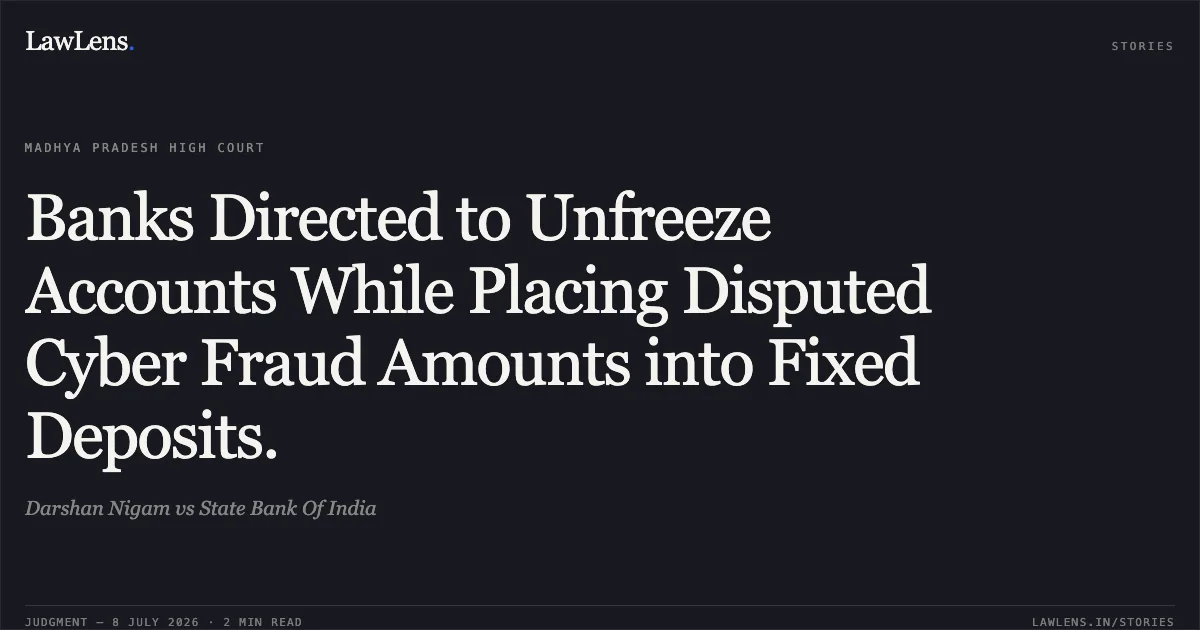
The petitioner, Darshan Nigam, filed a writ petition under Article 226 of the Constitution of India challenging the "illegal and arbitrary" freezing/hold placed on his State Bank of India (SBI) account (A/c No. 40525838889)
Source reference: para. 1The petitioner contended that the bank account was frozen without lawful authority or order
Source reference: para. 1The petitioner argued that the matter was squarely covered by a previous High Court decision in Malcolm Murayis & Ors. v. State Bank of India and Others (W.P. No. 1100 of 2024), where accounts were frozen based on cyber cell intimations regarding crypto-trading and alleged cyber fraud without following statutory procedures
Source reference: para. 2-3Issues
1. Whether the respondent bank can indefinitely freeze a customer's account based solely on police/cyber cell intimations without the investigating agencies following the mandatory requirements of the Code of Criminal Procedure or Bharatiya Nagarik Suraksha Sanhita
Source reference: para. 3, sub-para. 4 & 92. Whether the petitioner is entitled to the unfreezing of the bank account and access to funds not directly linked to the alleged crime
Source reference: para. 1, 5Law Applied
Section 102 of the Code of Criminal Procedure (Cr.P.C.) [para. 3, sub-para. 4], now corresponding to the relevant provisions of the Bharatiya Nagarik Suraksha Sanhita (BNSS)
Source reference: para. 5The precedent set in Malcolm Murayis & Ors. v. State Bank of India and Others (W.P. No. 1100 of 2024), which established that while disputed amounts can be secured in fixed deposits, the entire account should not remain frozen indefinitely if procedural laws are not followed
Source reference: para. 4Reasoning
The Court observed that the investigating agencies often fail to respond to bank inquiries or follow the procedural mandates of Section 102 Cr.P.C. (or BNSS), demonstrating an "irresponsible approach" toward account holders
Source reference: para. 3, sub-para. 8In line with the Malcolm Murayis precedent, the Court reasoned that the interests of justice are met by segregating the "disputed amount" from the rest of the account. By directing the disputed amount to be placed in a Fixed Deposit (FD), the Court ensures the recovery of potential proceeds of crime remains possible while the petitioner regains access to the remaining legitimate funds
Source reference: para. 3, sub-para. 9The Court emphasized that investigative agencies must act within a three-month window to obtain orders from a competent Judicial Magistrate, failing which the petitioner gains full rights over the FD
Source reference: para. 5Holding
The Court allowed the petition in part, applying the Malcolm Murayis ruling mutatis mutandis
It directed the Respondent Bank to unfreeze the petitioner’s account (A/c No. 40525838889). However, the Bank was ordered to keep the specific "disputed amount" (as informed by the crime agencies) in a Fixed Deposit. This FD is only to be liquidated upon orders from a competent Judicial Magistrate within three months; should the police fail to proceed in accordance with the BNSS/law within that time, the petitioner is permitted to withdraw those funds under intimation to the agency
Source reference: para. 5Acts & Sections Cited
1 provisions across 1 statute referred to in this judgment. Each provision opens on LawLens.
Code of Criminal Procedure, 19731
Original Court PDF
Darshan NigamvsState Bank Of India
Click to open original judgment
Original judgment, available to read, download and summarize on LawLens.in