Facts
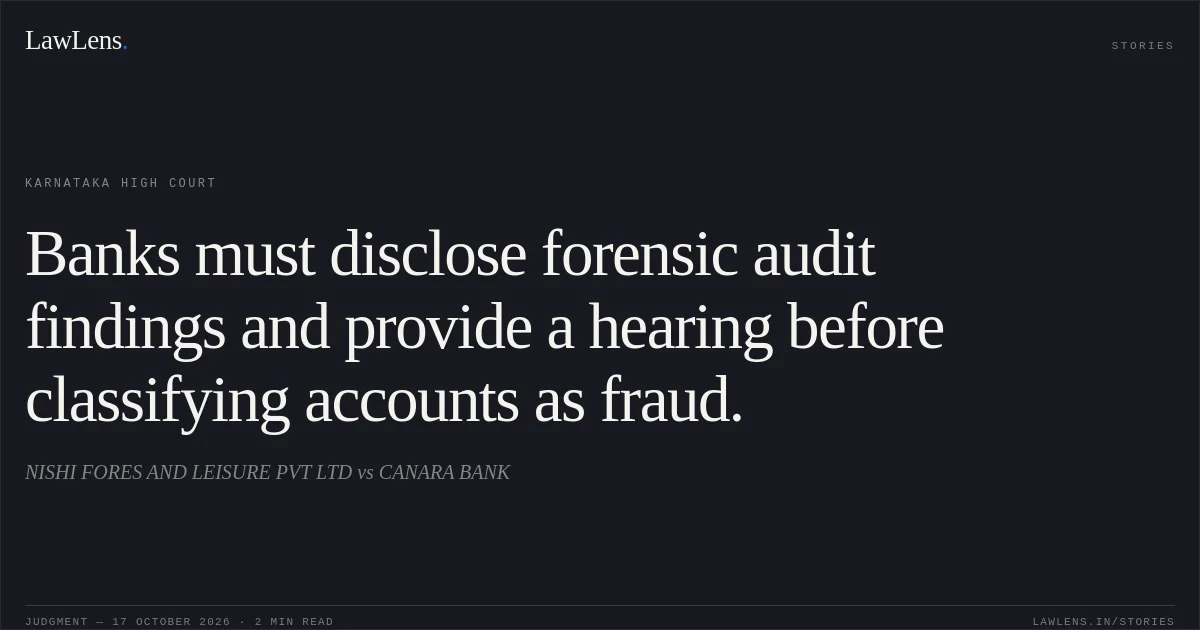
Canara Bank issued a show-cause notice dated 21 January 2025 concerning the petitioner company’s account.
Source reference: no citationThe Bank later classified the account as fraudulent by order dated 3 April 2025, relying on a forensic audit that reported, among other matters, discrepancies in debtor balances and alleged diversion or misappropriation of funds.
Source reference: pp. 4–5The petitioner challenged both the notice and the fraud-classification order, contending that the forensic audit findings had not been disclosed before the classification decision.
Source reference: no citationThe Bank submitted that the petitioner had received the show-cause notice but had not responded.
Source reference: pp. 3–4Issues
Whether the Bank could classify the petitioner’s account as fraudulent when the show-cause notice did not communicate the forensic audit findings relied upon in the final order.
Source reference: pp. 5–6Whether the petitioner was entitled to an opportunity to respond to those findings and to be heard before any further order was passed.
Source reference: pp. 3–4, 6–7Law Applied
In State Bank of India v. Rajesh Agarwal, (2023) 6 SCC 1, the Supreme Court held that classifying a borrower’s account as fraudulent has serious civil consequences and that the principles of natural justice require the borrower to be given notice, an opportunity to explain the conclusions of the forensic audit report, and an opportunity to make representations before the account is classified as fraud; the classification decision must also be reasoned.
Source reference: pp. 3–4The High Court applied these principles to the Bank’s fraud-classification process.
Source reference: pp. 5–6Reasoning
Although the Bank’s order set out reasons for classifying the account as fraudulent, the earlier show-cause notice did not disclose the forensic audit’s findings or particulars.
Source reference: pp. 4–6The petitioner therefore learned of the findings only through the order that had already classified its account as fraudulent.
Source reference: no citationApplying Rajesh Agarwal, the Court held that the borrower must be informed of the audit conclusions and allowed to explain them before the Bank makes its decision.
Source reference: pp. 3–4, 6Holding
The Court disposed of the petition by directing that the order dated 3 April 2025 be treated as a show-cause notice.
The petitioner was permitted to respond by 28 October 2026, after which the Bank must afford it an opportunity of hearing before passing any further order.
Source reference: p. 7Until then, the 3 April 2025 order must not be acted upon or precipitated in any manner.
Source reference: p. 7The Court did not finally determine whether the account was properly classifiable as fraudulent.
Source reference: no citationOriginal Court PDF
NISHI FORES AND LEISURE PVT LTDvsCANARA BANK
Click to open original judgment
Original judgment, available to read, download and summarize on LawLens.in