01Facts
In 2007, IDEB Projects Private Limited obtained working-capital facilities aggregating Rs. 380 crore from a consortium of banks, with State Bank of Travancore (later amalgamated with State Bank of India) as lead bank.
¶ 2In 2011, the bank issued Harkirat Singh Bedi a notice proposing to classify him as a wilful defaulter.
¶ 3He claimed to have replied and requested a personal hearing; the bank subsequently communicated the classification.
¶ 3–4The Court found that Bedi had received an individual notice allowing fifteen days to respond, but that the response relied on was submitted by IDEB through counsel, not by Bedi individually.
¶ 11–13He challenged the classification in 2019.
¶ 14The challenge followed the rejection of his resolution proposal in IDEB’s insolvency process, attributed to his subsisting wilful-defaulter status.
¶ 14–1602Issues
i.Whether the wilful-defaulter classification was made in breach of the applicable RBI Master Circular or the principles of natural justice, and whether Bedi had an effective opportunity to respond.
¶ 9(i)–(ii)ii.Whether Bedi’s failure to submit an individual representation disentitled him from challenging the classification after the bank did not proceed through later stages of the grievance-redressal process.
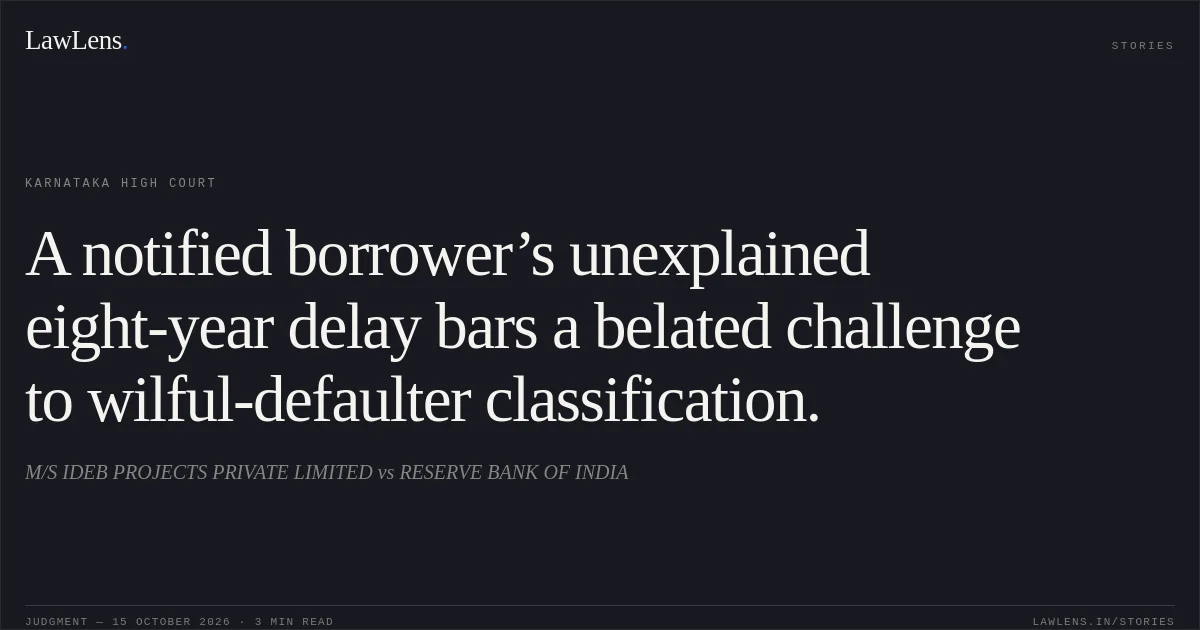
¶ 9(ii), 18–19iii.Whether the challenge was barred by unexplained delay and laches, given that it was brought nearly eight years after the classification.
¶ 9(iii)iv.Whether the RBI Master Circular dated 17 February 2015 could govern a classification made in 2011.
¶ 9(iv)v.Whether the later CIRP proceedings and the alleged rejection of Bedi’s resolution proposal supplied a fresh basis to challenge the classification.
¶ 9(v)vi.Whether Bedi was entitled to the relief sought under Articles 226 and 227 of the Constitution.
¶ 9(vi)03Law Applied
The Court applied the RBI Master Circular on Wilful Defaulters applicable when the 2011 classification was made.
¶ 10The prescribed process required that a proposed classification be supported by material and reasons, and that the affected person be notified and given a reasonable opportunity—including fifteen days—to submit a representation.
¶ 10The Court treated the further grievance-redressal stages as arising where the affected person submitted a representation.
¶ 13, 18–19It also applied the principles that relief under Article 226 is discretionary and may be refused for unexplained delay and laches, and that a later consequence does not ordinarily create a fresh cause of action to challenge an earlier decision.
¶ 21–22, 26–27The 2015 Circular could not retrospectively govern the 2011 classification absent demonstrated retrospective operation.
¶ 28Section 29A of the Insolvency and Bankruptcy Code, 2016, was considered as a consequence of the classification, not as a basis to reopen it.
¶ 6, 29–30No judicial precedent was identified in the judgment.
Provisions in the judgment · 1
Companies Act, 1956 Section 29A
04Reasoning
The Court found that Bedi had been individually notified of the proposed classification and given fifteen days to respond.
¶ 11–13As the response on record was made by IDEB, not Bedi in his individual capacity, the Court concluded that he had not used the opportunity provided to him; it therefore rejected his natural-justice challenge and held that the later grievance-redressal stages were not triggered.
¶ 11–13, 18–19, 23It declined to examine the merits of his arguments about the audit report and diversion or siphoning of funds, reasoning that he had not raised them through the available process and that the challenge was brought after an unexplained delay of nearly eight years.
¶ 20–21, 24–27The 2015 Circular did not apply retrospectively, and the adverse consequence in the CIRP did not revive the stale challenge.
¶ 28–3005Holding
The Court held that Bedi had not established a breach of the applicable procedure or natural justice, had failed to explain the delay, and could not rely on the later CIRP consequences to reopen the 2011 classification.
¶ 23–30It answered the first issue in the negative, the second in the affirmative, and the remaining issues against Bedi; it dismissed the writ petition without costs.
¶ 23–33Original Court PDF
M/S IDEB PROJECTS PRIVATE LIMITEDvsRESERVE BANK OF INDIA
Click to open original judgment
Original judgment, available to read, download and summarize on LawLens.in