Facts
GSR Marketing Limited had obtained credit facilities from Union Bank of India, secured by immovable properties owned by third-party guarantors.
Source reference: pp. 2–3, paras. 4–6After default, the Bank issued a show-cause notice proposing to classify the company’s account as fraudulent and subsequently passed an order classifying it as fraud.
Source reference: pp. 2–3, paras. 4–6The company challenged both actions, pleading that the Bank had not supplied the internal investigation/audit report or other material relied upon.
Source reference: p. 4, paras. 10–12The Bank’s notice and order referred to a forensic/internal audit/investigation report considered by its Fraud Monitoring Group.
Source reference: p. 6, para. 14Issues
Whether the Bank was required to provide the audit or investigation reports relied upon for fraud classification before deciding to classify the company’s account as fraudulent.
Source reference: pp. 4–6, paras. 10–14Whether the show-cause notice and fraud-classification order should be quashed for failure to provide those reports.
Source reference: pp. 6–7, paras. 14–15Law Applied
The Court applied the Supreme Court’s ruling in State Bank of India v. Amit Iron Private Limited, Civil Appeal Nos. 4243–4244 of 2026, which held that where banks consider audit reports relevant to fraud classification, copies—including forensic audit reports—must be furnished to the borrower and the borrower’s response elicited; disclosure in digital form is sufficient.
Source reference: pp. 5–6, para. 13The Supreme Court also recognised a limited exception: portions affecting third-party privacy may be withheld for recorded reasons.
Source reference: p. 5, para. 13The ruling interpreted the RBI’s Master Directions on Fraud and the procedure for fraud classification, building on State Bank of India v. Rajesh Agarwal.
Source reference: pp. 5–6, para. 13Reasoning
The Bank’s show-cause notice identified the forensic/internal audit/investigation report dated 11 September 2025 as having been placed before the Fraud Monitoring Group, and the classification order stated that it was based on the material on record.
Source reference: p. 6, para. 14Since the report was considered in reaching the decision, the rule in Amit Iron required the Bank to provide it to the company so that it could make an effective representation.
Source reference: p. 6, para. 14The Bank’s failure to do so breached that mandatory requirement, irrespective of its contention that the alleged fraud was apparent from the record.
Source reference: pp. 3, 6, paras. 9, 14Holding
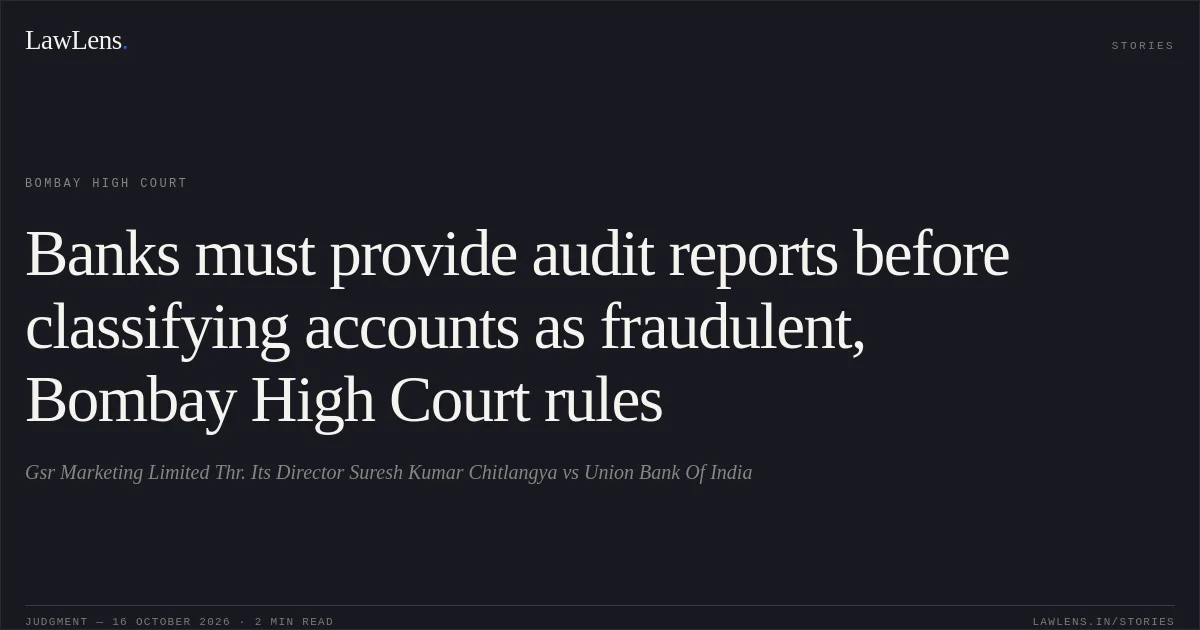
The Court held that the Bank had failed to comply with the mandatory disclosure requirement and allowed the petition.
It quashed and set aside the show-cause notice dated 23 March 2026 and the fraud-classification order dated 2 June 2026, while preserving the Bank’s liberty to issue a fresh notice and provide the documents, including reports, on which it proposes to rely.
Source reference: p. 7, paras. 15–16Original Court PDF
Gsr Marketing Limited Thr. Its Director Suresh Kumar ChitlangyavsUnion Bank Of India
Click to open original judgment
Original judgment, available to read, download and summarize on LawLens.in