Facts
The appellant was prosecuted for allegedly sexually assaulting a 13-year-old girl on 26 November 2019 and threatening her, leading to charges under Sections 3/4 of the Protection of Children from Sexual Offences Act, 2012 (“POCSO Act”) and Section 506 of the Indian Penal Code, 1860 (“IPC”).
Source reference: paras. 3–5; pp. 1–2The Trial Court convicted him under Section 4 of the POCSO Act and Section 506 IPC, sentencing him to twenty years’ rigorous imprisonment under the POCSO Act and two years’ rigorous imprisonment under Section 506 IPC.
Source reference: paras. 7–8; pp. 2–3The High Court affirmed the conviction and sentence.
Source reference: para. 9; p. 3Before the Supreme Court, the appellant challenged, inter alia, the proof of the victim’s age, relying principally on a baptismal certificate and the absence of an ossification or other age-determination test.
Source reference: paras. 10–17; pp. 3–6The prosecution relied on the victim’s testimony, medical evidence, the appellant’s injuries, identification evidence, and forensic evidence connecting blood found on the victim’s clothes with the appellant’s blood group.
Source reference: paras. 20–29; pp. 7–11Issues
Whether the victim’s minority had been proved in accordance with Section 94 of the Juvenile Justice (Care and Protection of Children) Act, 2015, so as to sustain the conviction under Sections 3 and 4 of the POCSO Act.
Source reference: para. 31(i); p. 11Whether, despite the absence of a charge under Section 376 IPC, the appellant could be convicted for rape under Section 376 IPC if the POCSO conviction failed for want of proof of the victim’s minority.
Source reference: para. 31(ii); p. 11Law Applied
The Court applied Section 94(2) of the Juvenile Justice Act, 2015, which requires age determination, in sequence, through a school date-of-birth or matriculation/equivalent certificate, a birth certificate issued by a corporation, municipality or panchayat, and only in their absence, an ossification test or other latest medical age-determination test.
Source reference: para. 35; pp. 14–16Relying on Jarnail Singh v. State of Haryana, State of Madhya Pradesh v. Anoop Singh, and P. Yuvaprakash v. State, the Court held that this statutory hierarchy applies to determining the age of a POCSO victim.
Source reference: paras. 33–35; pp. 11–17A baptismal certificate, by itself, is not one of the documents prescribed under Section 94(2).
Source reference: paras. 36–38; pp. 17–19The Court further applied Sections 375 and 376 IPC, observing that the actus reus of rape and penetrative sexual assault under Section 3 of the POCSO Act is substantially the same, with minority being the distinguishing feature.
Source reference: para. 44; pp. 21–22Under Sections 222, 386 and 464 CrPC, an appellate court may convict for a cognate offence not specifically charged where the accused had notice of the essential facts and suffered no failure of justice; non-framing of a charge is not automatically fatal.
Source reference: paras. 42–54; pp. 20–27The Court relied, inter alia, on Rafiq Ahmad v. State of Uttar Pradesh, Shamnsaheb M. Multtani v. State of Karnataka, Willie (William) Slaney v. State of Madhya Pradesh, and Dalbir Singh v. State of U.P.
Source reference: paras. 43–54; pp. 20–27Reasoning
The prosecution did not produce a school or matriculation certificate, a birth certificate issued by a statutory local authority, or any ossification or other medically recognised age-determination report.
Source reference: para. 36; pp. 17–18The only documentary material was the baptismal certificate, corroborated by the mother’s oral testimony, but that document did not satisfy the statutory requirements of Section 94(2) of the Juvenile Justice Act.
Source reference: para. 36; pp. 17–18The decision in Luis Caetano Viegas v. Estrelina Mariana R.M.A. Da’Costa was distinguished because it involved a duly proved birth certificate supported by baptismal records and did not concern the statutory scheme governing the age of a POCSO victim.
Source reference: paras. 37–38; pp. 18–19Consequently, the victim’s minority was not legally established and the POCSO conviction could not be sustained.
Source reference: para. 36; pp. 17–18However, the Court found the occurrence of penetrative sexual assault proved through the victim’s consistent testimony, medical evidence showing a torn hymen and partial penile penetration, the appellant’s forehead injury consistent with the victim’s account, identification evidence, and forensic evidence.
Source reference: paras. 55–57; pp. 27–29Since the appellant had defended himself against the same factual allegation of penetrative sexual assault under Section 3 of the POCSO Act, the absence of a separate Section 376 IPC charge did not cause failure of justice under Section 464 CrPC.
Source reference: paras. 44–54; pp. 21–27The appellate court therefore could substitute the legally sustainable cognate offence of rape under Section 376 IPC.
Source reference: paras. 44–54; pp. 21–27Holding
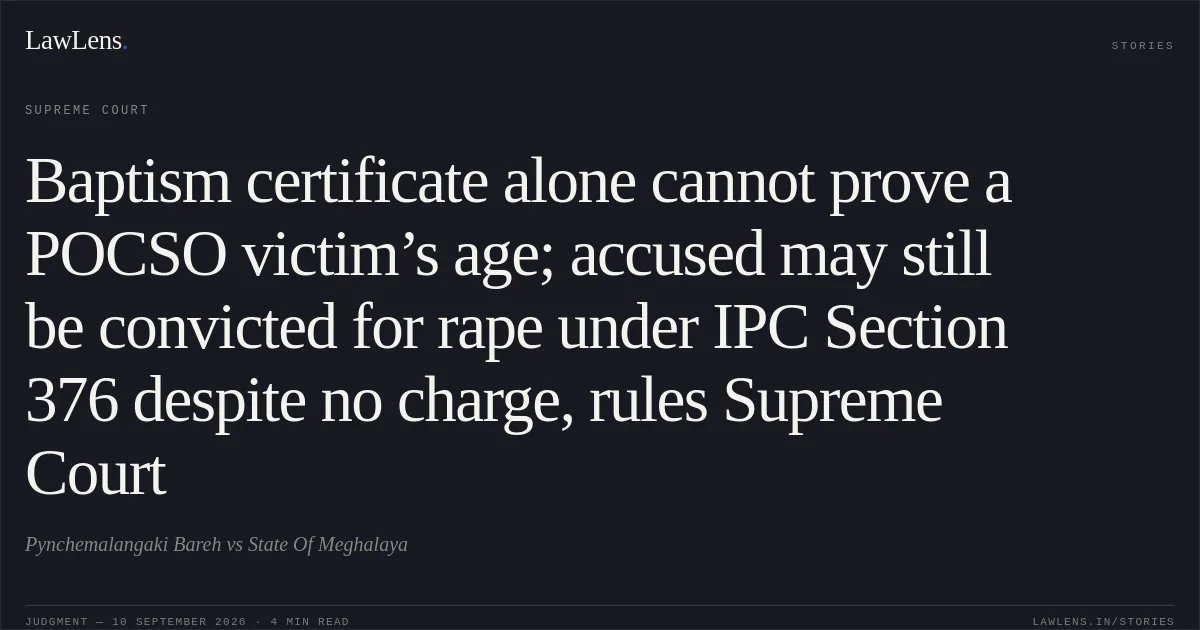
The Supreme Court held that the prosecution failed to prove the victim’s minority in the manner mandated by Section 94 of the Juvenile Justice Act; therefore, the conviction under the POCSO Act was unsustainable.
Nevertheless, the fact of rape was proved beyond reasonable doubt, and the appellant could be convicted under Section 376 IPC despite the absence of a separately framed charge, since no failure of justice was occasioned.
Source reference: paras. 50–57; pp. 26–29The conviction under Section 506 IPC was affirmed.
Source reference: paras. 58–60; p. 29The POCSO conviction and twenty-year sentence were modified, and the appellant was sentenced under Section 376 IPC to ten years’ rigorous imprisonment and a fine of ₹10,000, with six months’ additional rigorous imprisonment in default of payment of fine; the appeal was partly allowed.
Source reference: paras. 58–60; p. 29Acts & Sections Cited
22 provisions across 4 statutes referred to in this judgment. Each provision opens on LawLens.
Indian Penal Code, 1860
Protection of Children from Sexual Offences Act, 20124
Code of Criminal Procedure, 19735
Juvenile Justice (Care and Protection of Children) Act, 2015.4
Original Court PDF
Pynchemalangaki BarehvsState Of Meghalaya
Click to open original judgment
Original judgment, available to read, download and summarize on LawLens.in