Facts
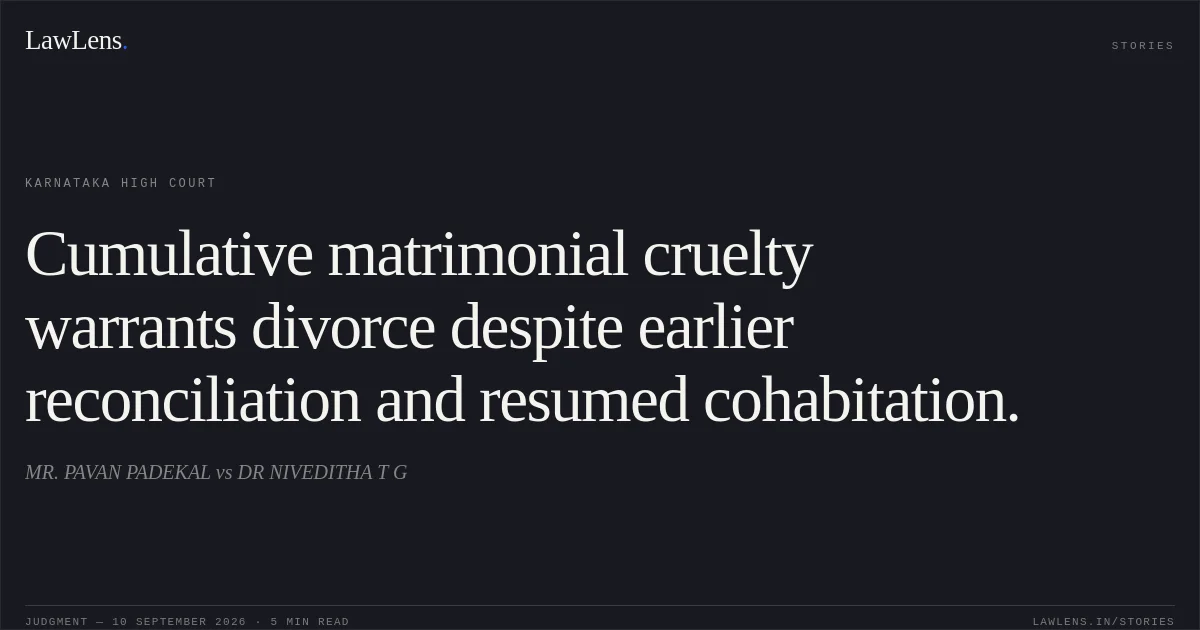
The parties, who were college mates, married on 23 May 2011 at Mangaluru and had two daughters.
Source reference: paras. 1, 3–5.3After living in India and the United Kingdom, serious matrimonial disputes arose between them, followed by prolonged separation and litigation concerning the marriage and children.
Source reference: paras. 1, 3–5.3The wife filed proceedings under Sections 13(1)(i-a) and 25 of the Hindu Marriage Act, 1955 (“HMA”), alleging physical and mental cruelty, including physical assaults, abusive and controlling conduct, hostility towards her parents, interference with her professional life, and repeated unsubstantiated allegations that she suffered from mental illness.
Source reference: paras. 4–4.2The husband denied cruelty, relied on the wife’s alleged emotional difficulties and conduct, and filed a counter-claim for restitution of conjugal rights under Section 9 HMA.
Source reference: paras. 5–5.3The Family Court relied substantially on WhatsApp conversations containing admissions and expressions of regret concerning physical assaults, abusive conduct, hostility towards the wife’s parents, and the husband’s allegations regarding her mental health.
Source reference: paras. 8, 13It dissolved the marriage on the ground of cruelty, dismissed the husband’s counter-claim, awarded the wife Rs.2 crore as permanent alimony, directed maintenance of Rs.25,000 per month for the two minor children with periodic enhancement, and awarded costs.
Source reference: paras. 15–16The husband appealed under Section 19(1) of the Family Courts Act, challenging the finding of cruelty and the monetary awards.
Source reference: para. 17Issues
Whether the Family Court’s judgment dissolving the marriage under Section 13(1)(i-a) HMA on the ground of cruelty and dismissing the husband’s counter-claim for restitution of conjugal rights under Section 9 HMA suffered from illegality or infirmity warranting appellate interference?
Source reference: para. 21Whether the earlier reconciliation, counselling, resumption of cohabitation and birth of the second child condoned the alleged acts of cruelty, such that the wife could not rely upon the earlier conduct?
Source reference: paras. 19.2, 23Whether the award of Rs.2 crore as permanent alimony was excessive and required reduction in view of the wife’s independent income, assets, qualifications and the husband’s financial obligations?
Source reference: paras. 19.5, 27–28What reasonable maintenance and welfare arrangements ought to be made for the parties’ two minor children?
Source reference: paras. 27–28Law Applied
The Court applied Section 13(1)(i-a) HMA, under which a marriage may be dissolved where one spouse has treated the other with cruelty, and Section 9 HMA governing restitution of conjugal rights.
Source reference: paras. 3, 16Cruelty is assessed from the cumulative effect of the parties’ conduct and the overall matrimonial relationship, rather than by isolating individual incidents.
Source reference: paras. 22–25The Court also applied Section 25 HMA concerning permanent alimony, holding that such relief must be reasonable, needs-based and proportionate, and is not intended to equalise the parties’ wealth or confer a windfall.
Source reference: para. 27In determining maintenance, the Court relied on Reema Salkan v. Sumer Singh Salkan, (2019) 12 SCC 303, and Anju Garg v. Deepak Kumar Garg, 2022 SCC OnLine SC 1314, regarding the continuing obligation of an able-bodied spouse to maintain dependants.
Source reference: para. 27It further relied on Rajnesh v. Neha, (2021) 2 SCC 324, for the relevant factors governing maintenance, including status, reasonable needs, qualifications, independent income, standard of living, assets, liabilities and the paying spouse’s capacity.
Source reference: para. 27The Court referred to Amutha v. A.R. Subramanian, 2024 SCC OnLine SC 3822, and Rajnesh for the principle that both parents share responsibility for the children’s education, healthcare and welfare.
Source reference: para. 27Reasoning
The Court held that the wife’s evidence was materially corroborated by contemporaneous WhatsApp communications, including messages in which the husband admitted or expressed regret regarding physical assaults and other conduct.
Source reference: para. 22Although the husband relied on the wife’s emotional outbursts, alleged threats of self-harm and competing communications, those circumstances did not displace the wife’s evidence when the matrimonial relationship was assessed cumulatively.
Source reference: para. 22The Court rejected the argument that counselling, resumed cohabitation, joint travel and the birth of the second child automatically extinguished the subsequent course of cruelty.
Source reference: para. 23The parties’ reconciliation attempts did not prevent the Court from considering later disputes, continuing acrimony, allegations concerning mental health, child-related conflicts and the eventual separation.
Source reference: para. 23The prolonged litigation in India and the United Kingdom, together with the parties’ separation and entrenched bitterness, demonstrated that the matrimonial bond had lost its substance and that meaningful resumption of cohabitation was unrealistic.
Source reference: paras. 24–26Accordingly, the finding of cruelty and dismissal of the restitution counter-claim were upheld.
Source reference: paras. 22–26As to alimony, the Court found the Family Court’s award of Rs.2 crore excessive because the wife was a qualified and employed medical professional with independent income and financial assets.
Source reference: para. 27At the same time, the husband’s higher income did not eliminate his obligation to provide reasonable financial security, particularly having regard to the duration of the marriage and the parties’ standard of living.
Source reference: para. 27Balancing the wife’s needs and resources against the husband’s income, liabilities, litigation expenditure and parental responsibilities, the Court reduced permanent alimony to Rs.50 lakh.
Source reference: para. 27The Court treated the children’s maintenance as distinct from the wife’s alimony and directed a regular contribution reflecting their educational, medical and other needs.
Source reference: paras. 27–28Holding
The appeal was disposed of without disturbing the decree of divorce on the ground of cruelty or the dismissal of the husband’s counter-claim for restitution of conjugal rights.
The award of permanent alimony was reduced from Rs.2 crore to Rs.50 lakh, payable within three months, with interest at 6% per annum from the date of decree in case of default.
Source reference: order (ii)(1), order (iii)The husband was directed to pay Rs.25,000 per month for each child, totalling Rs.50,000 per month, towards maintenance, education, medical and other reasonable needs, with an annual enhancement of Rs.5,000 per child until majority.
Source reference: order (ii)(2), order (iv)The Court also provided for the mother’s physical custody, the father’s weekend visitation and telephonic/video access, restrictions on relocation of the children outside India, payment of arrears, and the parties’ continuing parental responsibilities.
Source reference: order (ii)(3)–(9)Acts & Sections Cited
4 provisions across 2 statutes referred to in this judgment. Each provision opens on LawLens.
Family Courts Act, 19841
Hindu Marriage Act, 19553
Original Court PDF
MR. PAVAN PADEKALvsDR NIVEDITHA T G
Click to open original judgment
Original judgment, available to read, download and summarize on LawLens.in