Facts
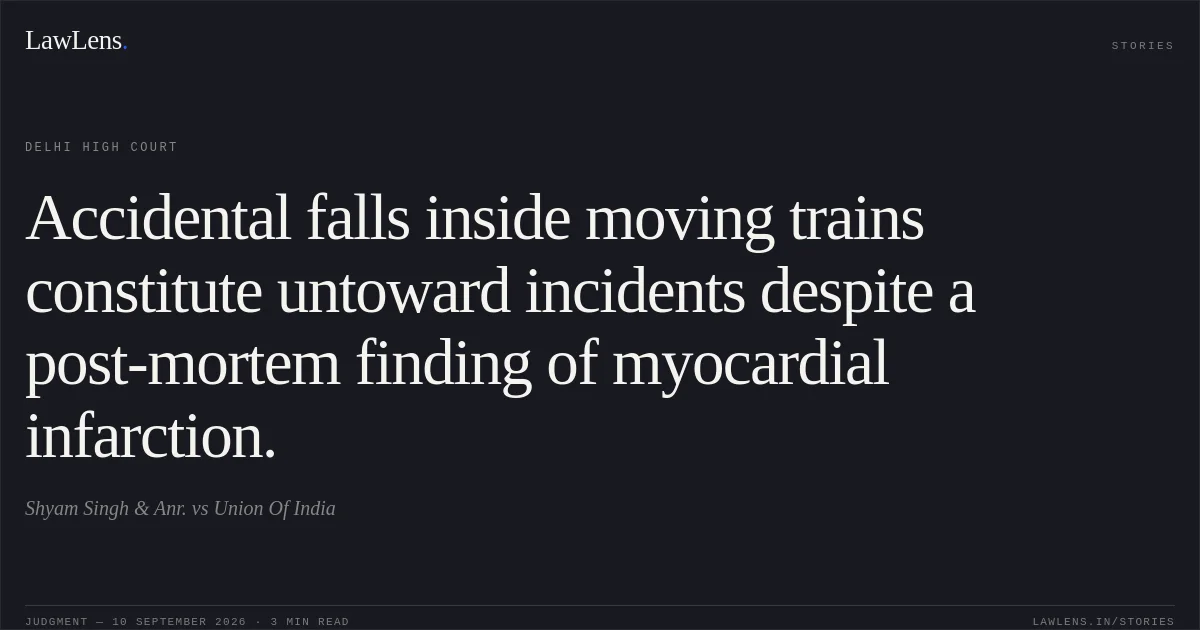
On 10 November 2015, Sanjeev Kumar travelled from Etawah to Agra Cantt. by Train No. 64157 on a valid second-class ticket, accompanied by his father, Shyam Singh. While the train was approaching Agra Cantt., he allegedly fell from the upper berth due to a sudden jerk, became unconscious, and was declared dead after being attended to by a railway doctor. A post-mortem report recorded the cause of death as shock resulting from myocardial infarction.
Source reference: p. 2, paras. 2–3The Railway Claims Tribunal accepted that the deceased was a bona fide passenger but dismissed the claim application, holding that the death was natural and did not result from an “untoward incident”. The claimants challenged that decision under Section 23 of the Railway Claims Tribunal Act, 1987.
Source reference: p. 2, para. 3; p. 1, para. 1Issues
1. Whether the deceased’s fall from the upper berth inside a moving train constituted an “untoward incident” under Sections 123(c)(2) and 124-A of the Railways Act, 1989.
Source reference: pp. 3–4, paras. 7–102. Whether the post-mortem finding of myocardial infarction, by itself, displaced the evidence establishing the deceased’s accidental fall and justified dismissal of the compensation claim.
Source reference: pp. 3–5, paras. 8, 11–13Law Applied
The Court applied Sections 123(c)(2) and 124-A of the Railways Act, 1989, under which the accidental falling of a passenger from a train is an “untoward incident” attracting the railway’s statutory strict/no-fault liability, subject to the statutory exceptions.
Source reference: pp. 4–5, paras. 9, 12It relied on Union of India through General Manager, Northern Railway v. Triveni W/o Late Shri Ram, 2014 SCC OnLine Del 741, which held that falling inside a train may constitute an untoward incident and that Section 123(c)(2) does not require the passenger to fall outside the train. It further relied on Union of India v. Prabhakaran Vijaya Kumar, (2008) 9 SCC 527, for the principle that Section 124-A incorporates strict or no-fault liability and that “accidental falling of a passenger from a train” must receive a purposive and liberal interpretation.
Source reference: p. 4, para. 9; p. 5, para. 12Reasoning
The Court found that the contemporaneous Dy. SS/AGC memo and panchnama recorded that the deceased had fallen from the seat, while the testimony of his father established that he fell from the upper berth due to a sudden jerk in the moving train. Applying Triveni, the Court held that a fall inside the train is legally capable of constituting an untoward incident.
Source reference: p. 4, para. 10Although the post-mortem report attributed death to myocardial infarction, that medical opinion addressed the cause of death and did not, by itself, negate the independently established occurrence of the fall. There was no medical or documentary evidence proving a pre-existing cardiac ailment or showing that the cardiac event preceded the fall; the fact that the deceased was travelling for treatment of back pain did not establish a cardiac condition. In light of the liberal interpretation mandated by Prabhakaran Vijaya Kumar, the evidence, viewed cumulatively, established an accidental fall falling within Section 123(c)(2).
Source reference: p. 5, paras. 11–12Holding
The Court answered both issues in favour of the appellants. It held that the deceased’s accidental fall from the upper berth inside the moving train constituted an “untoward incident” under Section 123(c)(2) of the Railways Act, 1989, and that the myocardial-infarction finding did not, by itself, defeat the claim.
The appeal was allowed, the Tribunal’s judgment dated 22 September 2022 was set aside, and the matter was remanded to the Tribunal to assess the compensation payable and direct disbursement within two months of receiving the order. The matter was directed to be listed before the Tribunal on 30 September 2026.
Source reference: p. 6, paras. 14–15Acts & Sections Cited
2 provisions across 2 statutes referred to in this judgment. Each provision opens on LawLens.
Railway Claims Tribunal Act, 19871
Railways Act, 19891
Original Court PDF
Shyam Singh & Anr.vsUnion Of India
Click to open original judgment
Original judgment, available to read, download and summarize on LawLens.in