Facts
The petitioner, an advocate enrolled with the Bar Council of Jammu & Kashmir and Ladakh in 2012 and claiming membership of the District Bar Association, Shopian since that year, challenged the Association’s amended Constitution of 2023.
Source reference: paras. 2–3; pp. 2–3The amendment enhanced the eligibility requirement from ten to fifteen years’ standing at the Bar for the offices of President and Vice-President, and from seven to ten years for Secretary.
Source reference: paras. 2–3; pp. 2–3The petitioner alleged that the amendment was adopted without proper notice, a valid General Body Meeting, or a lawful resolution, and sought production of the relevant records.
Source reference: paras. 4–5; pp. 3–4Following the issuance of Election Notification No. 01 dated 11 December 2025 on the basis of the amended Constitution, the petitioner sought quashment of both the amendment and the election notification.
Source reference: para. 6; p. 4The respondents contended that the Association was a private, voluntary body; that the amendment had been approved by the General Body after notice circulated through WhatsApp; and that the petition involved disputed questions of fact and was barred by delay, acquiescence and approbation and reprobation.
Source reference: paras. 13–18; pp. 5–6Issues
1. Whether the District Bar Association, Shopian is “State” or an instrumentality/agency of the State under Article 12 of the Constitution of India?
Source reference: paras. 20, 24–32; pp. 6–132. Whether the Association’s amendment of eligibility conditions for election to its internal offices constitutes the discharge of a public duty or public function so as to make it amenable to writ jurisdiction under Article 226?
Source reference: paras. 20, 31–37; pp. 6–153. Whether the disputed questions concerning notice, convening of the General Body Meeting and adoption of the amendment could be adjudicated in proceedings under Article 226?
Source reference: paras. 44–46; pp. 20–214. Whether the petitioner’s delay and alleged acquiescence in the operation of the amended Constitution disentitled him to discretionary relief under Article 226?
Source reference: paras. 47–54; pp. 21–24Law Applied
Article 12 encompasses the Government, legislatures, local authorities and other authorities, while the Article 12 inquiry depends upon statutory creation, statutory powers, governmental control and governmental or closely associated functions.
Source reference: paras. 25–29; pp. 8–12Applying Rajasthan State Electricity Board v. Mohan Lal, AIR 1967 SC 1857, the Court recognised that statutory creation and quasi-governmental powers may bring a body within Article 12.
Source reference: para. 27; p. 8Under Ajay Hasia v. Khalid Mujib Sehravardi, (1981) 1 SCC 722, factors such as governmental ownership, substantial financial assistance, State-conferred monopoly, deep and pervasive control, public importance of functions and transfer of a Government department are relevant indicia of an instrumentality or agency of the State.
Source reference: para. 28; pp. 9–10Pradeep Kumar Biswas v. Indian Institute of Chemical Biology, (2002) 5 SCC 111, requires a strong statutory character or deep and pervasive governmental control before an entity is treated as State or its instrumentality.
Source reference: para. 29; pp. 10–12Although Article 226 is wider than Article 32 and may extend to a private body performing a public duty, Andi Mukta Sadguru Shree Muktajeevandas Swami Suvarna Jayanti Mahotsav Smarak Trust v. V.R. Rudani, (1989) 2 SCC 691, requires a positive obligation of a public character.
Source reference: para. 36; pp. 14–15The Court also relied on authorities holding that internal election disputes of voluntary Bar Associations generally lack a public-law element and are not amenable to writ jurisdiction.
Source reference: paras. 38–43; pp. 15–20Further, the doctrines of acquiescence and approbation and reprobation prevent a party from accepting or permitting a process to operate and later challenging its validity when it becomes disadvantageous, as explained in Union of India v. N. Murugesan, (2022) 2 SCC 25, and Rajasthan State Industrial Development & Investment Corpn. v. Diamond & Gem Development Corpn. Ltd., (2013) 5 SCC 470.
Source reference: paras. 50–52; pp. 22–23Reasoning
The Association was neither created by statute nor under the Advocates Act, 1961; it was a voluntary body governed by its own Constitution and Bye-laws, with office-bearers elected by its members.
Source reference: paras. 30–32; pp. 12–13It exercised no statutory powers, performed no governmental functions and was not shown to be subject to deep or pervasive governmental control. It therefore did not qualify as “State” or an instrumentality or agency of the State under Article 12.
Source reference: paras. 30–32; pp. 12–13Although Article 226 can reach private bodies performing public duties, the impugned action concerned only the Association’s internal governance and the eligibility of its members to contest its offices.
Source reference: paras. 33–37, 42; pp. 13–15, 19It neither imposed a duty owed to the public at large nor possessed the requisite public-law character; the professional importance of advocates could not transform every internal act of a Bar Association into a public function.
Source reference: paras. 33–37, 42; pp. 13–15, 19The petitioner’s allegations regarding absence of notice, a General Body Meeting and a valid resolution were directly disputed by the respondents and required examination of records and evidence, which was inappropriate in writ proceedings.
Source reference: paras. 44–46; pp. 20–21Additionally, the amendment had allegedly operated since 2023 and governed subsequent elections, while the challenge was brought only after the 2025 election notification affected the petitioner’s eligibility. This conduct raised acquiescence and approbation-reprobation concerns and independently militated against discretionary relief.
Source reference: paras. 47–54; pp. 21–24Holding
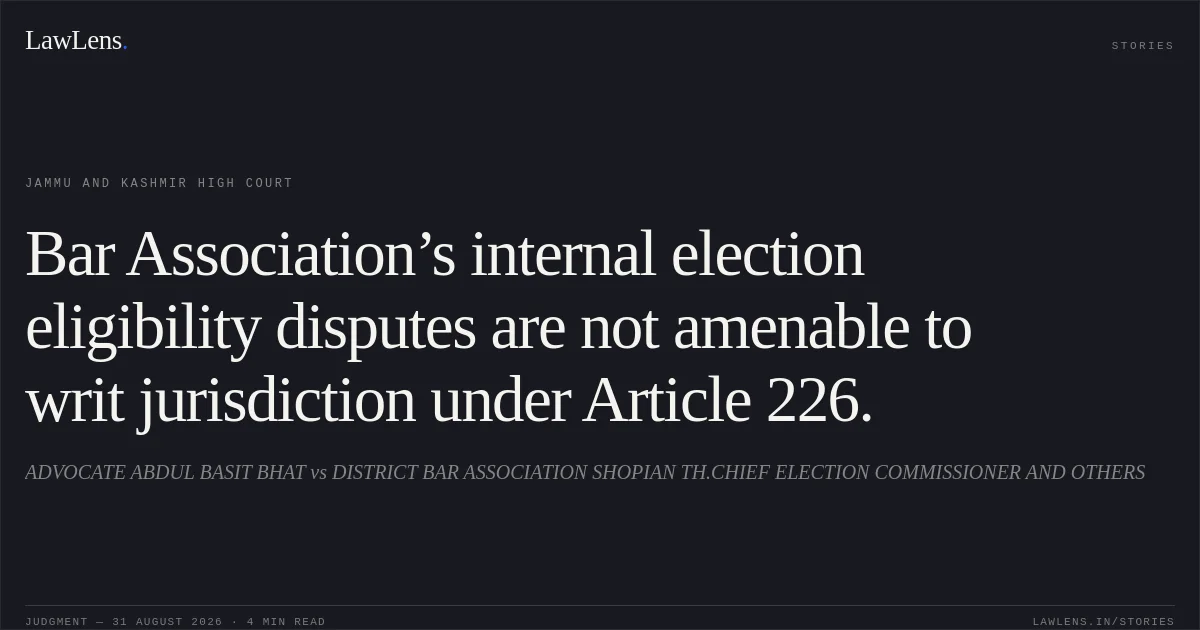
The Court held that the District Bar Association, Shopian is not “State” under Article 12 and is not amenable to writ jurisdiction under Article 226 in relation to the internal amendment of eligibility conditions or its electoral governance.
The writ petition was therefore dismissed as not maintainable, along with connected applications, if any.
Source reference: para. 58; p. 25The dismissal was without prejudice to the petitioner’s right to pursue an appropriate remedy before the competent court in accordance with law.
Source reference: para. 59; p. 25Original Court PDF
ADVOCATE ABDUL BASIT BHATvsDISTRICT BAR ASSOCIATION SHOPIAN TH.CHIEF ELECTION COMMISSIONER AND OTHERS
Click to open original judgment
Original judgment, available to read, download and summarize on LawLens.in