Facts
The complainant alleged that, during business dealings, he and his family members transferred approximately ₹94 lakhs to the petitioner’s company and associated entities for the supply of stone chips.
Source reference: paras. 2–4; pp. 2–4The petitioner, described as the Managing Director and authorised signatory of Sona Infracon Pvt. Ltd., issued a cheque for ₹40 lakhs bearing an endorsement that it was issued only as security and would be returned upon payment.
Source reference: paras. 2–4; pp. 2–4The cheque was presented on 10 January 2022 and again on 24 January 2022, but was dishonoured after payment had been stopped.
Source reference: paras. 2–4; pp. 2–4A statutory notice was issued on 1 February 2022, following which Complaint Case No. 360 of 2022 was instituted under Section 138 of the Negotiable Instruments Act, 1881 (“N.I. Act”).
Source reference: paras. 2–4; pp. 2–4The company allegedly maintaining the bank account on which the cheque was drawn was not arraigned as an accused; only the petitioner was impleaded in his individual capacity with reference to his designation as Managing Director.
Source reference: para. 16; p. 10The Magistrate took cognizance under Section 138 of the N.I. Act on 16 August 2022 and issued summons.
Source reference: para. 3; p. 2Subsequently, by order dated 1 February 2024, the Magistrate directed the petitioner to pay interim compensation equivalent to 20% of the dishonoured cheque amount under Section 143-A of the N.I. Act.
Source reference: para. 2; p. 2The petitioner challenged both orders under Section 482 of the Code of Criminal Procedure, 1973 (“Cr.P.C.”).
Source reference: no citationIssues
Whether a complaint under Sections 138 and 141 of the N.I. Act is maintainable against the Managing Director or authorised signatory when the company, being the drawer of the cheque and the primary offender, has not been arraigned as an accused?
Source reference: paras. 16–19, 27–28; pp. 10–20Whether the petitioner’s contention that the cheque was issued only as security and that the underlying amounts had already been paid could be adjudicated at the stage of exercising inherent jurisdiction under Section 482 Cr.P.C.?
Source reference: paras. 20–27; pp. 13–19Whether the High Court could exercise jurisdiction under Section 482 Cr.P.C. despite the criminal trial having progressed to the stage of recording the accused’s statement under Section 313 Cr.P.C.?
Source reference: paras. 13–14, 29–33; pp. 8–23Whether the order directing payment of interim compensation under Section 143-A of the N.I. Act could survive after quashing the cognizance order and consequential proceedings?
Source reference: paras. 35–36; pp. 23–24Law Applied
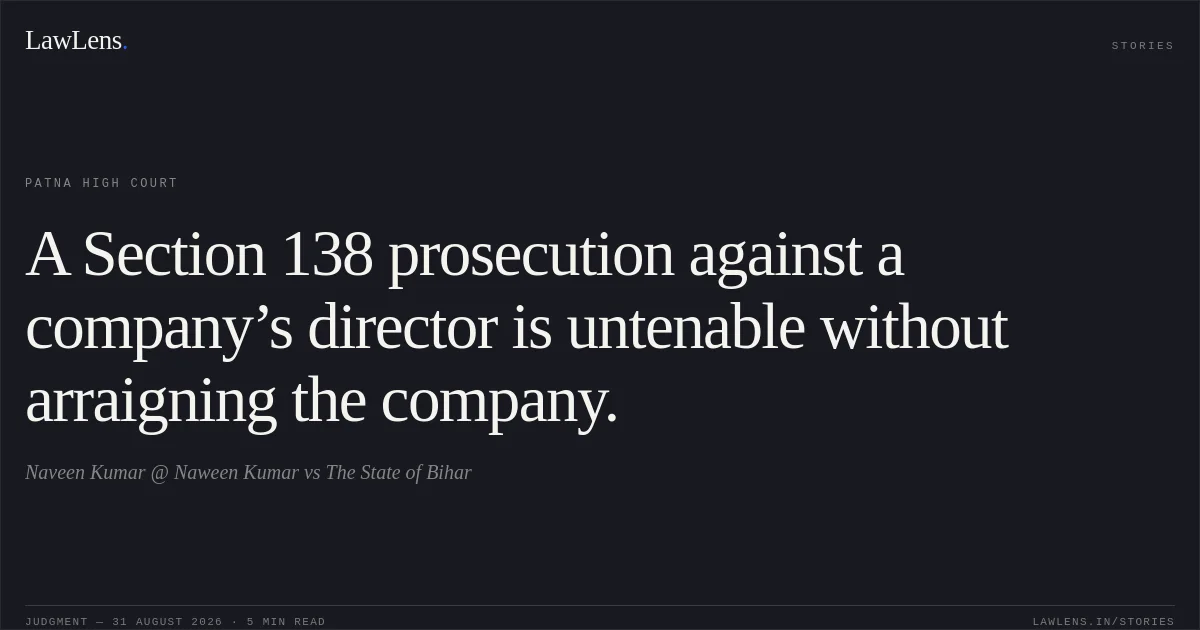
The Court applied Sections 138 and 141 of the N.I. Act, holding that the company on whose account the cheque was drawn is the primary offender and that prosecution of its directors or authorised signatories through vicarious liability ordinarily requires the company to be arraigned as an accused.
Source reference: para. 16; pp. 10–11Relying on Aneeta Hada v. Godfather Travels & Tours (P) Ltd., (2012) 5 SCC 661, the Court treated arraignment of the company as an express condition precedent for attracting vicarious liability under Section 141.
Source reference: para. 16; pp. 10–11The same principle was reaffirmed through Himanshu v. B. Shivamurthy, (2019) 3 SCC 797, Bijoy Kumar Moni v. Paresh Manna & Anr., (2026) 5 SCC 380, and Manjula Kapoor v. State of Himachal Pradesh & Anr., 2026 SCC OnLine SC 1521.
Source reference: paras. 17–19; pp. 11–13Under Sripati Singh (since deceased) through his son Gaurav Singh v. State of Jharkhand & Anr., (2022) 18 SCC 614, a security cheque may attract Section 138 if the debt has matured and remains unpaid, but whether payment was made and whether the cheque continued to be only a security instrument are ordinarily triable factual questions.
Source reference: paras. 23–26; pp. 15–18The Court further applied Section 482 Cr.P.C., relying on Anand Kumar Mohatta v. State (NCT of Delhi), (2019) 11 SCC 706, to hold that inherent jurisdiction may be exercised at an advanced stage where continuation of proceedings would constitute abuse of process, and Section 143-A of the N.I. Act as the statutory basis for interim compensation.
Source reference: paras. 29–36; pp. 20–24Reasoning
The Court found from the complaint itself that the relevant transactions were conducted through the company’s account and that the cheque had been issued by the petitioner on behalf of the company.
Source reference: para. 16; p. 10Since the company was not made an accused, the foundational requirement for fastening vicarious liability upon the petitioner under Section 141 was absent.
Source reference: paras. 16–19, 27–28; pp. 10–20This was considered a fundamental and fatal defect in the complaint, not a disputed factual matter capable of being cured during trial.
Source reference: paras. 16–19, 27–28; pp. 10–20The Court declined to determine conclusively whether the cheque was a security cheque or whether the alleged payments had discharged the liability, observing that those matters involved competing factual claims and would ordinarily require evidence.
Source reference: paras. 20–27; pp. 13–19However, the unresolved merits of the security-cheque issue did not prevent quashing because the complaint was legally unsustainable at its inception due to non-impleadment of the company.
Source reference: paras. 20–28; pp. 13–20The advanced stage of the trial also did not bar relief under Section 482 Cr.P.C.; although the Court ordinarily exercises restraint at such a stage, continuation of proceedings founded on a fundamentally defective complaint would itself amount to abuse of process.
Source reference: paras. 29–33; pp. 20–23Since the cognizance order was quashed, the consequential order directing interim compensation under Section 143-A could not independently survive.
Source reference: paras. 35–36; pp. 23–24Holding
The High Court held that the complaint under Section 138 of the N.I. Act was not maintainable against the petitioner because Sona Infracon Pvt. Ltd., the company alleged to be the drawer and holder of the relevant bank account, had not been impleaded as an accused.
Exercising jurisdiction under Section 482 Cr.P.C., the Court quashed the Magistrate’s cognizance order dated 16 August 2022 and all consequential proceedings in Complaint Case No. 360 of 2022.
Source reference: para. 34; p. 23The order dated 1 February 2024 directing payment of 20% interim compensation under Section 143-A of the N.I. Act was also quashed.
Source reference: paras. 35–36; pp. 23–24Both criminal miscellaneous applications were allowed.
Source reference: no citationThe Court clarified that the quashing was based on the fatal procedural and legal defect in the complaint and was not an adjudication on the merits of the complainant’s allegations; the complainant remained at liberty to pursue any other remedy available in law.
Source reference: paras. 37–38; pp. 24–25Acts & Sections Cited
7 provisions across 2 statutes referred to in this judgment. Each provision opens on LawLens.
Negotiable Instruments Act, 18814
Code of Criminal Procedure, 19733
Original Court PDF
Naveen Kumar @ Naween KumarvsThe State of Bihar
Click to open original judgment
Original judgment, available to read, download and summarize on LawLens.in