Facts
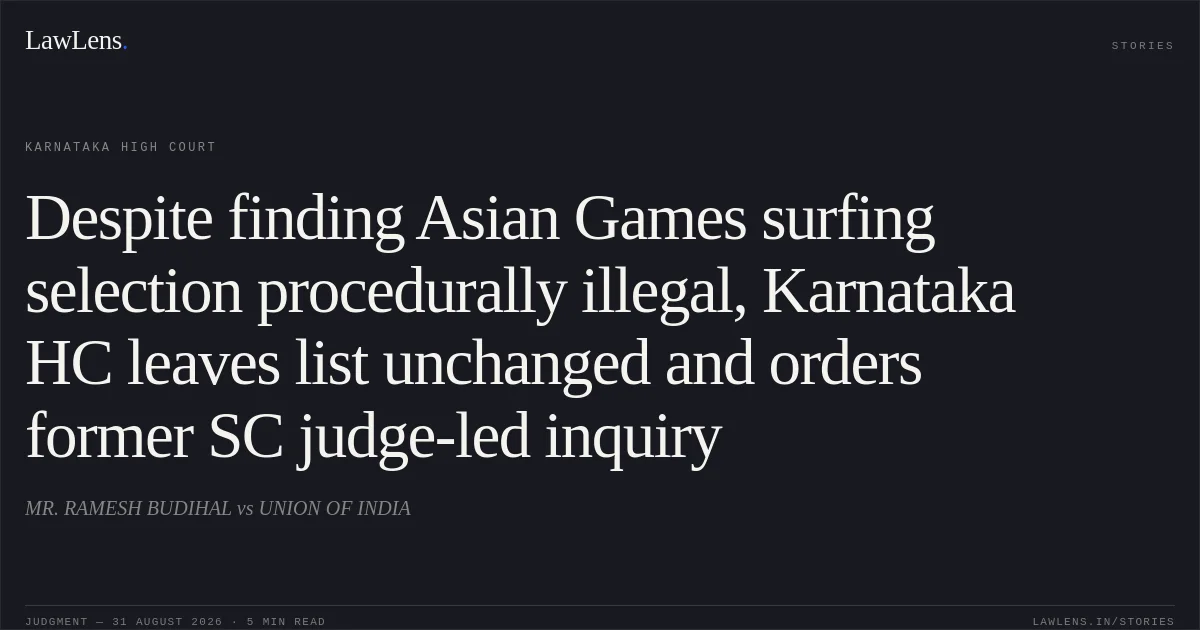
The petitioner, a professional Indian surfer, challenged the Surfing Federation of India’s (“SFI”) decision dated 23 June 2026 selecting Respondent No. 5 as the second confirmed male athlete for the 2026 Asian Games and placing the petitioner as the first reserve.
Source reference: paras. 1–3An earlier selection had been set aside by an Appeals Panel on 16 June 2026, which directed a fresh selection by a properly constituted committee, consideration of international performances from 1 January 2025 onwards, and recording of detailed reasons for any departure from the relevance accorded to the Asian Surfing Championships.
Source reference: paras. 4–5, 23.21The Special Selection Committee unanimously selected one confirmed athlete and one reserve athlete but remained divided 2:2 between the petitioner and Respondent No. 5 for the remaining confirmed position.
Source reference: paras. 6–8, 23.24Instead of completing the prescribed objective assessment and tie-break process, the Committee recommended a “Surf-Off”; one member objected to the methodology and resigned.
Source reference: paras. 9–10, 24.12–24.18Thereafter, the SFI Executive Council made an “Executive Call” selecting Respondent No. 5, and the names were forwarded through the Sports Authority of India and the Indian Olympic Association to the Asian Olympic Association.
Source reference: para. 11Issues
1. Whether the writ petition was maintainable and whether the Court could examine the legality of the selection process notwithstanding the forwarding and uploading of the selected names.
Source reference: para. 20(i); paras. 22.12–22.252. Whether the fresh selection complied with the SFI Selection Policy and the Appeals Panel’s directions, including consideration of international performances from 1 January 2025 and the petitioner’s performance at the 2025 Asian Surfing Championship.
Source reference: para. 20(ii); paras. 23.20–23.363. Whether the Special Selection Committee was justified in recommending a Surf-Off without first completing the prescribed objective assessment and tie-break process.
Source reference: para. 20(iii); paras. 24.8–24.334. Whether the SFI Executive Council had authority to independently select Respondent No. 5 when the Special Selection Committee had not approved a provisional selection.
Source reference: para. 20(iv); paras. 25.9–25.275. Whether the impugned selection and the petitioner’s placement as first reserve were liable to be quashed, and what consequential relief was appropriate in the circumstances.
Source reference: para. 20(v); paras. 26.5–26.53Law Applied
The Court applied Articles 226 and 227 of the Constitution and held that a recognised National Sports Federation performing the public function of selecting athletes for national representation is amenable to judicial review.
Source reference: paras. 22.13, 22.24–22.25Judicial review in sports-selection matters is limited and does not permit the Court to substitute its assessment for that of sporting experts; however, interference is justified where the decision is arbitrary, perverse, mala fide, illegal, or contrary to the governing selection rules, as recognised in Swastika Ghosh v. Table Tennis Federation of India, Shumel v. Union of India, Sushil Kumar v. Union of India, Karamjyoti v. Union of India, and Paralympic Committee of India v. Naresh Kumar Sharma.
Source reference: paras. 13.32, 23.19, 23.30The Court relied on Manjeet v. Indian Olympic Association for the principle that forwarding or acting upon selected names does not immunise an unlawful selection from judicial scrutiny.
Source reference: paras. 22.16–22.18Under the SFI Selection Policy, the selection process had to follow the staged framework in Clause 5, including objective assessment, prescribed tie-breakers, and a later, conditional Surf-Off; Module 5 contemplated that provisional names would first be approved by the Selection Committee and thereafter ratified by the Executive Council.
Source reference: paras. 19, 23.22–23.23The Court also considered Ishwar Singh v. State of Rajasthan on delegation, but held that the general principle that delegation does not necessarily divest the principal of power could not override the specific limits imposed by the SFI’s own Selection Policy.
Source reference: paras. 25.14–25.16, 25.26Reasoning
The Court found that the Appeals Panel’s remand required the fresh committee to consider all relevant international events from 1 January 2025, including the petitioner’s bronze-medal performance, and to provide detailed and cogent reasons for departing from the applicable Asian Championship benchmark.
Source reference: paras. 23.21, 23.26–23.29Although comparative rankings and other data were placed before the Committee, the record did not disclose how the petitioner’s bronze medal was weighed against Respondent No. 5’s later ranking trajectory or why the former was treated as outweighed.
Source reference: paras. 23.26–23.33The General Secretary’s clarification prescribed a sequential process: objective comparison, application of the policy’s tie-break criteria, possible Surf-Off, and escalation to MYAS/SAI if necessary.
Source reference: paras. 24.8–24.11Since the Committee remained divided over how to apply the objective criteria, it had not completed the earlier stages and therefore could not prematurely proceed to a Surf-Off.
Source reference: paras. 24.12–24.15, 24.29–24.33Further, because the Committee had not approved either athlete for the disputed position, the Executive Council had nothing to ratify; its “Executive Call” was substantively an original selection, which the Policy did not authorise.
Source reference: paras. 25.10–25.13, 25.24–25.27Nevertheless, the Court distinguished the legality of the process from the appropriate remedy. Given that the Asian Games were imminent, the names had been uploaded internationally, and recalling them could jeopardise India’s quota and participation, the Court declined to undo the selection despite finding it legally defective.
Source reference: paras. 26.11–26.22, 26.43–26.47Holding
The writ petition was partly allowed.
The Court held that the selection of Respondent No. 5 as the second confirmed athlete and the petitioner’s consequential placement as first reserve were vitiated because the SFI failed to demonstrate reasoned consideration of the Asian Championship performance, the Special Selection Committee prematurely recommended a Surf-Off, and the Executive Council exercised an unauthorised original selection power.
Source reference: paras. 26.43, 26.53However, because of the advanced stage of the Asian Games arrangements and the risk to India’s participation, the Court declined to quash the SFI decision, recall the forwarded list, or order an immediate fresh selection.
Source reference: paras. 26.44–26.47; para. 27.1(ii)–(iv)The Court directed an independent fact-finding inquiry by former Supreme Court Judge R.V. Raveendran into the conduct of the Special Selection Committee and Executive Council, compliance with the Selection Policy and Appeals Panel’s directions, the treatment of the petitioner’s performance, the tie-break process, the Executive Council’s role, and the communications with the SAI and IOA.
Source reference: para. 27.1(v)–(xi)The inquiry report was directed to be submitted preferably by 1 February 2027, with the matter relisted on 12 February 2027.
Source reference: para. 27.1(xii)–(xiv)Acts & Sections Cited
5 provisions across 2 statutes referred to in this judgment. Linked provisions open on LawLens.
Athlete Selection Policy4
Regulating Entry Of Tibetan Nationals Into India1
Original Court PDF
MR. RAMESH BUDIHALvsUNION OF INDIA
Click to open original judgment
Original judgment, available to read, download and summarize on LawLens.in