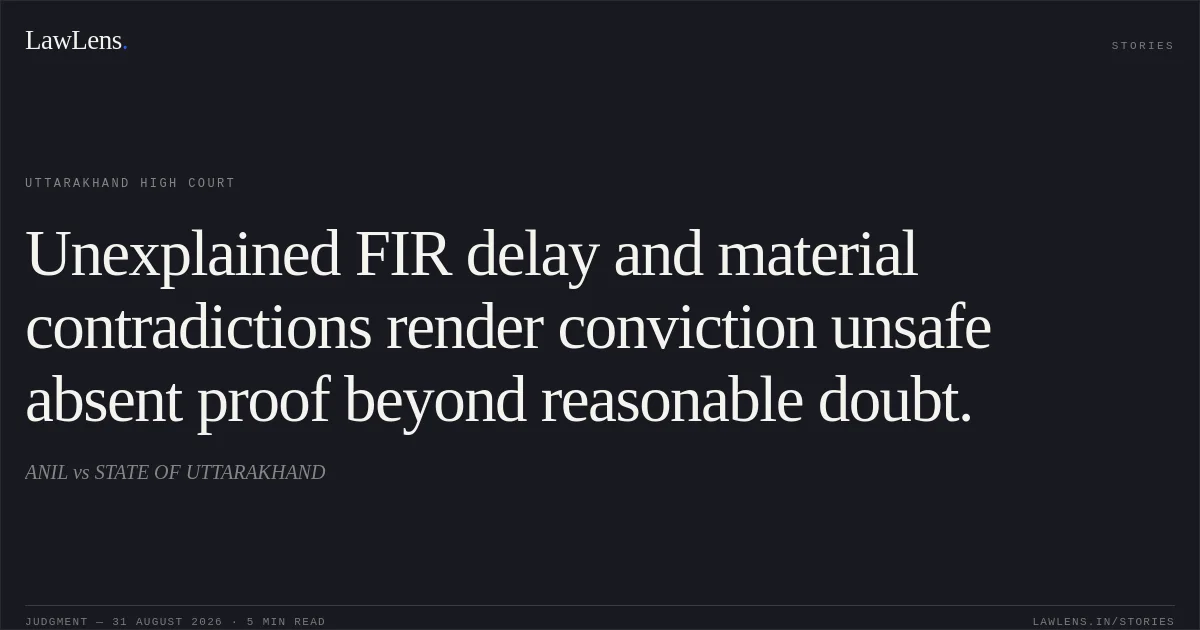
Facts
The appeals arose from the common judgment dated 04/05.06.2009 in Sessions Trial No. 50 of 2003, whereby Anil and Mohammad Imran were convicted under Sections 120-B, 302/34, 307/34, 328 and 394 IPC, while Pappu alias Sarvar and Wasif were convicted under Section 411 IPC.
Source reference: paras. 2–4The prosecution alleged that, on 30.06.2002, Raj alias Raju and Aditya Sharma travelled from Moradabad to Haldwani for CD-related collections.
Source reference: paras. 5–6After receiving ₹47,500, they allegedly consumed liquor mixed with Pepsi in a Maruti car driven by Anil; Aditya later became unconscious, suffered throat and other injuries, and was thrown into a canal, while Raj went missing.
Source reference: paras. 5–6Aditya was rescued by police constables during night patrol and medically examined at 1:45 a.m. on 01.07.2002, where he was found to have simple incised, lacerated and abrasion injuries.
Source reference: paras. 7, 28The FIR was registered at 2:30 p.m. on 01.07.2002, more than twelve hours after the medical examination.
Source reference: para. 64Raj’s dead body was recovered from a canal on 05.07.2002; the post-mortem found no ante-mortem injuries and could not ascertain the cause of death.
Source reference: paras. 11–12, 24–26Cash and CDs were allegedly recovered from Wasif and Pappu pursuant to disclosures attributed to Imran and Anil.
Source reference: paras. 8–10, 33The High Court’s earlier decision was set aside by the Supreme Court, and the appeals were remanded for fresh consideration.
Source reference: para. 1Issues
1. Whether the prosecution proved the charges against Anil and Imran, including murder, attempt to murder, administration of a poisonous substance and robbery, beyond reasonable doubt on the basis of Aditya’s testimony and the surrounding circumstances.
Source reference: paras. 47, 61, 63–802. Whether the unexplained delay of more than twelve hours in registration of the FIR, together with inconsistencies in the prosecution evidence, rendered the FIR and the testimony of PW-1 and PW-7 unreliable.
Source reference: paras. 64–803. Whether the alleged recoveries of cash and CDs from Wasif and Pappu were legally reliable and sufficient to sustain their convictions under Section 411 IPC.
Source reference: paras. 83–874. Whether Anil could be convicted under Section 302 IPC when, according to the record, no specific charge under Section 302 IPC had been framed against him.
Source reference: paras. 81–825. Whether the investigation’s failure to examine the alleged poison, obtain gastric lavage, properly investigate the Maruti car, establish the source of light, and maintain reliable arrest and recovery documentation created reasonable doubt.
Source reference: paras. 77–90Law Applied
The Court applied the fundamental criminal-law principle that the prosecution must establish guilt beyond reasonable doubt and that an accused cannot be deprived of liberty without a reasonable level of certainty; where substantial doubt exists, acquittal is preferable to conviction of an innocent person, as stated in Rang Bahadur Singh v. State of U.P., (2000) 3 SCC 454, and State of U.P. v. Krishna Gopal, (1988) 4 SCC 302.
Source reference: paras. 47–49It applied the rule that unexplained delay in lodging an FIR may lead to embellishment, afterthought and a coloured version, relying on Thulia Kali v. State of Tamil Nadu, (1972) 3 SCC 393, Rajeevan v. State of Kerala, (2003) 3 SCC 355, and Meharaj Singh v. State of U.P., (1994) 5 SCC 188.
Source reference: paras. 68–70The Court further applied the requirement that a conviction must be founded on evidence proving each charged offence and held that conviction under Section 302 IPC cannot ordinarily be sustained where no charge under that provision was framed.
Source reference: paras. 81–82The relevant substantive provisions were Sections 120-B, 302, 307, 328, 394, 411 and 34 IPC, concerning criminal conspiracy, murder, attempt to murder, administration of intoxicating or poisonous substances, robbery, dishonestly receiving stolen property and common intention.
Source reference: no citationReasoning
The Court found that the prosecution evidence did not satisfy the beyond-reasonable-doubt standard.
Source reference: no citationAlthough PW-1 claimed to have seen Anil assaulting him, the FIR was lodged more than twelve hours after his medical examination, despite his allegedly narrating the incident to the police immediately after rescue and despite the disappearance of Raj requiring prompt investigation.
Source reference: paras. 64–67, 74The FIR was unusually detailed even though PW-1 had visited Haldwani for the first time, raising doubt about its spontaneity.
Source reference: paras. 71–74PW-1’s versions regarding the purchase and consumption of liquor and the mixing of Pepsi materially differed between the FIR, his Section 164 statement and his trial testimony.
Source reference: para. 72His account also conflicted with PW-7’s evidence regarding the number of persons present near the canal, while the source of light necessary for identification at night was neither established in the site plan nor satisfactorily explained.
Source reference: paras. 75–79The absence of a general-diary entry regarding PW-1’s alleged arrival at the police station and the absence of the injury letter further weakened the prosecution case.
Source reference: para. 80The medical evidence showed only simple injuries and did not establish poisoning; no gastric lavage was obtained, and neither the alleged liquor/Pepsi containers nor the vehicle was properly investigated.
Source reference: paras. 22–23, 89The recovery evidence against Wasif and Pappu was also found unreliable because the sample seal was not produced, the CDs were not identified, no independent neighbourhood witnesses were associated, and the search documentation and arrest memo were defective.
Source reference: paras. 83–86The Court additionally held that the absence of a charge under Section 302 IPC made Anil’s conviction under that provision legally unsustainable.
Source reference: paras. 81–82Holding
The Court answered the issues in favour of the appellants and held that the prosecution failed to prove the charges beyond reasonable doubt.
The common judgment and order dated 04/05.06.2009 was set aside, and Anil, Mohammad Imran, Wasif and Pappu alias Sarvar were acquitted of the charges.
Source reference: para. 91As the appellants were already on bail, their bail bonds were cancelled and the sureties discharged; however, they were directed to furnish fresh bonds under Section 437-A CrPC within one month.
Source reference: para. 92The original record was directed to be transmitted to the trial court.
Source reference: para. 93Acts & Sections Cited
15 provisions across 2 statutes referred to in this judgment. Each provision opens on LawLens.
Indian Penal Code, 1860
Code of Criminal Procedure, 19735
Original Court PDF
ANILvsSTATE OF UTTARAKHAND
Click to open original judgment
Original judgment, available to read, download and summarize on LawLens.in
![Judicial review cannot reappreciate disciplinary evidence absent procedural illegality or findings based on no evidence.. AWADHESH KUMAR vs D/o Post. CAT - ['Allahabad']. LawLens](/stories/thumbnails/judicial-review-cannot-reappreciate-disciplinary-evidence-absent-procedural-illegality-or-0d13f16bd29b4af4a5971c203a4bdf4a.webp)