Facts
The plaintiffs (appellants) filed a suit for permanent prohibitory injunction and alternative possession against the defendants, claiming continued bartandari (customary usage) rights—such as grazing cattle and burying the dead—over land in Village Kohla.
Source reference: para. 2The suit land had vested in the State under the H.P. Village Common Land (Vesting and Utilization) Act ("HP Common Land Act") and was subsequently allotted to Defendant No. 1 in 1975.
Source reference: para. 2-4The Trial Court dismissed the suit, holding that vestment in the State was free from all encumbrances and extinguished existing rights.
Source reference: para. 8The Appellate Court upheld this decision.
Source reference: para. 9The plaintiffs then appealed to the High Court, challenging the validity of the vestment and the eligibility of the allottee for the first time.
Source reference: para. 12Issues
1. Whether the vestment of the suit land in the State was unlawful due to lack of notice under Section 3(5) of the HP Common Land Act and Rule 3.
Source reference: para. 102. Whether a valid title was conferred on the State in the absence of notice to estate right holders.
Source reference: para. 103. Whether Respondent No. 1 was ineligible for allotment of land under Section 8(b) due to his status as a military/government employee rather than a landless person.
Source reference: para. 104. What is the effect of the alleged non-following of the procedure prescribed in the allotment scheme.
Source reference: para. 10Law Applied
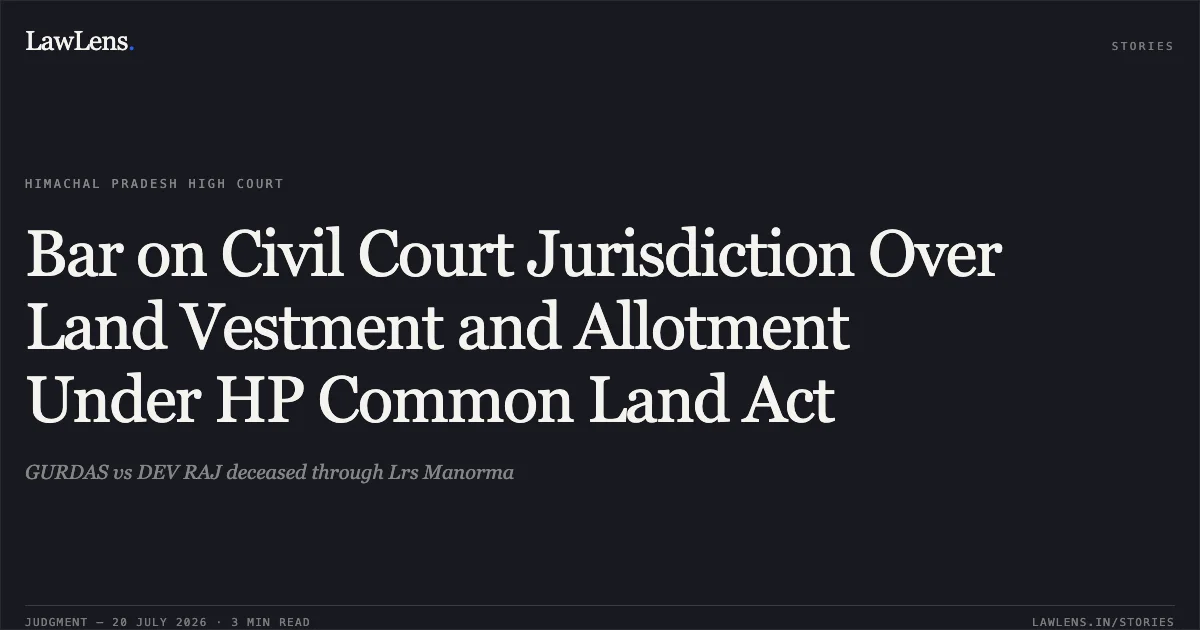
The court primarily applied Section 10 of the HP Common Land Act, which bars the jurisdiction of Civil Courts from questioning orders made by the Collector or State Government.
Source reference: para. 17It relied on Dalip Singh v. State of H.P., establishing that Civil Courts cannot declare rights as owners where the Act provides adequate statutory remedies.
Source reference: para. 18Per State of H.P. v. Siri Dutt, Section 3 of the Act has an overriding effect that extinguishes all rights, title, and interests of landowners upon vestment.
Source reference: para. 24the court applied the principle from Dr. Mahesh Chand Sharma v. Raj Kumari Sharma, which prohibits raising new factual or legal pleas regarding allotment/eligibility for the first time during a Second Appeal.
Source reference: para. 22Reasoning
The Court reasoned that the plaintiffs failed to specifically seek a declaration in their original pleadings regarding the invalidity of the vestment or the cancellation of the allotment based on a violation of natural justice.
Source reference: para. 22Consequently, because these issues (notice and eligibility) were not raised before the lower courts, they could not be entertained in a Regular Second Appeal.
Source reference: para. 22, 28Regarding the bartandari rights, the Court found that under the statutory framework of the HP Common Land Act, once land vests in the State, it is "free from all encumbrances," meaning any customary rights were legally extinguished as of the date of vestment.
Source reference: para. 23, 25the Court noted that the lower courts had concurrently found that the plaintiffs were not in actual possession of the land, a finding of fact that was not perverse and thus binding on the High Court.
Source reference: para. 26Holding
The High Court answered the substantial questions of law against the appellants, holding that the jurisdiction of the Civil Court was barred under Section 10 of the HP Common Land Act and that the issues of notice and eligibility were not properly raised in the lower courts.
The court held that all bartandari rights stood extinguished upon the lawful vestment of the land in the State.
Source reference: para. 25The appeal was dismissed, and the judgments of the Trial and Appellate Courts were upheld.
Source reference: para. 29Acts & Sections Cited
5 provisions across 2 statutes referred to in this judgment. Linked provisions open on LawLens.
Himachal Pradesh Village Common Lands Vesting And Utilisation Act, 19744
Himachal Pradesh Panchayati Raj Act, 19681
Original Court PDF
GURDASvsDEV RAJ deceased through Lrs Manorma
Click to open original judgment
Original judgment, available to read, download and summarize on LawLens.in