Facts
The Appellants (mother and two daughters) filed a suit (the ‘second suit’) in 2013 seeking a declaration that a Power of Attorney (PoA) dated 04.11.2011 was void due to fraud and coercion, and for an injunction regarding properties in Ooty and Pudukottai
Source reference: para 1.8, 3.1Previously, in 2012, the mother and her late husband had filed a suit (the ‘first suit’) for a permanent injunction regarding a Chennai property and bank accounts, alleging intimidation by their son (Respondent 1)
Source reference: para 1.5, 2.1The Respondents filed an application under Order VII Rule 11(d) of the CPC, contending the second suit was barred under Order II Rule 2 as the Appellants failed to claim the PoA-related reliefs in the first suit despite allegedly knowing about it
Source reference: para 1.9, 7The Trial Court dismissed the application, holding the causes of action and properties were distinct
Source reference: para 1.10However, the Madras High Court reversed this, rejecting the plaint by evaluating evidence such as letters and the prior knowledge of the parties to conclude the causes of action were identical
Source reference: para 1.11, 8Issues
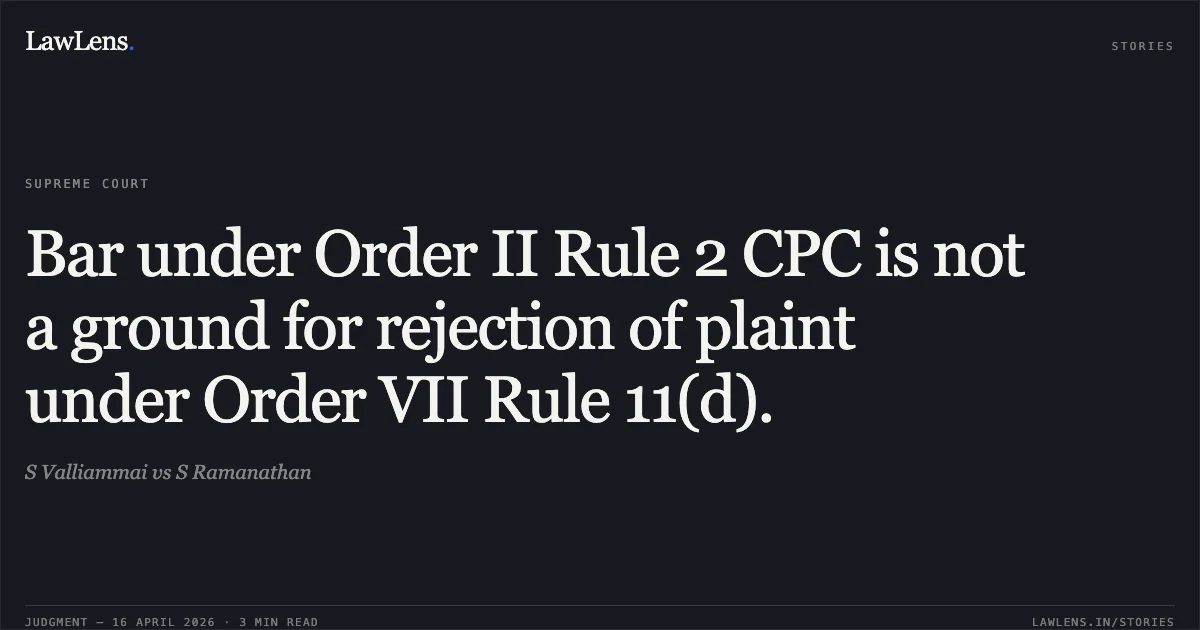
Whether a plea of bar under Order II Rule 2 of the Code of Civil Procedure (CPC) can constitute a ground for rejection of a plaint under Order VII Rule 11(d)
Source reference: para 5.18, 5.21Whether the High Court was justified in evaluating the merits of the averments and external evidence at the stage of deciding an application for rejection of a plaint
Source reference: para 8.1Law Applied
The Court applied Order VII Rule 11(d) of the CPC, which mandates the rejection of a plaint where the suit appears from the "statement in the plaint" to be barred by any law
Source reference: para 4, 5.17It distinguished this from Order II Rule 2 of the CPC, which prohibits splitting claims or remedies arising from the "same cause of action"
Source reference: para 5.2, 5.7The Court relied on Mohammad Khalil Khan v. Mahbub Ali Mian, establishing that the identity of the cause of action is a matter of substance and evidence
Source reference: para 5.10, 5.11and Cuddalore Powergen Corporation Ltd. v. Chemplast Cuddalore Vinyls Limited, which held that a defendant must establish the bar of Order II Rule 2 through evidence and by producing the earlier plaint
Source reference: para 5.12Reasoning
The Court held that there is a subtle but distinct difference between a "bar to sue" (Order II Rule 2) and a suit being "barred by law" (Order VII Rule 11d)
Source reference: para 5.13, 5.20Under Order VII Rule 11(d), the bar must be apparent strictly from the averments in the plaint or annexed documents without considering the written statement or external evidence
Source reference: para 5.17Conversely, for the bar under Order II Rule 2 to apply, a court must conduct a comparative analysis of the plaints and the evidence to determine if the cause of action is identical; this cannot be achieved at the preliminary stage of rejection of a plaint
Source reference: para 5.21, 7The Court observed that Order II Rule 2 may lead to the dismissal of a suit after trial, but not the rejection of a plaint at the threshold
Source reference: para 5.20It further found that the High Court erred by acting as a trial court—analyzing the merits of the PoA, witness statements, and release letters—instead of limiting its inquiry to the face of the plaint
Source reference: para 8, 8.1Holding
The Supreme Court allowed the appeal and set aside the High Court’s order
It held that a plea under Order II Rule 2 cannot be the basis for rejection of a plaint under Order VII Rule 11(d) as it requires evidentiary proof
Source reference: para 7, 5.21The Trial Court's order was restored, and the second suit (O.S. No. 2320 of 2013) was revived for trial
Source reference: para 9Acts & Sections Cited
6 provisions across 2 statutes referred to in this judgment. Each provision opens on LawLens.
Code of Civil Procedure, 19085
Securitisation and Reconstruction of Financial Assets and Enforcement of Security Interest Act, 20021
Original Court PDF
S ValliammaivsS Ramanathan
Click to open original judgment
Original judgment, available to read, download and summarize on LawLens.in