01Facts
On 17.11.2025, the SHO, Sirsi Town Police Station, received credible information that accused Nos. 1 and 2 were collecting money from the public and allowing "O.C. Matka" gambling near C.P. Bazar Road, opposite KDCC Bank, Sirsi.
pp. 2–3 · ¶ 2A raid seized ₹1,070 in cash, an O.C. chit, and a ballpen.
p. 3 · ¶ 2On the basis of the police complaint, a case was registered under Section 78(3) of the Karnataka Police Act (KP Act), leading to an FIR and investigation.
p. 3 · ¶ 2The petitioners contended that the offence is non-cognizable, that no articles were seized from them and no panchanama was drawn in their presence, and that the police did not comply with Section 155(1) and (2) CrPC: the information was not entered in the prescribed book, the informant was not referred to the Magistrate, and there was no speaking order by the Magistrate permitting investigation.
pp. 3–4 · ¶ 3The State contended that the jurisdictional Magistrate had permitted investigation, satisfying Section 155(2) CrPC.
p. 4 · ¶ 4A charge sheet was filed in C.C. No. 628/2025 before the Senior Civil Judge, Sirsi.
pp. 1–2The petitioners (accused Nos. 1 and 2) sought quashing under Section 528 BNSS.
p. 102Issues
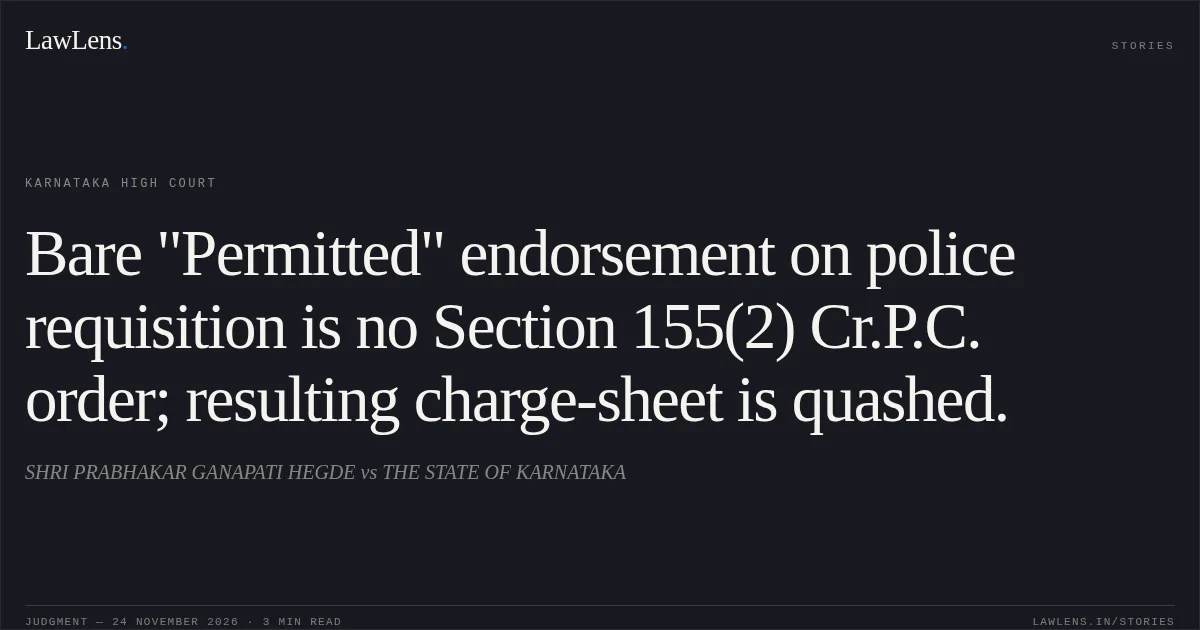
i.1. Whether an investigation and charge sheet for a non-cognizable offence under Section 78(3) of the KP Act is valid where the jurisdictional Magistrate's permission under Section 155(2) CrPC consists only of an endorsement "Permitted" on the police requisition.
p. 5 · ¶ 5 · pp. 7–8 · ¶ 7–9ii.2. Whether the proceedings against the petitioners must be quashed for non-compliance with Section 155(1) and (2) CrPC.
pp. 8–9 · ¶ 8–1003Law Applied
Section 155(1) and (2) of the CrPC require the officer in charge of a police station, on receiving information of a non-cognizable offence, to enter its substance in the prescribed book and refer the informant to the Magistrate, and bar any police officer from investigating a non-cognizable case without a Magistrate's order having power to try or commit such case.
p. 5 · ¶ 5Absent such an order, the police lack jurisdiction to investigate and file a final report or charge sheet.
p. 6 · ¶ 6Vaggeppa Gurulinga Jangaligi v. State of Karnataka, ILR 2020 KAR 630, held that a "Permitted" endorsement on a police requisition is not an order under Section 155(2), and laid down guidelines requiring the Magistrate to record a separate order sheet, examine whether the informant was referred, make a judicious subjective satisfaction finding on whether the case is fit for investigation, and specify the rank and designation of the investigating officer.
pp. 6–8 · ¶ 7–8Provisions in the judgment · 4 · Linked ones open on LawLens
Bharatiya Nagarik Suraksha Sanhita, 2023 Section 528
Code of Criminal Procedure, 1973 Section 482Section 155
KARNATAKA POLICE ACT, 1963. Section 78
04Reasoning
The Court noted that the offence under Section 78(3) KP Act is non-cognizable and therefore the SHO was bound by Section 155 CrPC.
pp. 4–5 · ¶ 5Applying Vaggeppa, the Court examined the Magistrate's action on the requisition and found it was merely an endorsement stating "Permitted," with no record of judicious application of mind or any reasoned satisfaction that the case was fit for investigation.
p. 8 · ¶ 8 · p. 9 · ¶ 9Because the statutory precondition under Section 155(2) was not met, the investigating officer had no authority to investigate, and the resulting charge sheet was without jurisdiction.
p. 6 · ¶ 6 · p. 8 · ¶ 8The Court did not consider the State's contention of compliance to be sustainable on the record, and it did not separately address the petitioners' other contentions regarding seizure and panchanama. Accordingly, the Court found it unnecessary to go further and quashed the proceedings on the Section 155(2) ground alone.
p. 4 · ¶ 4 · p. 4 · ¶ 3 · p. 9 · ¶ 1005Holding
A Magistrate's endorsement "Permitted" on a police requisition does not satisfy Section 155(2) CrPC, and investigation of a non-cognizable offence without a valid, judicious Magistrate's order is without jurisdiction.
pp. 8–9 · ¶ 8–9The petition was allowed, and the entire proceedings in C.C. No. 628/2025 (arising from Crime No. 121/2025, Sirsi Town PS), under Section 78(3) KP Act, were quashed as against accused Nos. 1 and 2.
p. 9 · ¶ 10 · order (i)–(ii)Original Court PDF
SHRI PRABHAKAR GANAPATI HEGDEvsTHE STATE OF KARNATAKA
Click to open original judgment
Original judgment, available to read, download and summarize on LawLens.in