01Facts
Respondent No. 2 (Basavaraj Timmanna Beeralli, an advocate) lodged a complaint leading to Crime No. 299/2026 at Gadag Rural PS against Accused Nos. 1 to 7 (the petitioners).
¶ 2The offences are under Sections 115(2), 126(2), 127(2), 109, 189, 191, 351(2), 352 and 190 of the Bharatiya Nyaya Sanhita, 2023, and Sections 3(1)(r), 3(1)(s), 3(2)(va) and 3(2)(v) of the SC/ST (Prevention of Atrocities) Act.
¶ 2 · ¶ 3The case was pending before the Additional District and Sessions Court, Gadag.
¶ 2The petitioners filed the petition under Section 528 BNSS / Section 482 CrPC to quash the entire proceedings, stating that the parties had amicably settled.
¶ 1 · ¶ 2The de facto complainant filed an affidavit stating that the complaint was filed under a misconception and misunderstanding, and that he agreed to quashing in view of the advice of the Bar, elders, and the petitioners' careers.
¶ 4The petitioners, the complainant and the State (HCGP) all supported acceptance of the compromise.
¶ 5The Court recorded that the offences are non-compoundable.
¶ 602Issues
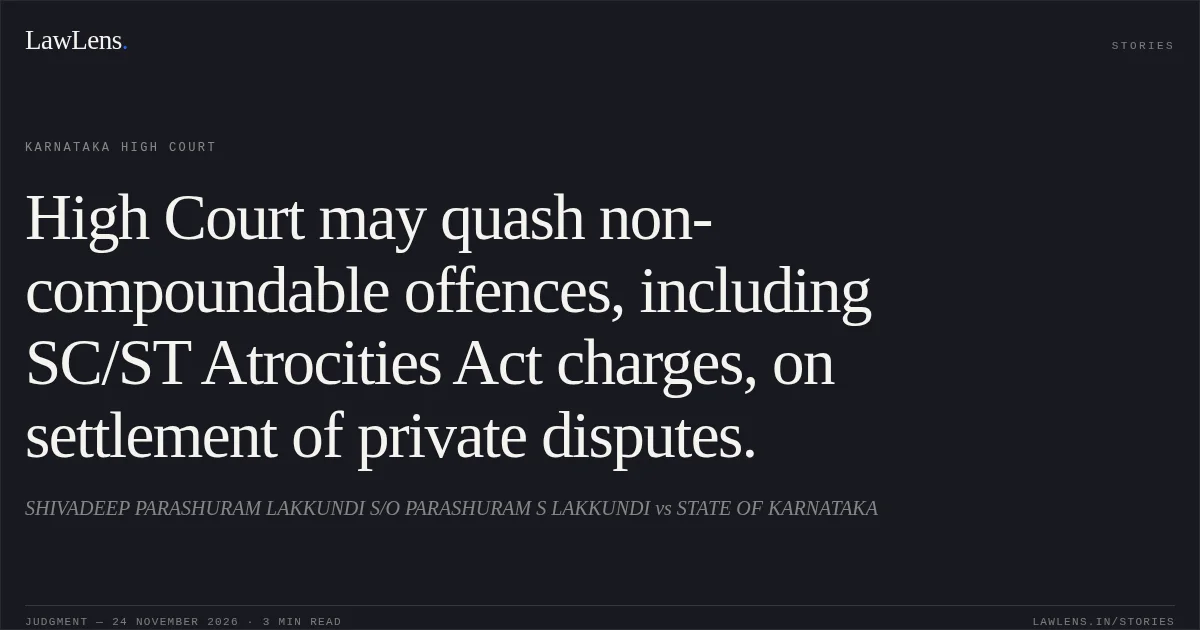
i.1. Whether the criminal proceedings in Crime No. 299/2026, involving non-compoundable offences under the BNS and the SC/ST Act, can be quashed under the inherent powers of the High Court on the basis of a settlement between the complainant and the accused.
¶ 2 · ¶ 6ii.2. Whether continuation of the prosecution against Accused Nos. 1 to 7 is an abuse of the process of law, such that the chances of conviction are remote and quashing is warranted.
¶ 6 · ¶ 803Law Applied
Section 482 CrPC (now Section 528 BNSS) preserves the High Court's inherent power to prevent abuse of process and secure the ends of justice, and is distinct from compounding under Section 320 CrPC.
¶ 7 (quoting Narinder Singh · ¶ 31(I))Under Narinder Singh & Ors. v. State of Punjab & Anr., (2014) 6 SCC 466, the High Court may quash non-compoundable proceedings on settlement where the guiding factors are ends of justice or prevention of abuse of process.
¶ 7 (para. 31(II))Such power must be exercised sparingly. It should not be used for heinous or serious offences of mental depravity or offences affecting society, but may be used for cases of predominantly civil or family character.
¶ 7 (para. 31(III)–(IV))The Court must assess whether the possibility of conviction is remote and bleak, and whether continuation would cause oppression or injustice.
¶ 7 (para. 31(V))The timing of settlement is relevant, and the Court must consider how far the trial has progressed.
¶ 7 (para. 31(VII))Provisions in the judgment · 16 · Linked ones open on LawLens
Bharatiya Nagarik Suraksha Sanhita, 2023 Section 528
Code of Criminal Procedure, 1973 Section 482Section 320
Bharatiya Nyaya Sanhita, 2023 9 provisions
Section 115Section 126Section 127Section 109Section 189Section 191Section 351Section 352Section 190Indian Penal Code, 1860 Section 307Section 324Section 323Section 34
04Reasoning
The Court first examined the stage and nature of the case. The complainant's affidavit showed that the complaint was lodged under a misunderstanding and in anger, and that the dispute was settled through the mediation of the Bar and village elders, with the parties agreeing to live peacefully.
¶ 4 · ¶ 8Applying the factors in Narinder Singh, the Court found that the settlement brought harmony to the parties, which weighed in favour of quashing.
¶ 8On the probability of conviction, the Court held that witnesses were unlikely to support the prosecution after the settlement, that no further investigation was needed, and that the complainant had not clearly alleged a direct nexus between the accused and the offences.
¶ 8Together, these factors led the Court to conclude that the chances of conviction were very remote and that continuing the proceedings would be unnecessary.
¶ 8The Court did not separately analyse whether the SC/ST Act offences fall within the "heinous or serious" exclusion in Narinder Singh, nor did it examine the bar on quashing under the SC/ST Act itself. The order rests on the private, family-dispute character of the matter and the remoteness of conviction.
¶ 6 · ¶ 805Holding
1. Although the offences are non-compoundable, the settlement, the complainant's withdrawal of the complaint, the remoteness of conviction and the absence of a clearly alleged direct nexus justified invoking inherent power to prevent abuse of process.
¶ 6 · ¶ 8 · ¶ 92. The chances of conviction were held to be very remote, and continuation of the prosecution against Accused Nos. 1 to 7 was held to be an abuse of process warranting quashing.
¶ 8 · ¶ 9The petition was allowed. The entire proceedings in Crime No. 299/2026 of Gadag Rural PS, pending before the Additional District and Sessions Court, Gadag, were quashed insofar as Accused Nos. 1 to 7 are concerned. Pending I.As., if any, were disposed of.
¶ 9Original Court PDF
SHIVADEEP PARASHURAM LAKKUNDI S/O PARASHURAM S LAKKUNDIvsSTATE OF KARNATAKA
Click to open original judgment
Original judgment, available to read, download and summarize on LawLens.in