01Facts
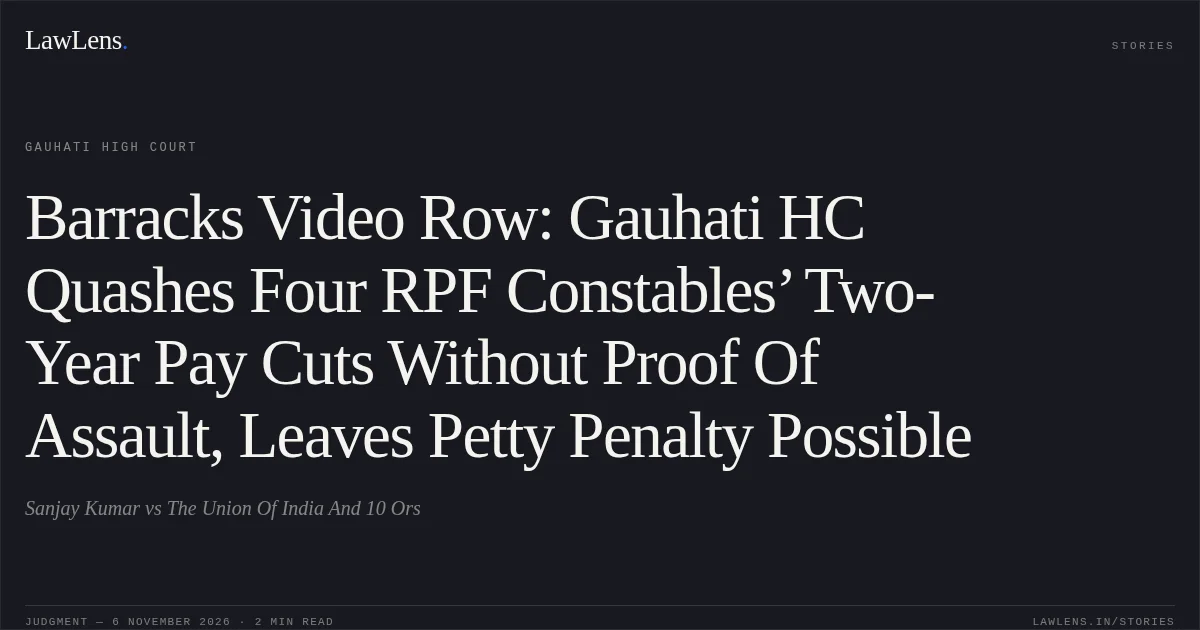
The four petitioners, RPF Constables posted at New Jalpaiguri, were charged under Section 9(1) of the Railway Protection Force Act, 1957, read with Rule 153 of the Railway Protection Force Rules, 1987, with creating a disturbance in the barrack, abusing and assaulting a colleague after he recorded a video.
pp. 9–13Following an enquiry, the Assistant Security Commissioner imposed stoppage of the next annual increment for six months with non-cumulative effect.
pp. 9–13The disciplinary authority enhanced the penalty to reduction to the initial pay stage for two years with cumulative effect; the appellate and revisional authorities upheld the enhanced penalty.
pp. 9–13The petitioners challenged those orders, contending that the witnesses did not establish abuse or assault and that the complainant had withdrawn his first complaint.
pp. 9–13, 23–2402Issues
i.1. Whether the enquiry evidence established misconduct by the petitioners under Rules 146.4 and 146.5 of the RPF Rules
pp. 17–21ii.2. Whether the penalties imposed and enhanced were proportionate to the conduct established on the evidence
pp. 21–2403Law Applied
Rule 146.1 of the RPF Rules requires members of the Force to maintain discipline and obedience; Rule 146.4 prohibits conduct prejudicial to discipline or bringing discredit to the Force; and Rule 146.5 treats oppressive or abusive conduct, assault, or misbehaviour towards another Force member as misconduct.
pp. 20–21Rule 160.1 provides for disposal of petty cases of misconduct in an orderly room, while Rule 148.4 prescribes petty punishments, including a fine, confinement to quarter-guard, or reprimand.
p. 22The Court also relied on Mithilesh Singh v. Union of India, (2003) 3 SCC 309, for the principle that a disciplinary punishment may be interfered with when it is disproportionate to the conduct.
p. 23Provisions in the judgment · 1 · Linked ones open on LawLens
Railway Protection Force Act, 1957 Section 9
04Reasoning
The witnesses who were present at the barrack described the staff confronting the complainant about recording a video and asking him to delete it, but did not establish that the petitioners abused, assaulted, or misbehaved with him.
pp. 18–21The evidence also did not support the charges of taking alcohol or creating a nuisance; the disciplinary authority itself recorded that the petitioners had taken lunch and asked the complainant not to record the video.
pp. 18–21The Court further noted that the complainant’s testimony was not considered in the enquiry report, notwithstanding the respondents’ submission that he had been examined.
p. 22On the evidence, the conduct established was, at most, a petty breach of discipline, and the enhanced penalty was disproportionate.
pp. 21–2305Holding
The Court set aside the original penalty order, the enhancement orders, and the appellate and revisional orders.
pp. 23–24It partly allowed the writ petitions and left the competent authority at liberty, if required, to impose a petty punishment under Rule 148.4 after following the applicable procedure.
pp. 23–24Original Court PDF
Sanjay KumarvsThe Union Of India And 10 Ors
Click to open original judgment
Original judgment, available to read, download and summarize on LawLens.in