01Facts
The petitioner’s land and structures were acquired for a four-lane National Highway.
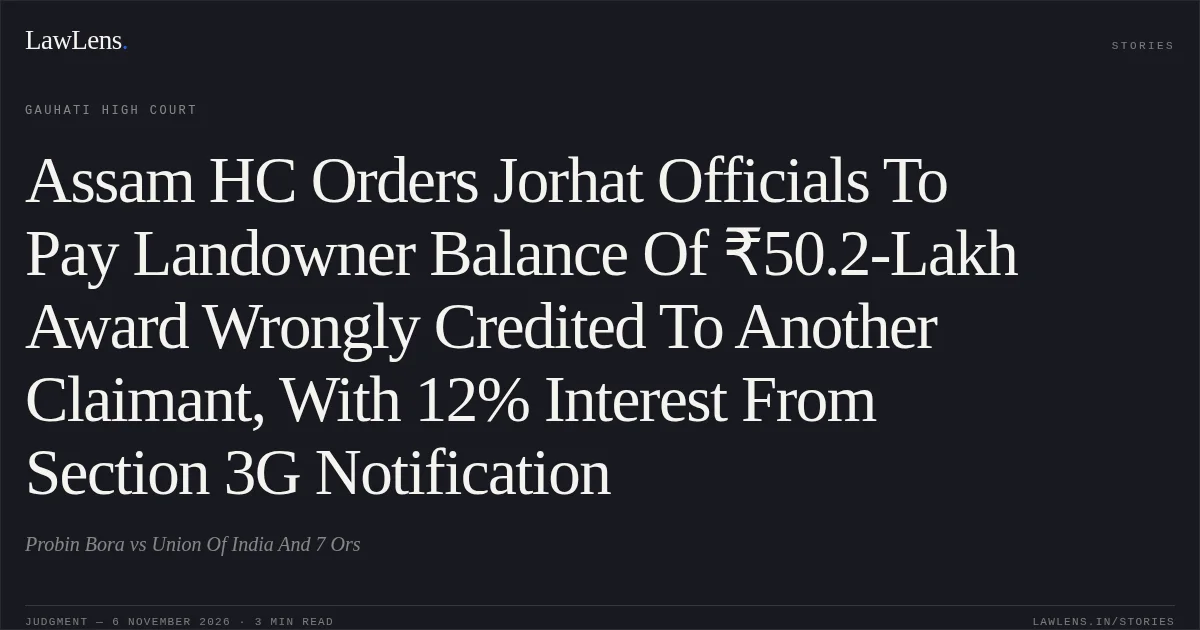
¶ 3–10, 17–20, 23–24The competent authority assessed compensation of ₹50,21,954 as payable to him, but, through an admitted disbursement error, that amount was deposited in the account of respondent No. 8, who was separately entitled to ₹20,35,389.
¶ 3–10, 17–20, 23–24Respondent No. 8 received ₹63,45,534 in total.
¶ 3–10, 17–20, 23–24The petitioner received only ₹7,11,809 after an interim order of the Court; the balance remained unpaid.
¶ 3–10, 17–20, 23–24The State authorities acknowledged the mistake and stated that recovery proceedings had been initiated against respondent No. 8.
¶ 3–10, 17–20, 23–24The petitioner sought payment of the outstanding compensation, interest and other reliefs under Article 226.
¶ 3–10, 17–20, 23–2402Issues
i.Whether the writ petition was maintainable where the dispute concerned wrongful disbursement of assessed compensation, rather than determination of its amount
¶ 21ii.Whether the State authorities’ mistaken payment of the petitioner’s assessed compensation to another claimant, and the resulting delay in payment to the petitioner, violated Article 300A
¶ 22–25iii.Whether the petitioner was entitled to payment of the unpaid compensation with interest, notwithstanding the authorities’ efforts to recover the mistaken payment from respondent No. 8
¶ 23–2703Law Applied
Article 300A prohibits deprivation of property except by authority of law; the right to claim compensation is inherent in that protection, and the State must ensure a fair and timely process.
¶ 22.1–22.2, 22.6The Court relied on K.T. Plantation (P) Ltd. v. State of Karnataka, which recognised the constitutional protection of property and the inbuilt right to compensation.
¶ 22.1–22.2Kolkata Municipal Corporation v. Bimal Kumar Shah, which identified fair compensation and an efficient, timely process among the protections under Article 300A.
¶ 22.3Ultra-Tech Cement Ltd. v. Mast Ram, which held that compensation, once determined, must be paid promptly and that delay may breach Article 300A.
¶ 22.4–22.5The Court also considered Section 3G(5) of the National Highways Act, 1956, observing that the arbitration route for disputes over determination of compensation did not govern a case where the assessed amount was undisputed and had instead been wrongly disbursed.
¶ 21Provisions in the judgment · 2 · Linked ones open on LawLens
Indian Penal Code, 1860 Section 406Section 420
04Reasoning
The compensation amount payable to the petitioner was undisputed, and the authorities admitted that it had mistakenly been deposited in respondent No. 8’s account.
¶ 19, 21The Court therefore distinguished the case from disputes about the determination of compensation or apportionment that may engage the statutory remedies under Section 3G(5).
¶ 19, 21Because the petitioner’s land had been acquired and the assessed compensation had remained unpaid for more than a decade, the Court held that the wrongful disbursement and prolonged delay deprived him of compensation and an efficient, timely process, contrary to Article 300A.
¶ 23–25The authorities’ recovery efforts against respondent No. 8 did not displace their obligation to pay the petitioner.
¶ 23–2705Holding
The Court allowed the writ petition.
¶ 27–28It directed respondent Nos. 5 and 6 to pay the petitioner’s assessed compensation of ₹50,21,954, adjusting the ₹7,11,809 already paid, within three months of receiving the certified judgment.
¶ 27–28It further directed payment of interest at 12% per annum on the entire compensation amount from publication of the notification under Section 3G until payment.
¶ 27–28The authorities may recover the mistaken payment from respondent No. 8 and must, after an inquiry by an officer not below the rank of Additional Chief Secretary, initiate appropriate legal action against the officials responsible for the erroneous disbursement.
¶ 27–28Original Court PDF
Probin BoravsUnion Of India And 7 Ors
Click to open original judgment
Original judgment, available to read, download and summarize on LawLens.in