Facts
The petitioner, a non-government educational institution holding provisional prior permission and provisional registration under the Assam Non-Government Educational Institution (Regulation and Management) Act, 2006, was operating Classes I–XII from a rented RCC G+2 residential building at Beltola, Guwahati, pending establishment of its permanent campus at Senabor, Kamrup Metropolitan.
Source reference: p.2, para. 2The Guwahati Metropolitan Development Authority (GMDA) issued a notice dated 2 June 2026 under Section 87 of the Guwahati Metropolitan Development Authority Act, 1985, alleging that the building was sanctioned only for residential use and calling upon the school to show cause why action under Section 88, including demolition or sealing, should not be taken.
Source reference: p.2, para. 4After the petitioner submitted its reply on 8 June 2026, the GMDA passed an order dated 15 July 2026 directing discontinuance of institutional use and voluntary sealing of the premises within seven days, failing which the premises would be sealed and further action taken.
Source reference: p.3, paras. 5–6The petitioner challenged that order under Article 226 of the Constitution. The GMDA opposed the writ petition on the ground that the petitioner had an efficacious statutory appeal under Chapter VIII of the GMDA Act.
Source reference: p.3, para. 8Issues
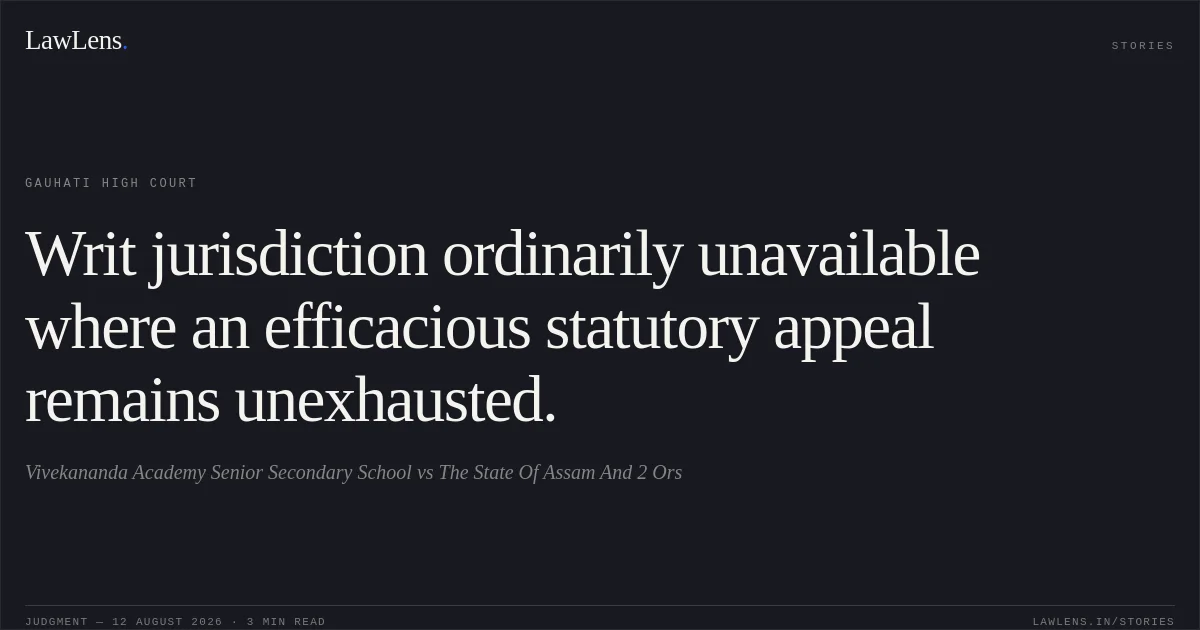
Whether the writ petition under Article 226 was maintainable when the impugned GMDA order was appealable under Chapter VIII of the GMDA Act, 1985.
Source reference: p.3, para. 8; p.4, paras. 10–12Whether the petitioner should first exhaust the statutory appellate remedy before seeking relief from the High Court.
Source reference: p.4, para. 11; p.7, paras. 16–17Whether interim protection should be granted to prevent coercive action during the period available for filing the statutory appeal.
Source reference: p.7, para. 18Law Applied
The Court applied the doctrine that although the jurisdiction under Article 226 is wide, its exercise is discretionary and ordinarily should be declined where the petitioner has an adequate and efficacious statutory alternative remedy.
Source reference: p.4, para. 10The Court relied on Thansingh Nathmal v. Superintendent of Taxes, Dhubri, AIR 1964 SC 1419, which holds that the High Court should not ordinarily permit the statutory appellate machinery to be bypassed, particularly where disputed questions of fact may arise.
Source reference: p.4, para. 10The Court further recognised that exceptional intervention may be justified in cases involving breach of natural justice or failure to follow the prescribed procedure.
Source reference: p.5, para. 11Sections 71–73 of the GMDA Act provide for appointment of an appellate authority, filing of appeals within one month, condonation of delay, hearing of parties, and civil-court powers for taking evidence and compelling attendance or production of documents. The District and Sessions Judge, Kamrup, Guwahati, had been designated as the appellate authority under the State Government notification dated 22 August 1996.
Source reference: pp.5–6, paras. 13–14Reasoning
The Court found that the impugned order dated 15 July 2026 was appealable under Chapter VIII of the GMDA Act and that the statutory appeal provided an adequate and efficacious remedy.
Source reference: p.6, para. 12; p.7, para. 16The appellate authority possessed powers to consider factual matters, take evidence, compel production of documents, and grant appropriate relief—functions not ordinarily undertaken in a writ proceeding involving disputed questions of fact.
Source reference: p.7, para. 16Since the one-month limitation period had not expired and no exceptional circumstance warranting immediate exercise of Article 226 jurisdiction was established, the Court declined to examine the merits of the petitioner’s challenge and directed it to pursue the statutory remedy.
Source reference: p.7, para. 17Nevertheless, recognising the possibility of imminent sealing, the Court protected the petitioner from coercive action until expiry of the statutory limitation period and left interim relief to the appellate authority.
Source reference: p.7, para. 18Holding
The writ petition was not entertained on account of the petitioner’s available and efficacious statutory remedy of appeal under Sections 71–73 of the GMDA Act.
The petitioner was granted liberty to file an appeal before the District and Sessions Judge, Kamrup, Guwahati, preferably within the limitation period.
Source reference: p.7, para. 17The appellate authority was directed to consider the appeal and any application for interim relief on its own merits and in accordance with law. The GMDA, particularly respondent no. 2, was directed not to initiate coercive action against the petitioner until expiry of the period for filing the appeal. All merits were expressly left open, and the writ petition was accordingly disposed of without adjudication on the substantive legality of the GMDA order.
Source reference: p.7, para. 18Acts & Sections Cited
5 provisions across 1 statute referred to in this judgment. Each provision opens on LawLens.
Guwahati Metropolitan Development Authority Act, 19855
Original Court PDF
Vivekananda Academy Senior Secondary SchoolvsThe State Of Assam And 2 Ors
Click to open original judgment
Original judgment, available to read, download and summarize on LawLens.in