01Facts
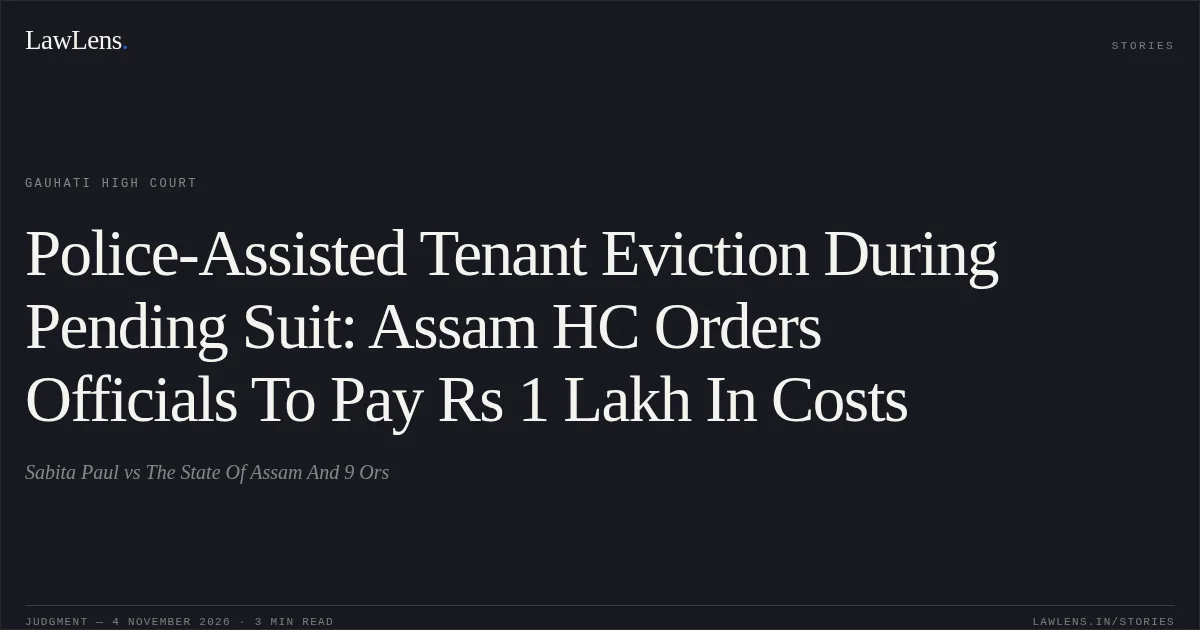
The petitioner occupied a room as a tenant. Her landlord, Respondent No. 6, had filed a civil suit seeking possession and arrears of rent.
¶ 4–9, 21, 25While that suit was pending, the landlord complained to the police; the police later sought an Executive Magistrate’s assistance for a proposed eviction.
¶ 4–9, 21, 25The Additional Deputy Commissioner deputed an Executive Magistrate to attend to law and order, and police personnel subsequently accompanied Respondent No. 7, who broke the shutter lock and entered the premises while the petitioner was absent.
¶ 4–9, 21, 25No eviction decree or other order authorising dispossession was shown.
¶ 4–9, 21, 25The petitioner brought this writ petition. During its pendency, she and Respondent No. 6 settled, and the petitioner no longer sought restoration of possession.
¶ 10–15The Court nevertheless examined the conduct of the officials involved.
¶ 10–1502Issues
i.Whether police and executive authorities could facilitate the petitioner’s dispossession without a lawful order, while the landlord’s civil suit for possession was pending.
¶ 16, 21–25ii.Whether consequences should follow for the public officials who initiated or facilitated the dispossession, notwithstanding the private settlement.
¶ 16, 32–3903Law Applied
Article 300A of the Constitution prohibits deprivation of property except by authority of law; Article 14 prohibits arbitrary state action.
¶ 29–30In Lallu Yeshwant Singh v. Rao Jagdish Singh, (1968) 2 SCR 203, and Krishna Ram Mahale v. Mrs. Shobha Venkat Rao, (1989) 4 SCC 131, the Supreme Court affirmed that a person claiming possession—even an owner—must recover it through lawful process and cannot resort to force or self-help.
¶ 18–20Police and executive authorities may act to prevent breaches of peace but cannot adjudicate civil rights or use law-and-order powers to effect a private eviction.
¶ 22–24Satrughna Atmaram Patil v. Vinod Dodu Choudhari, 2024 INSC 75, supports the principle that settlement of the private dispute does not necessarily preclude judicial scrutiny or consequences for misuse of public authority.
¶ 31–33Provisions in the judgment · 3 · Linked ones open on LawLens
Indian Penal Code, 1860 Section 406Section 420Section 506
04Reasoning
The landlord had already invoked the civil court’s jurisdiction, leaving the tenancy, rent default and entitlement to possession for adjudication through that process.
¶ 21–22The deputation order concerned maintenance of law and order; it did not authorise eviction.
¶ 23–30, 35The breaking of the lock and entry in the petitioner’s absence, with police assistance and without a decree, warrant or statutory order, therefore lacked lawful authority and amounted to arbitrary state action contrary to Articles 300A and 14.
¶ 23–30, 35The settlement and the petitioner’s decision not to seek restoration did not validate the officials’ conduct or remove the Court’s concern about the use of state machinery.
¶ 32–34The Court imposed costs in light of the officials’ respective roles, Respondent No. 9’s failure to explain his order, and Respondent No. 10’s apology and undertaking.
¶ 38–3905Holding
The Court held that the petitioner’s dispossession was effected without demonstrated legal authority and by circumventing the civil process, in violation of the rule of law and constitutional protections under Articles 300A and 14.
¶ 35–37It disposed of the petition, directing Respondent No. 9 to deposit ₹75,000 and Respondent No. 10 to deposit ₹25,000 with the High Court Legal Services Authority within six weeks; it accepted Respondent No. 10’s unconditional apology and, given the settlement and the petitioner’s position, made no order for restoration of possession.
¶ 40The Registry was directed to relist the matter if the costs were not paid within the stipulated period.
¶ 40Original Court PDF
Sabita PaulvsThe State Of Assam And 9 Ors
Click to open original judgment
Original judgment, available to read, download and summarize on LawLens.in