Facts
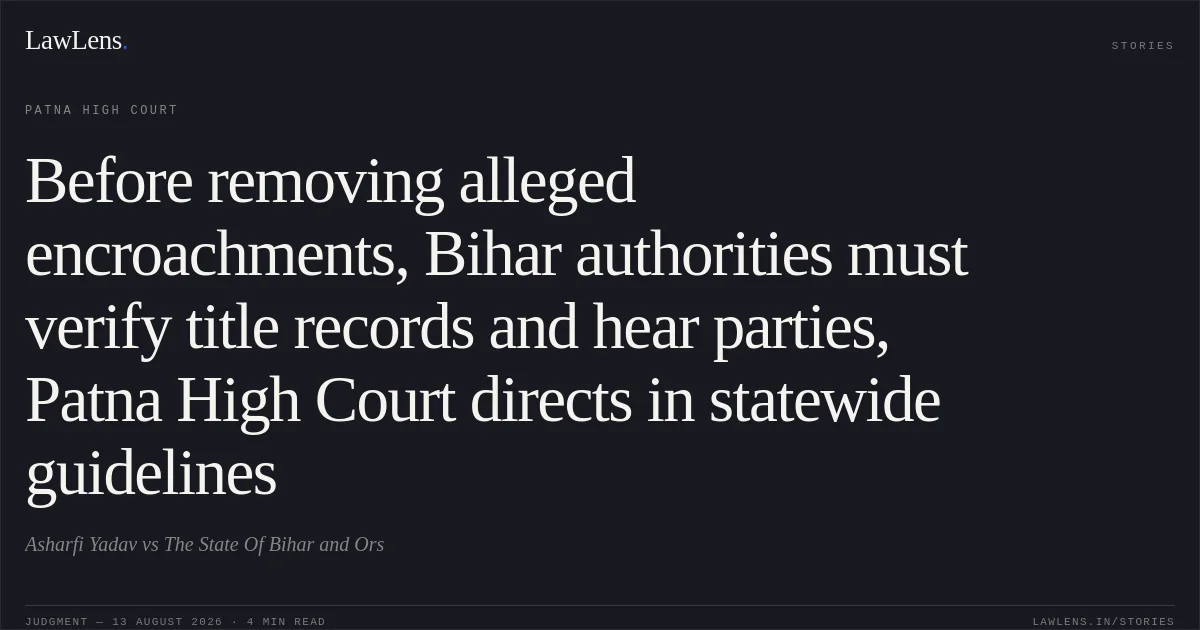
The petitioner claimed that three kathas of land bearing Khesra/Plot No. 1099, Khata No. 275, Village Amarpura, had been settled in favour of his grandfather by the erstwhile Maharaja of Darbhanga on 20 July 1926. He relied on long-standing possession, a running jamabandi, and payment of land revenue up to 2013–14.
Source reference: paras. 4–5On a complaint by respondent no. 6, the Circle Officer initiated Encroachment Case No. 21/13–14 under the Bihar Public Land Encroachment Act, 1956, alleging that six dhurs of the plot were recorded as gairmazarua aam rasta and had been encroached upon by construction of a thatched hut.
Source reference: paras. 6, 9, 17Although the petitioner filed a show-cause reply on 5 May 2014, the Circle Officer passed a final order on the same day directing removal of the alleged encroachment within fifteen days.
Source reference: para. 7The Collector dismissed the petitioner’s statutory appeal under Section 11 and affirmed the removal order, relying on revenue reports and the alleged absence of proof of title or settlement.
Source reference: paras. 8–9The petitioner challenged both orders under Article 226 of the Constitution.
Source reference: no citationIssues
Whether proceedings under the Bihar Public Land Encroachment Act, 1956 could be used to remove the petitioner from land claimed to be raiyati land covered by a pre-vesting settlement and long-standing jamabandi.
Source reference: paras. 10–13, 19–22Whether the Circle Officer complied with the mandatory procedural requirements under Sections 3, 4, 5, 6 and 10 of the Bihar Public Land Encroachment Act, 1956, including proper notice, hearing, inquiry, consideration of evidence, and examination of relevant revenue and title records.
Source reference: paras. 13, 19, 26–30Whether a dispute concerning a settlement made before 1 January 1946 and a long-standing jamabandi could be determined or cancelled summarily by the revenue authorities, or whether the State was required to approach a competent civil court.
Source reference: paras. 19–21, 28–29Law Applied
The Court applied the Bihar Public Land Encroachment Act, 1956, particularly Sections 2(3), 3, 4, 5, 6, 10, 11 and 13: the Act concerns encroachment upon public land, and proceedings require a prima facie determination, valid notice, opportunity to show cause, hearing, consideration of evidence, and such inquiry as necessary.
Source reference: paras. 26–28, 31Under Section 10, the competent authority possesses civil-court-like powers to summon witnesses, compel production of documents, conduct local inspection, and examine relevant records.
Source reference: para. 28The Court relied on Uma Devi v. State of Bihar, CWJC No. 9773 of 2000, for the principle that a disputed question of title cannot ordinarily be decided in summary encroachment proceedings and must be resolved by a competent civil court.
Source reference: para. 19It further relied on Bipin Bihari Verma v. State of Bihar, CWJC No. 4876 of 2021, and Sunita Rani Sah v. State of Bihar, CWJC No. 15484 of 2022, for the rule that long-standing jamabandis cannot be cancelled summarily and that the State must seek cancellation or declaration through a civil suit where substantial title documents support the claim.
Source reference: paras. 20–21, 28The Court also applied Section 4(g)–(h) of the Bihar Land Reforms Act, 1950, under which the Collector’s power to annul pre-vesting transfers, settlements or leases does not extend to settlements made before 1 January 1946 in favour of the claimant.
Source reference: para. 29Reasoning
The Court found that the Circle Officer passed the final order on the very day the petitioner submitted his show-cause reply, without demonstrating that the reply was considered, that relevant revenue records were summoned, or that evidence was properly taken.
Source reference: paras. 7, 19The alleged encroachment involved land which the petitioner claimed formed part of a 1926 settlement supported by a long-standing jamabandi and continuous possession. This raised a bona fide dispute regarding the nature and title of the land, which could not be conclusively determined merely on the basis of an inspection or revenue report describing the plot as gairmazarua aam rasta.
Source reference: paras. 9, 17–19, 28The appellate authority also failed to record a clear and definitive finding after examining the competing claims and relevant documents.
Source reference: para. 19Applying the principles governing long-standing settlements and jamabandis, the Court held that the State could not indirectly cancel or disregard the petitioner’s claimed title through summary encroachment proceedings; if the State disputed the validity of the pre-1946 settlement or jamabandi, it had to pursue the appropriate remedy before a competent civil court.
Source reference: paras. 20–22, 28–29The Court also directed authorities in future cases to examine jamabandis, khatiyans, Register-II entries, judicial decrees, and historical settlements before proceeding under the Act.
Source reference: para. 28Holding
The Court held that the proceedings under the Bihar Public Land Encroachment Act, 1956 were vitiated by breach of the statutory procedure, denial of a meaningful hearing, failure to conduct the required inquiry, and failure to properly consider the petitioner’s claim based on a pre-1946 settlement and long-standing jamabandi.
It accordingly quashed the Circle Officer’s order dated 5 May 2014 and the Collector’s appellate order dated 18 November 2014.
Source reference: para. 22The matter was remanded to the Circle Officer to reconsider the petitioner’s settlement and jamabandi claims after hearing all parties and recording a prima facie finding in accordance with the Court’s directions.
Source reference: paras. 23–24The exercise was to be completed within four months, with status quo maintained until then.
Source reference: para. 25The Court also issued general guidelines requiring authorities to verify complaints, examine relevant records, identify bona fide title disputes, avoid summary proceedings where such disputes exist, and ensure compliance with the statutory procedure under the 1956 Act.
Source reference: paras. 26–33The writ application was allowed.
Source reference: para. 34Acts & Sections Cited
3 provisions across 3 statutes referred to in this judgment. Each provision opens on LawLens.
Bihar Land Reforms Act, 19501
Bihar Land Mutation ACT, 20111
Bharatiya Nyaya Sanhita, 20231
Original Court PDF
Asharfi YadavvsThe State Of Bihar and Ors
Click to open original judgment
Original judgment, available to read, download and summarize on LawLens.in