01Facts
The petitioner-plaintiff instituted O.S. No. 444/2012 seeking declaration, possession and mandatory injunction concerning alleged encroachment on the suit property.
¶ 1The defendants disputed the property’s measurements, boundaries and description, and those matters were explored in cross-examination.
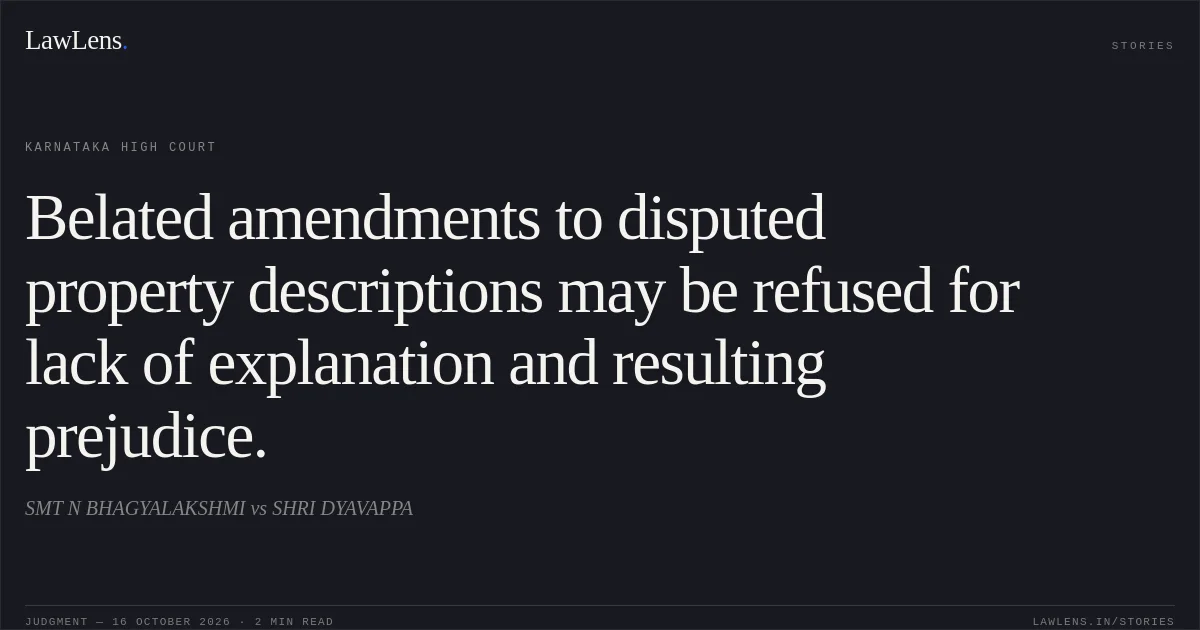
¶ 3After the suit had been posted for pronouncement of judgment, the plaintiff sought to amend the plaint to alter the property’s measurements, boundaries and description.
¶ 3The trial court rejected the application, and the plaintiff challenged that order under Article 227 of the Constitution.
¶ 1, 302Issues
i.1. Whether the trial court was justified in rejecting the plaintiff’s application to amend the suit-property description after the suit had been posted for pronouncement of judgment.
¶ 3–5ii.2. Whether the trial court’s order disclosed a ground for interference under Article 227 of the Constitution.
¶ 603Law Applied
The Court considered the amendment jurisdiction under Order VI Rule 17 of the Code of Civil Procedure and the High Court’s supervisory jurisdiction under Article 227 of the Constitution.
¶ 1Although amendment applications are ordinarily considered liberally, the discretion must account for the nature of the proposed amendment, the stage of the proceedings, prejudice to the opposing party and the explanation for delay.
¶ 4–5A belated application unsupported by a satisfactory explanation may be refused where the amendment risks prejudice or affects the course of adjudication.
¶ 4–5The judgment cited no precedent.
04Reasoning
The proposed amendment concerned matters already disputed in the pleadings and examined in cross-examination.
¶ 3–5The application was made when the suit was ready for judgment, yet the supporting affidavit did not adequately explain why the alleged discrepancies could not have been addressed earlier.
¶ 3–5In those circumstances, the defendants’ concern that the amendment would undermine the effect of the cross-examination and prejudice their position was material.
¶ 3–5The Court therefore found the trial court’s refusal consistent with the relevant discretionary considerations.
¶ 3–505Holding
The High Court held that no ground for interference under Article 227 was established and dismissed the writ petition.
¶ 6Pending interlocutory applications, if any, were also disposed of.
¶ 6Original Court PDF
SMT N BHAGYALAKSHMIvsSHRI DYAVAPPA
Click to open original judgment
Original judgment, available to read, download and summarize on LawLens.in