Facts
Jograj, predecessor-in-interest of the petitioners, was recorded as bhumidhar over the disputed land.
Source reference: no citationCeiling proceedings under the U.P. Urban Land (Ceiling and Regulation) Act, 1976 (“ULC Act”) were initiated against him in Case No. 211/51/1982.
Source reference: no citationHe filed objections, which were decided under Section 8(4); a final statement under Section 9 was issued, followed by notification under Section 10(3), service of notice under Section 10(5), and proceedings under Section 10(6).
Source reference: paras. 8, 16–17The State relied on a dakhalnama dated 10 January 1992 to establish that possession had been taken, and the revenue records were thereafter changed in favour of the State.
Source reference: paras. 8, 16–17The petitioners, claiming inheritance through Jograj, asserted that they remained in possession and sought correction of the revenue entries, recognition as bhumidhars, and protection against interference.
Source reference: paras. 2–5, 34They approached the High Court in 2014, more than twenty-two years after the alleged dispossession and fifteen years after the Urban Land (Ceiling and Regulation) Repeal Act, 1999 came into force.
Source reference: paras. 2–5, 34Issues
Whether, where the original tenure-holder did not challenge the alleged dispossession under Sections 10(5) or 10(6) of the ULC Act within a reasonable time, a writ of mandamus could subsequently be issued for correction of revenue entries or for consequential relief.
Source reference: Issue No. I; paras. 7, 31Whether the petitioners, as legal heirs of the original tenure-holder, could obtain relief after an unexplained delay of more than twenty-two years from the alleged taking of possession, and whether the State’s possession acquired legitimacy by lapse of time.
Source reference: Issue No. II; paras. 7, 32–34Whether the petitioners were entitled to the benefit of Sections 3 and 4 of the Repeal Act, 1999 on the basis that they remained in de facto possession on 18 March 1999.
Source reference: paras. 15–20, 27Law Applied
The Court applied the scheme of Sections 8(3), 8(4), 9, 10(3), 10(5) and 10(6) of the ULC Act, under which surplus land could vest in the State and possession could be obtained either through voluntary surrender or through statutory dispossession.
Source reference: no citationSection 3 of the Repeal Act, 1999 preserves vesting where possession had already been taken, while land vested under Section 10(3) but not physically possessed by the State may receive the benefit of repeal; Section 4 abates pending proceedings subject to its statutory proviso.
Source reference: para. 11In State of U.P. v. Hari Ram, the Supreme Court held that mere vesting under Section 10(3) does not confer de facto possession and that the State must establish voluntary surrender or possession under Sections 10(5) or 10(6).
Source reference: para. 21However, in State of Assam v. Bhaskar Jyoti Sarma, the Supreme Court held that where actual possession had been taken, an objection to non-compliance with Section 10(5) must be raised within a reasonable time; otherwise, the right to object is waived and the dispossession acquires legitimacy by lapse of time.
Source reference: paras. 28–30The Court also applied the principles that revenue entries do not conclusively establish title but may raise a rebuttable presumption regarding possession, and that relief under Article 226 may be denied on the grounds of delay, laches, waiver and acquiescence.
Source reference: para. 17Reasoning
The Court found that Jograj had participated in the ceiling proceedings by filing objections and that the record demonstrated service of notice under Section 10(5), subsequent action under Section 10(6), preparation of the dakhalnama dated 10 January 1992, and corresponding revenue entries in favour of the State.
Source reference: paras. 8, 10Although the petitioners questioned the absence of the tenure-holder’s signature on the dakhalnama and relied on later khatauni entries showing the heirs’ names, they produced no independent evidence proving continued possession of the surplus land on 18 March 1999, the date on which the Repeal Act applied in Uttar Pradesh.
Source reference: paras. 13–20The Court held that the khatauni entry concerned a miljumla plot and could not, without corroboration, establish possession over the surplus portion.
Source reference: para. 19Unlike cases where the State failed to prove possession or where third-party occupants were unaware of the ceiling proceedings, the present case involved the original tenure-holder’s participation, service of statutory notices, a contemporaneous possession document, and an unexplained delay of more than two decades.
Source reference: paras. 37–53Consequently, any challenge to the manner of dispossession, including alleged irregularities in the notice or dakhalnama, was treated as waived, and the Court declined to examine such objections in a belated writ petition.
Source reference: paras. 29–31, 57–59Holding
The Court answered both issues against the petitioners.
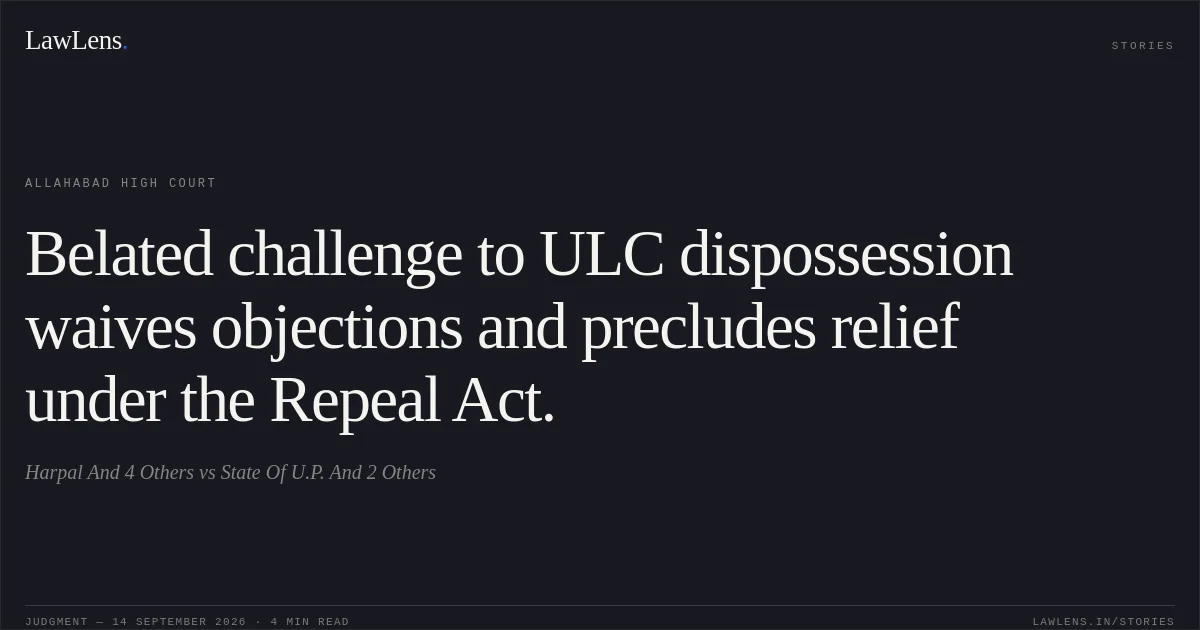
It held that, once possession had been taken pursuant to the ULC Act and the original tenure-holder had failed to challenge the dispossession within a reasonable time, the petitioners could not obtain a writ of mandamus for correction of the revenue entries or claim the benefit of the Repeal Act.
Source reference: paras. 27, 31The petitioners failed to establish that they were in actual possession of the surplus land on 18 March 1999, and their unexplained delay constituted laches, waiver and acquiescence.
Source reference: paras. 34, 56–58The writ petition was therefore dismissed, with no order as to costs.
Source reference: para. 60Acts & Sections Cited
2 provisions across 1 statute referred to in this judgment. Each provision opens on LawLens.
Original Court PDF
Harpal And 4 OthersvsState Of U.P. And 2 Others
Click to open original judgment
Original judgment, available to read, download and summarize on LawLens.in