Facts
The appellants, eight members of one family, were involved in a longstanding land dispute with Respondent No. 2, Shankar Maurya.
Source reference: no citationOn 09.11.2020, Appellant No. 4 lodged FIR No. 405 of 2020 against the complainant and others under Sections 188, 323, 504, 506 and 342 IPC concerning the same occurrence; a chargesheet was filed on 30.11.2020 and trial had commenced.
Source reference: para. 5In 2021, the complainant filed Complaint Case No. 909 of 2021 alleging counter-versions of assault and house-trespass against the entire appellant-family, including three women, without disclosing the earlier FIR or chargesheet.
Source reference: paras. 6, 23After recording evidence under Sections 200 and 202 CrPC, the Magistrate summoned Appellants 4–8 under Sections 323, 354 and 452 IPC and Appellants 1–3 under Sections 323 and 452 IPC on 10.02.2025.
Source reference: para. 7The revisional court dismissed the appellants’ challenge on 26.11.2025.
Source reference: para. 8The High Court, exercising jurisdiction under Section 528 BNSS, declined to quash the complaint and summoning order, holding that the allegations disclosed a prima facie case and involved disputed questions of fact.
Source reference: para. 9Issues
Whether the continuation of the complaint and criminal proceedings against the appellants constituted an abuse of the process of the court warranting exercise of inherent jurisdiction under Section 528 BNSS, corresponding to Section 482 CrPC?
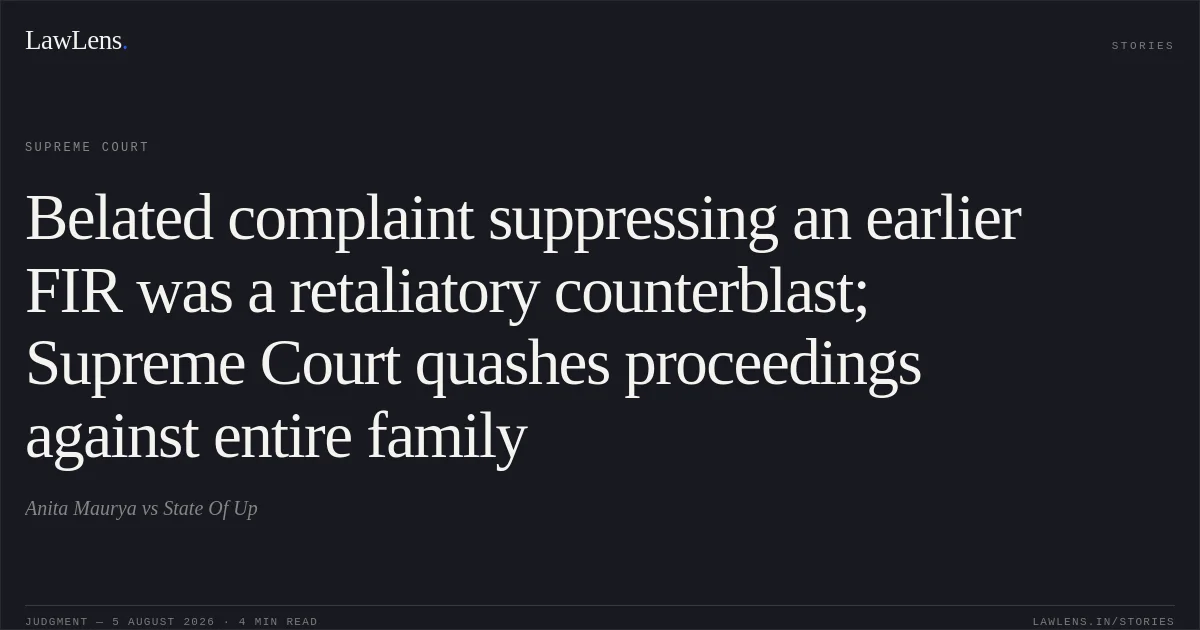
Source reference: para. 14Whether the unexplained delay in filing the complaint, suppression of the earlier FIR and chargesheet arising from the same incident, and the essentially civil nature of the dispute demonstrated that the complaint was a mala fide retaliatory counterblast?
Source reference: paras. 19–25Whether the High Court erred by restricting its consideration to the allegations in the complaint and treating the surrounding circumstances as disputed questions requiring trial?
Source reference: para. 25Law Applied
The Court applied Section 528 BNSS, which preserves the High Court’s inherent power to prevent abuse of the process of court and secure the ends of justice, corresponding to Section 482 CrPC.
Source reference: para. 15It relied on State of Haryana v. Bhajan Lal, which permits quashing where the allegations do not prima facie constitute an offence, are inherently improbable, or where the proceeding is manifestly mala fide and instituted to wreak vengeance.
Source reference: para. 15Under Mahmood Ali v. State of U.P. and Mohammad Wajid v. State of U.P., courts must examine the surrounding circumstances and, where mala fides are alleged, read the complaint carefully and beyond its bare averments.
Source reference: paras. 16–17G. Sagar Suri v. State of U.P. establishes that a dispute essentially civil in nature should not be given the cloak of criminality.
Source reference: para. 18Under Kishan Singh v. Gurpal Singh and Nazibul Rahim Khan v. State of U.P., deliberate and unexplained delay in initiating criminal proceedings may indicate an afterthought or pressure tactic and justify quashing.
Source reference: paras. 19–20Anukul Singh v. State of U.P. recognises that suppression of an antecedent proceeding arising from the same incident and institution of a retaliatory counterblast may fall within categories (1) and (7) of Bhajan Lal.
Source reference: para. 21Reasoning
The Supreme Court examined the cumulative circumstances rather than merely the complaint’s allegations.
Source reference: no citationThe appellants’ FIR had been lodged on the very day of the incident, followed by a chargesheet and commencement of trial, whereas the complainant instituted the complaint only in 2021 without explaining the delay.
Source reference: para. 22The complaint also suppressed the pre-existing FIR and chargesheet, despite arising from the identical occurrence, indicating a retaliatory counterblast and lack of bona fides.
Source reference: para. 23The dispute had an underlying civil substratum concerning land, and the complainant had previously pursued proceedings relating to that dispute before the High Court.
Source reference: para. 24The summoning of the entire opposing family, including three women, on the basis of the belated version further reflected insufficient application of mind by the Magistrate.
Source reference: para. 24Accordingly, the case fell within categories (1), (5) and (7) of Bhajan Lal: the proceedings did not disclose a genuine basis for prosecution, were inherently improbable in their overall context, and were manifestly attended by mala fides and an ulterior motive.
Source reference: para. 25Holding
The Court held that the continuation of Complaint Case No. 909 of 2021 amounted to an abuse of the process of the court.
It set aside the High Court’s order dated 21.01.2026 and allowed the appeal.
Source reference: para. 26The complaint, the summoning order dated 10.02.2025, and all consequential proceedings pending before the Additional Chief Judicial Magistrate, Jaunpur, were quashed.
Source reference: para. 27The Court clarified that its decision did not express any opinion on the merits of FIR No. 405 of 2020, the connected chargesheet, or the underlying civil dispute.
Source reference: para. 28Original Court PDF
Anita MauryavsState Of Up
Click to open original judgment
Original judgment, available to read, download and summarize on LawLens.in