Facts
The Petitioner, appointed as a vaccinator in 1990 and later a Vaccination Inspector in 1999, sought promotion to the vacant post of Chief Vaccinating Inspector
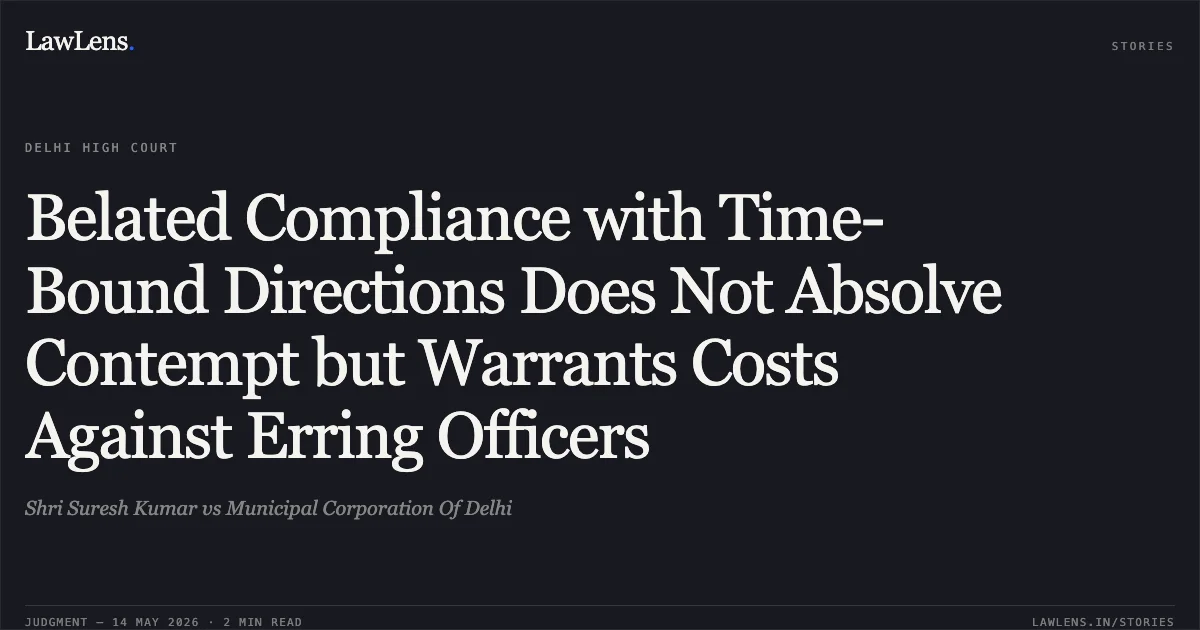
Source reference: p. 1-2Due to administrative inaction, he filed O.A. No. 2978/2019 before the Central Administrative Tribunal (CAT). On 24.02.2020, the CAT directed the Respondent to decide the Petitioner's representation by 29.02.2020 via a reasoned order
Source reference: p. 2-3The Respondent failed to comply by the deadline. After the Petitioner initiated contempt proceedings (C.P. No. 266/2021), the Respondent passed a speaking order on 16.11.2022—more than 2.5 years late—stating the grievance would be considered in a future DPC
Source reference: p. 3-4The CAT subsequently closed the contempt proceedings, leading to this writ petition challenging that closure
Source reference: p. 4Issues
1. Whether the Respondent’s passing of a speaking order after a delay of 2 years and 8 months constituted sufficient compliance with the Tribunal’s time-bound directions
Source reference: p. 6, para. 10; p. 10, para. 202. Whether the Court can hold an abstract entity (the Commissioner/Department) liable for contempt without the impleadment of specific natural persons as contemnors
Source reference: p. 9, para. 19Law Applied
The court applied the principles of contempt jurisdiction, which require proof of "wilful disobedience" of a court order
Source reference: p. 9, para. 18It emphasized that contempt is a quasi-criminal jurisdiction directed against natural persons rather than abstract institutions, necessitating the impleadment of specific individuals to satisfy procedural fairness and natural justice
Source reference: p. 10, para. 19Furthermore, the court referred to the principle that while administrative delays (such as municipal unification or DPC logistics) may explain tardiness, they do not excuse the failure to seek an extension of a binding judicial timeframe
Source reference: p. 8-9Reasoning
The Court observed that the Respondent was fully aware of the CAT's order and the specific 29.02.2020 deadline, which was linked to the Petitioner's superannuation
Source reference: p. 7The Respondent neither challenged the order nor sought an extension, rendering the two-and-a-half-year delay an act of "manifest administrative indifference"
Source reference: p. 10However, the Court identified a foundational defect in the petition: even though the conduct was "lethargic" and showed a "dearth of accountability" [p. 9], the Petitioner failed to implead the specific officers responsible
Source reference: p. 10The Court reasoned that while the Respondent's approach was unsatisfactory, it could not "judicially rewind" the clock at this belated stage
Source reference: p. 9To balance justice without further prolonging the litigation, the Court determined that the public exchequer should not bear the cost of individual negligence
Source reference: p. 10-11Holding
The Court expressed strong disapproval of the Respondent's inaction but declined to revive contempt proceedings due to the failure to implead individual contemnors
The Court disposed of the petition by directing the Respondent to pay a cost of ₹2,00,000 to the Petitioner within four weeks as a measure of substantive justice [p. 10-11, para. 21]. Notably, the Respondent was granted liberty to recover this amount from the salaries of the "erring officers" responsible for the delay
Source reference: p. 11, para. 22Acts & Sections Cited
5 provisions across 3 statutes referred to in this judgment. Each provision opens on LawLens.
Administrative Tribunals Act, 19852
Contempt of Courts Act, 19712
Delhi Municipal Corporation Act, 19571
Original Court PDF
Shri Suresh KumarvsMunicipal Corporation Of Delhi
Click to open original judgment
Original judgment, available to read, download and summarize on LawLens.in