Facts
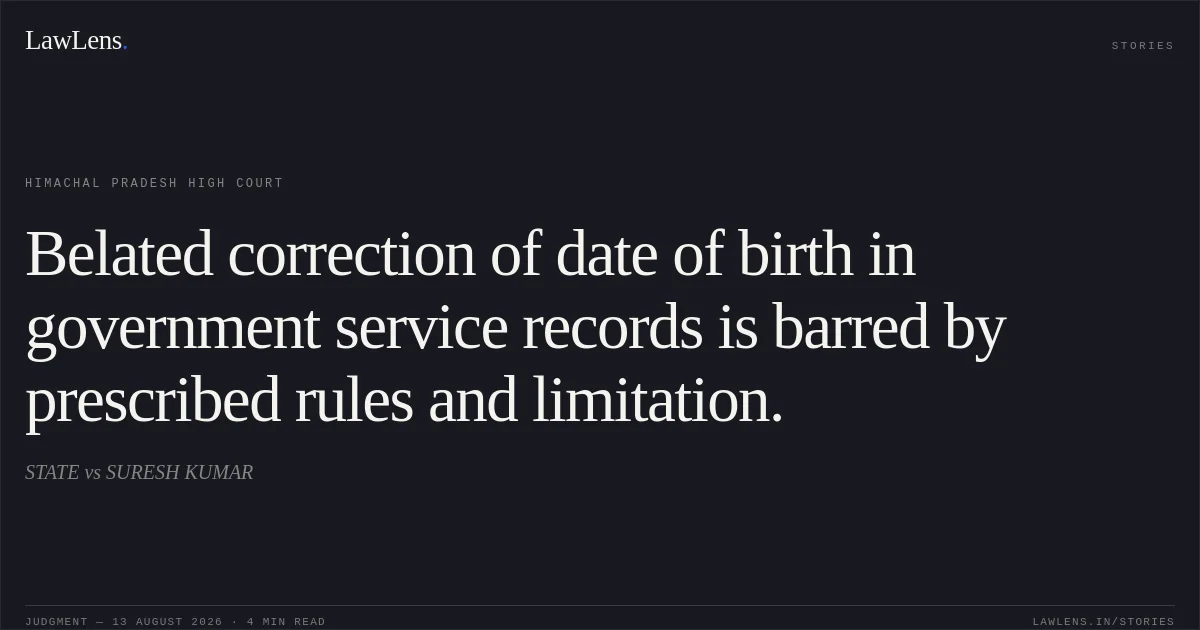
The plaintiff, a Trained Graduate Teacher, sought a declaration that his correct date of birth was 01.09.1969, instead of 30.08.1968, which was recorded in his matriculation certificate, school records, and government service record, along with a mandatory injunction directing correction of those records.
Source reference: para. 2He claimed that the incorrect entry resulted from his parents’ illiteracy and that he discovered his actual date of birth after consulting an astrologer and obtaining a birth certificate from the competent authority.
Source reference: para. 2The defendants relied upon the matriculation certificate, school-leaving certificate, service record, and an application signed by the plaintiff’s father, all recording 30.08.1968.
Source reference: para. 3The Trial Court dismissed the suit, holding, inter alia, that the plaintiff had not sought correction within the two-year period prescribed by the H.P. Financial Rules and was estopped by his conduct.
Source reference: para. 7The First Appellate Court reversed that decision and decreed the suit, reasoning that the delay was insignificant and that the two-year period was intended primarily to prevent claims raised at the fag end of service.
Source reference: para. 8The State challenged that decree in the present second appeal.
Source reference: para. 9Issues
Whether the First Appellate Court misinterpreted the H.P. Financial Rules and misapplied the law by permitting correction of the plaintiff’s date of birth after expiry of the prescribed two-year period?
Source reference: para. 9; paras. 15–26Whether the plaintiff’s suit seeking correction of his date of birth in the matriculation and service records was within limitation?
Source reference: para. 9; paras. 27–31Law Applied
Rule 7.1, Note d1 of the H.P. Financial Rules, 1971 provides that the date of birth declared at entry into government service is conclusive against the employee unless an application for correction is made within two years from the date of joining service.
Source reference: para. 15The Court relied on Government of A.P. v. M. Hayagreev Sarma, holding that service rules may regulate the recording and correction of an employee’s date of birth; Home Department v. R. Kirubakaran, requiring strict compliance with the prescribed procedure and time limit; State of Gujarat v. Vali Mohd. Dosabhai Sindhi and State of Haryana v. Satish Kumar Mittal, holding that belated applications for correction cannot ordinarily be entertained beyond the period prescribed by the applicable rules; State of Punjab v. S.C. Chadha, holding that subsequent evidence cannot ordinarily overcome an unchallenged service-record entry; and Union of India v. C. Rama Swamy, applying estoppel where the employee himself furnished a particular date of birth at entry into service.
Source reference: paras. 16–23On limitation, the Court applied Section 3 of the Limitation Act, 1963, under which a court must dismiss a time-barred suit even if limitation is not pleaded by the defendant.
Source reference: para. 30The Court relied on Board of Secondary Education of Assam v. Mohd. Sarifuz Zaman and Ambika Kaul v. CBSE for the principle that claims for correction of date of birth in educational records must be made within a reasonable and prescribed period.
Source reference: paras. 27–28Reasoning
The plaintiff’s date of birth was consistently recorded as 30.08.1968 in the matriculation certificate, school records, service book, and the form signed by his father.
Source reference: paras. 3, 7, 26The High Court recorded that he joined government service on 01.09.2001 but made his first representation for correction only on 13.05.2003, beyond the two-year period mandated by Rule 7.1, Note d1.
Source reference: para. 16The First Appellate Court was not entitled to relax or disregard the mandatory time limit merely because the delay was short or because no immediate prejudice was demonstrated; the purpose and operation of the rule had to be determined by its text and binding precedent.
Source reference: paras. 24–26The plaintiff’s own declaration and failure to seek timely correction also attracted estoppel.
Source reference: no citationIndependently, the incorrect date appeared in the matriculation certificate issued in 1985, when the plaintiff’s cause of action accrued.
Source reference: paras. 27–31His suit, filed in 2004, was therefore clearly beyond the permissible period for seeking correction, and his alleged later discovery of the error through an astrologer did not postpone the accrual of the right to sue.
Source reference: paras. 27–31Holding
The High Court answered both substantial questions of law in favour of the State.
It held that the two-year limitation under Rule 7.1, Note d1 of the H.P. Financial Rules had to be strictly enforced and that the plaintiff’s suit for correction of the date of birth was also barred by limitation.
Source reference: paras. 24–31The second appeal was accordingly allowed; the judgment and decree of the First Appellate Court dated 26.08.2009 were set aside, and the Trial Court’s judgment dismissing the plaintiff’s suit dated 19.05.2007 was restored.
Source reference: para. 32Acts & Sections Cited
2 provisions across 1 statute referred to in this judgment. Each provision opens on LawLens.
Original Court PDF
STATEvsSURESH KUMAR
Click to open original judgment
Original judgment, available to read, download and summarize on LawLens.in