Facts
The plaintiffs instituted Special Civil Suit No. 494 of 2011 seeking partition, maintenance, declaration and permanent injunction against the petitioners and other defendants.
Source reference: para. 3On 16 January 2020, the trial court directed the parties to maintain status quo, file documentary evidence within fifteen days and conclude oral evidence within three months; issues were also framed on the same day.
Source reference: paras. 3.1–3.2The order was challenged before the High Court, which modified only the status-quo arrangement and did not disturb the direction for expeditious trial.
Source reference: para. 7.3The Supreme Court subsequently directed expeditious disposal of the suit.
Source reference: paras. 3.4, 7.5After the plaintiffs’ evidence had substantially concluded, the defendants filed an application below Exhibit 341 on 1 December 2021 seeking leave under Order VIII Rule 1A(3) CPC to produce documents allegedly omitted from their written statements.
Source reference: paras. 3.5, 7.7The trial court rejected the application on 8 December 2021, principally because the documents were produced belatedly, without sufficient explanation, and after completion of the plaintiffs’ evidence.
Source reference: para. 8The defendants consequently invoked the High Court’s supervisory jurisdiction under Article 227 of the Constitution.
Source reference: para. 2Issues
1. Whether the trial court erred in refusing to grant the defendants leave under Order VIII Rule 1A(3) CPC to produce documents not filed with their written statements?
Source reference: paras. 8, 11, 18–192. Whether the belated production of documents, after completion of the plaintiffs’ evidence, caused such prejudice or delay as to justify rejection of the defendants’ application?
Source reference: paras. 9, 15–173. Whether the High Court ought to interfere under Article 227 of the Constitution where the trial court failed to exercise the discretion vested in it by Order VIII Rule 1A(3) CPC?
Source reference: para. 19Law Applied
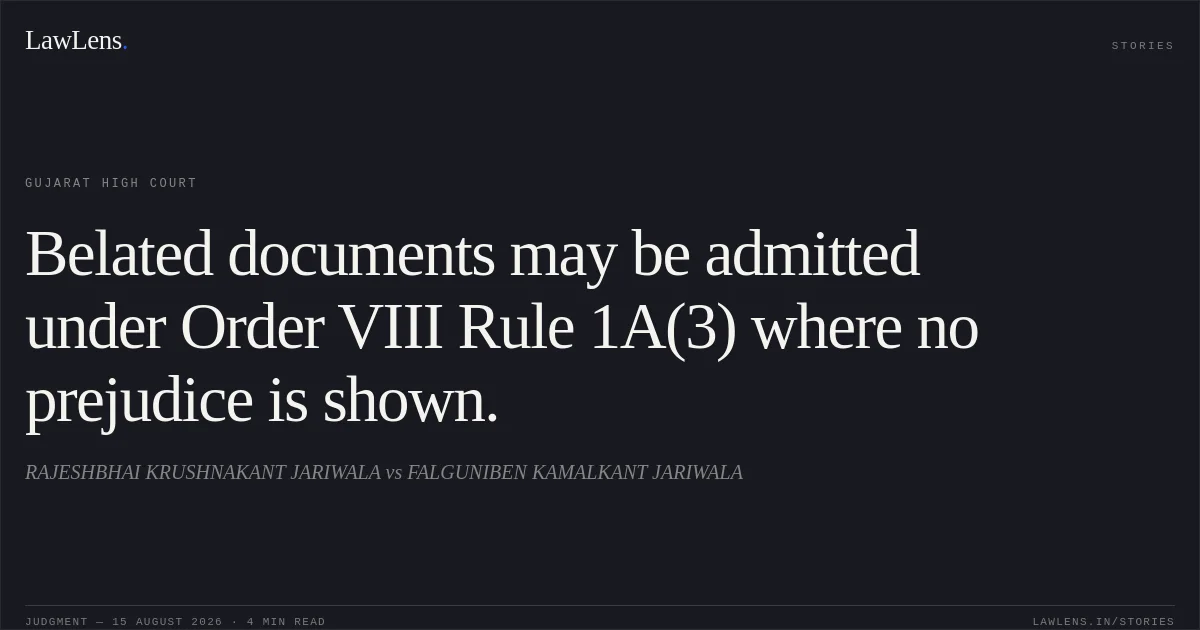
The Court applied Order VIII Rule 1A(1) and (3) of the Code of Civil Procedure, 1908, under which a defendant is ordinarily required to produce documents relied upon in support of the defence with the written statement, but may subsequently produce them with the leave of the court.
Source reference: para. 12The discretion to grant such leave must be exercised judicially, particularly where a good cause is shown and production does not seriously prejudice the opposite party.
Source reference: para. 12The Court relied principally on Sugandhi (Dead) v. P. Rajkumar, (2020) 10 SCC 706, which held that procedural and technical requirements should not obstruct substantial justice and that courts should adopt a lenient approach to applications under Order VIII Rule 1A(3) CPC where the truth can thereby be better ascertained.
Source reference: para. 12It also applied the principle that procedure is the handmaid of justice and that courts should avoid a hyper-technical approach.
Source reference: paras. 10, 12–13Under Article 227 of the Constitution, the High Court may interfere where a subordinate court commits a jurisdictional error or fails to exercise jurisdiction vested in it; the Court referred to Waryam Singh v. Amarnath, AIR 1954 SC 215, and Bhudev Mallick v. Ghoshal, 2025 SCC OnLine SC 360.
Source reference: para. 19Reasoning
The High Court held that although the defendants had failed to comply with the original fifteen-day direction, the default occurred against the backdrop of the COVID-19 lockdown and there was no finding of deliberate or intentional delay.
Source reference: para. 9The application was filed before the commencement of the defendants’ evidence, giving the plaintiffs an opportunity to cross-examine the defendants and their witnesses on the documents and to object to their relevance and admissibility.
Source reference: para. 15The Court also noted that the plaintiffs themselves had been permitted to introduce documents near the completion of their evidence through Exhibit 300, weakening their objection based solely on timing.
Source reference: paras. 3.7, 16Since the plaintiffs did not allege that the documents were fabricated or otherwise unreliable, exclusion of the documents would have unduly foreclosed the defendants’ opportunity to place potentially relevant evidence before the court.
Source reference: para. 17The trial court possessed discretion under Order VIII Rule 1A(3) CPC and could have imposed appropriate conditions instead of rejecting the application outright.
Source reference: paras. 9, 11, 18Its failure to exercise that discretion constituted a procedural and jurisdictional error warranting interference under Article 227.
Source reference: para. 19Holding
The High Court answered the issues in favour of the defendants.
It held that the trial court had acted erroneously in rejecting the application under Exhibit 341 and had failed to properly exercise its jurisdiction under Order VIII Rule 1A(3) CPC.
Source reference: paras. 18–19The impugned order dated 8 December 2021 was quashed and set aside, and the defendants’ application was allowed.
Source reference: para. 20The trial court was directed to permit production of the documents by a separate list, while preserving the plaintiffs’ right to object to their relevance and admissibility and to cross-examine the defendants and their witnesses.
Source reference: paras. 20.1–20.2The petition was accordingly allowed, the rule was made absolute to that extent, and no costs were imposed.
Source reference: para. 21The subsequent request to suspend the judgment for two weeks was refused in view of the age of the suit and the Supreme Court’s directions for expeditious disposal.
Source reference: no citationOriginal Court PDF
RAJESHBHAI KRUSHNAKANT JARIWALAvsFALGUNIBEN KAMALKANT JARIWALA
Click to open original judgment
Original judgment, available to read, download and summarize on LawLens.in