01Facts
The appellant's father was granted occupancy rights over the subject land by the Land Tribunal in 1977
¶ 3.1On 09.06.1990, the appellant executed a General Power of Attorney (GPA) in favour of Respondent No. 5, which the appellant alleges was executed on a misconception
¶ 3.1An agreement of sale dated 14.06.1990 followed in favour of Respondent No. 7, a housing society
¶ 4Preliminary notification under Section 4(1) of the Land Acquisition Act, 1894 was issued on 09.07.1992, and final notification under Section 6(1) on 11.11.1992
¶ 4The appellant received compensation of ₹11,95,600/- and filed an affidavit stating satisfaction with the award amount
¶ 5, 8In 2004, he filed W.P. No. 3486/2004 seeking to quash the 1993 award; it was dismissed as withdrawn with liberty to approach the Civil Court and the LAO
¶ 9His son (Respondent No. 8) filed O.S. No. 35/2002 for partition, which was dismissed as to the subject property because it had been acquired; RFA No. 100098/2015 is pending
¶ 5 of single judge order, quoted in para. 11The son was also allotted a plot in the formed layout
¶ 10In 2016, the appellant filed W.P. No. 106990/2016 alleging fraud in the GPA and agreement of sale
¶ 3.2, 8The learned Single Judge dismissed the petition, noting the fraud plea was raised for the first time after more than 12 years, the GPA was never cancelled, and no civil proceedings were initiated. The Single Judge described the petition as a "classic case of abuse of process" but refrained from imposing costs
¶ 11The appellant then filed this appeal
¶ 3.2, 1102Issues
i.1. Whether the plea of fraud in the execution of the GPA dated 09.06.1990 and the agreement of sale dated 14.06.1990, raised for the first time in 2016, can be entertained to challenge the 1992 acquisition notifications and award
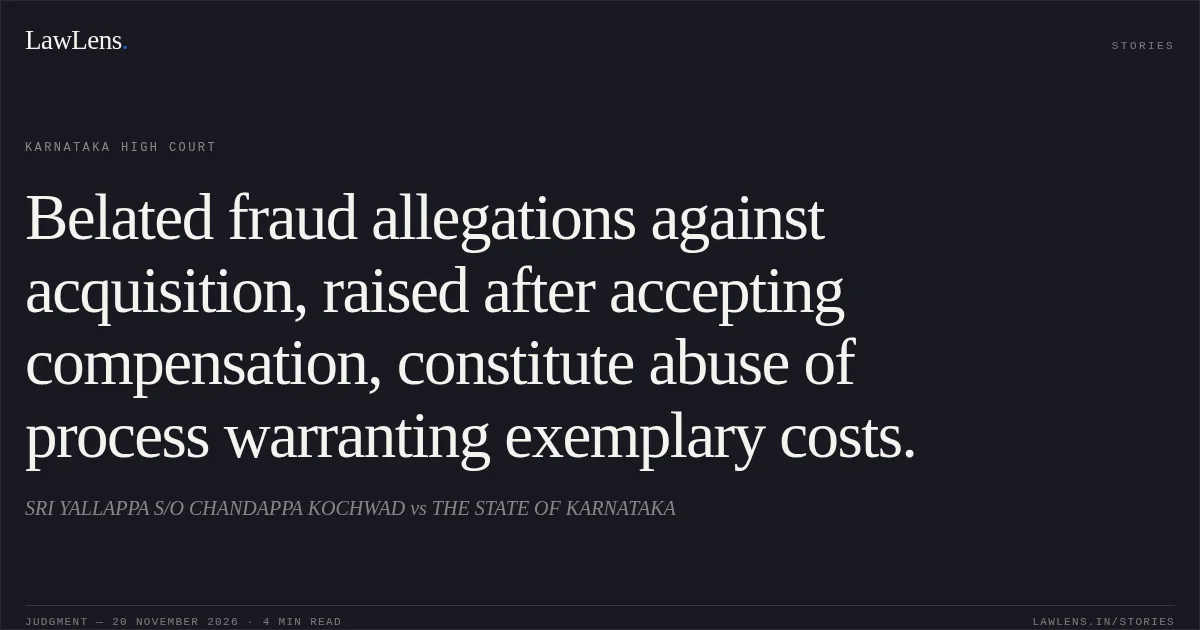
¶ 8, 11ii.2. Whether the writ petition, filed after about 24 years of acquisition and after the appellant's acceptance of compensation and earlier withdrawal of a challenge, constitutes an abuse of process warranting exemplary costs
¶ 8–11iii.3. Whether the appeal, which reiterates the contentions rejected by the Single Judge, should be dismissed with costs rather than dismissed simpliciter
¶ 12–1303Law Applied
The Court's reasoning rests on the Land Acquisition Act, 1894, specifically the Section 4(1) and Section 6(1) notifications that were challenged and the award passed under the Act
¶ 3.1, 8A party who has received compensation and given an affidavit of satisfaction with the award cannot later repudiate the acquisition without explanation
¶ 5, 8The doctrine of delay and acquiescence: unexplained inordinate delay in raising a plea of fraud, particularly where the party had earlier withdrawn a challenge with liberty to pursue civil remedies, weighs against relief
¶ 8, 9, 11The non-cancellation of the GPA is relevant to the validity of the transaction it governs
¶ 9Litigative persistence and abuse of process must be deterred, and dismissal without costs would encourage such conduct
¶ 11, 12The appellant's contention that "fraud vitiates every solemn act" was advanced but not expressly adjudicated on its merits
¶ 4Provisions in the judgment · 3
Karnataka High Court Act, 1960 Section 4
Land Acquisition Act, 1894 Section 4Section 6
04Reasoning
The Court first reconstructed the chronology from the admitted record: the GPA and agreement of sale of 1990, the 1992 notifications, receipt of compensation, the 1993 affidavit of satisfaction, and the 2004 writ petition withdrawn with liberty
¶ 8–9The fraud plea surfaced only in 2016, about 12 years after the withdrawal and roughly 24 years after the acquisition, without any explanation or civil proceedings to set aside the GPA
¶ 8, 9, 11Applying the delay and acquiescence principles to these facts, the Court held that the belated allegation could not be used to unsettle a completed acquisition, especially where the appellant had accepted compensation and his son had taken a benefit in the layout formed on the land
¶ 8, 10The Court treated the writ petition as an attempt to relitigate matters already settled, which amounted to abuse of process
¶ 11, 12Rejecting the appeal without costs would reward persistence, so the Court imposed exemplary costs while dismissing the appeal
¶ 12The judgment does not separately analyse the merits of the fraud allegation, so the decision rests on delay, acquiescence and abuse of process rather than on a finding that fraud was or was not established
¶ 8, 11, 1305Holding
The belated plea of fraud, raised after an inordinate delay and after the appellant had accepted compensation and affirmed satisfaction with the award, could not be entertained, and the writ petition was an abuse of process
¶ 8–12The writ appeal was found to be without merit and was dismissed, but not simpliciter. The appellant was directed to pay exemplary costs of ₹50,000/- to the Karnataka State Legal Services Authority within four weeks of receiving a copy of the order
¶ 13Pending interlocutory applications, if any, stand disposed of as not calling for adjudication
¶ 14Original Court PDF
SRI YALLAPPA S/O CHANDAPPA KOCHWADvsTHE STATE OF KARNATAKA
Click to open original judgment
Original judgment, available to read, download and summarize on LawLens.in