01Facts
The land was granted to the original grantee in 1964 under the PTCL framework.
It was alienated by sale deed in 1992.
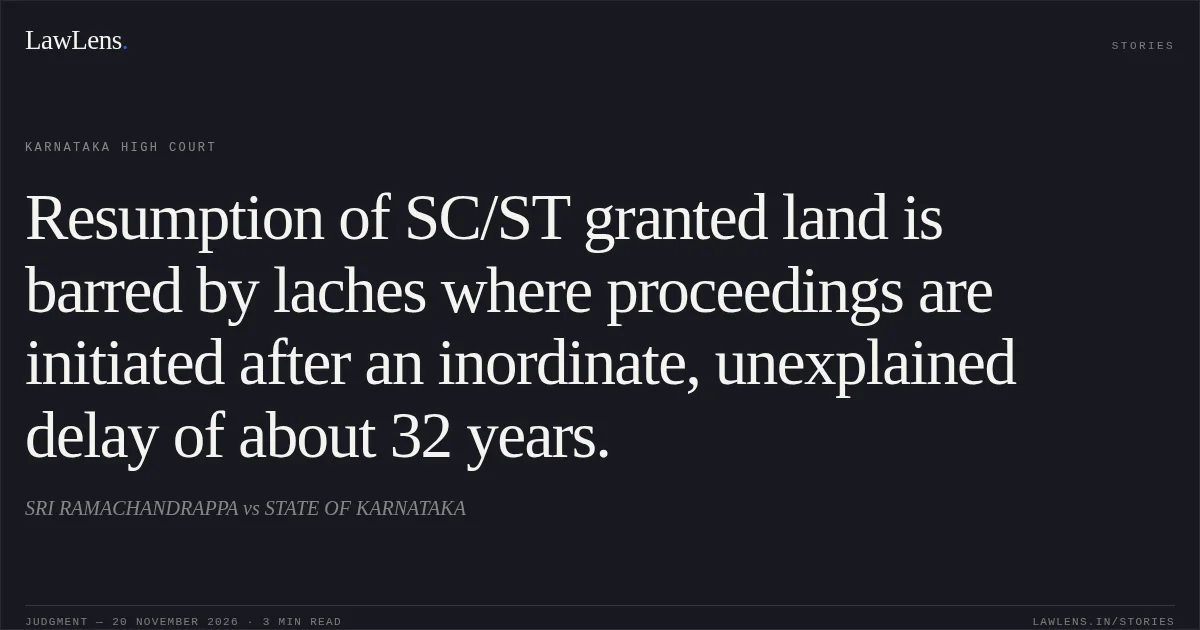
¶ 6Resumption proceedings were initiated only in 2024, about 32 years after alienation.
¶ 6The Assistant Commissioner allowed resumption by order dated 19.12.2024.
¶ 2 · ¶ 6The Deputy Commissioner affirmed that order in appeal by order dated 14.07.2025.
¶ 2 · ¶ 6The petitioner, who claims through the grantee's side, challenged both orders under Articles 226 and 227 of the Constitution.
¶ 2The petitioner specifically contended that the proceedings were initiated after an unreasonable and unexplained lapse of time.
¶ 6Respondent No. 5 argued that there was no laches because of a 2023 amendment to the Act, and that the resumption was justified by violation of the PTCL Act.
¶ 4The State's counsel sought appropriate orders.
¶ 4Neither authority examined delay or laches.
¶ 602Issues
i.1. Whether resumption proceedings initiated nearly 32 years after alienation of granted land are barred by delay and laches, and whether the authorities erred in failing to consider this contention.
¶ 6ii.2. Whether a grantee or his heirs who voluntarily executed a registered sale deed can invoke the PTCL Act to challenge and nullify that transaction, such that estoppel applies.
¶ 603Law Applied
The court relied on the Karnataka Scheduled Castes and Scheduled Tribes (Prohibition of Transfer of Certain Lands) Act, which protects SC/ST grantees by prohibiting alienation of granted lands without prior permission, and under which resumption is the remedy against unauthorised transfers.
¶ 6The court held that the Act's protection is intended to shield grantees from exploitation by others, not to allow a grantee to repudiate his own voluntary, registered sale deed; accordingly, estoppel operates against the grantee.
¶ 6The court applied the Division Bench principle that laches is a primary requirement in resumption proceedings, and that a restoration action filed after significant delay may be barred by laches.
The court applied the settled requirement that authorities must address a party's specific, material contentions before passing orders affecting rights in land.
¶ 604Reasoning
The court found that the Assistant Commissioner and Deputy Commissioner both failed to consider the nearly 32-year delay between the 1992 alienation and the 2024 initiation of resumption.
¶ 6Neither authority examined laches or addressed the petitioner's specific objection that the proceedings followed an unreasonable and unexplained lapse of time.
¶ 6The court observed that the rights in the land had been settled by the 1992 sale deed, which made the delay especially significant.
¶ 6The court also held that the grantee's voluntary registered sale deed limited the right to challenge the transaction under the Act, and that estoppel applied.
¶ 6Because these material aspects were not considered, the resumption orders were legally unsustainable.
¶ 6The judgment does not expressly decide respondent No. 5's argument regarding the 2023 amendment.
¶ 4 · ¶ 605Holding
Laches and estoppel are material considerations in PTCL resumption, and the failure to consider them renders resumption orders invalid.
¶ 6The writ petition is allowed. The writ of certiorari is issued quashing the Assistant Commissioner's order dated 19.12.2024 and the Deputy Commissioner's order dated 14.07.2025.
¶ 7 · ¶ 8The concerned authority is directed to mutate or restore the petitioner's name in the revenue records for the subject land.
¶ 8Interim orders stand discharged.
¶ 9The court did not remand the matter for fresh consideration.
¶ 8 · ¶ 9Original Court PDF
SRI RAMACHANDRAPPAvsSTATE OF KARNATAKA
Click to open original judgment
Original judgment, available to read, download and summarize on LawLens.in