Facts
The sixteen applicants were initially engaged as casual/seasonal laborers in 1998 and were subsequently converted to permanent daily wage workers on June 30, 2014.
Source reference: para. 15-16The applicants alleged that their wages for the period from 2014 to the end of 2018 were withheld by the respondents without justification.
Source reference: para. 17They contended that they made several representations, including one dated April 4, 2024, and received verbal assurances that their grievances would be addressed.
Source reference: para. 04, 20The applicants filed the present Miscellaneous Application (M.A.) seeking condonation of delay in filing the Original Application (O.A.) for the release of outstanding wages.
Source reference: para. 01The respondents opposed the application, arguing that the delay was not explained on a day-to-day basis and the claim was stale.
Source reference: para. 09-10Issues
1. Whether the applicants demonstrated "sufficient cause" under Section 21(3) of the Administrative Tribunals Act, 1985, to justify the condonation of an inordinate delay in filing the O.A.
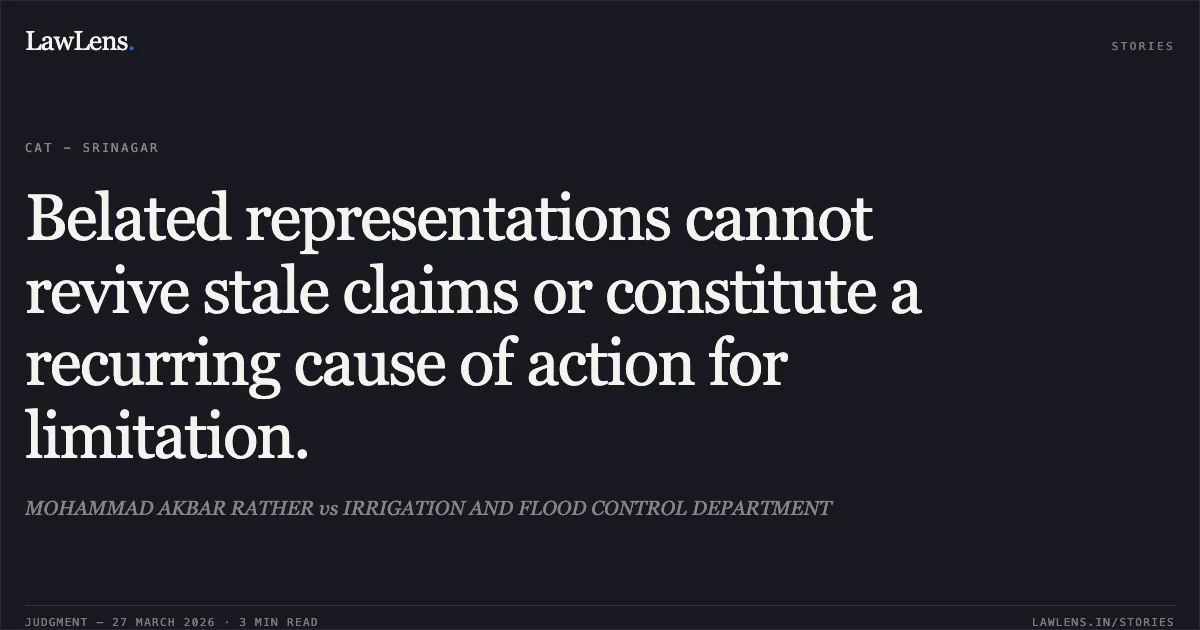
Source reference: para. 24, 322. Whether the non-payment of wages for a specific past period (2014–2018) constitutes a "recurring cause of action" that exempts the claim from the bar of limitation.
Source reference: para. 29-30Law Applied
The Tribunal applied Section 21 of the Administrative Tribunals Act, 1985, which mandates that applications must be filed within one year of a final order or within one year after the expiry of six months from the date of a representation.
Source reference: para. 22-24It relied on the Supreme Court precedents in C. Jacob v. Director of Geology and Mining, which held that belated representations do not revive a stale claim.
Source reference: para. 27Union of India v. M.K. Sarkar, which affirmed that stale claims cannot defeat the law of limitation through mere representations.
Source reference: para. 28It applied the principle from Union of India v. Tarsem Singh, distinguishing between a "continuing wrong" and the "continuing effect of a completed act," holding that a recurring cause of action does not apply to completed acts.
Source reference: para. 29It cited Naza Banoo v. State of J&K, emphasizing that the law favors the vigilant and courts should not assist the indolent.
Source reference: para. 31Reasoning
The Tribunal observed that the cause of action first accrued in 2014 and concluded by the end of 2018, yet the applicants waited until 2024 to file the O.A., resulting in a delay of six to ten years.
Source reference: para. 26The Tribunal found that the representation dated April 4, 2024, was itself submitted after an inordinate and unexplained delay and, per settled law, could not extend the limitation period.
Source reference: para. 26-27The Tribunal rejected the applicants' plea of a "recurring cause of action," reasoning that the withholding of wages for a specific duration (2014–2018) is a "one-time cause of action" or a "completed act," rather than a continuing wrong.
Source reference: para. 30-31It further noted the absence of any material evidence to support the claim that the applicants were "continuously and diligently" pursuing the matter or that verbal assurances were given.
Source reference: para. 26Consequently, the Tribunal determined that the applicants failed to provide a plausible or sufficient explanation for the delay.
Source reference: para. 32Holding
The Tribunal held that the applicants failed to demonstrate "sufficient cause" for the delay in filing the O.A.
Accordingly, M.A. No. 866/2024 for condonation of delay was dismissed.
Source reference: para. 32As a consequence of the delay not being condoned, the main O.A. No. 367/2024 was also dismissed as being ex facie barred by limitation.
Source reference: para. 32No order was made as to costs.
Source reference: para. 33Original Court PDF
MOHAMMAD AKBAR RATHERvsIRRIGATION AND FLOOD CONTROL DEPARTMENT
Click to open original judgment
Original judgment, available to read, download and summarize on LawLens.in