Facts
The dispute concerned land bearing Survey No. 129 at Isanpur, Ahmedabad. The Inamdar, Shah Alam Estate, granted non-agricultural permission for the land on 29 August 1969, followed by construction permission from the Isanpur Gram Panchayat on 19 October 1974.
Source reference: p. 2; para. 7Respondent No. 5, the original owner and occupant, first agreed to sell the property to Respondent Nos. 6 and 7 on 10 June 1993 and executed a registered sale deed on 16 July 1998, pursuant to which Mutation Entry No. 3023 was recorded.
Source reference: p. 3; para. 7Respondent Nos. 6 and 7 thereafter sold the property to the petitioners by registered sale deed dated 10 October 2005, leading to Mutation Entry No. 4400, which was mutated on 7 July 2012.
Source reference: p. 3; para. 7Respondent No. 5 challenged the mutation, alleging that the land was agricultural and had been transferred to non-agriculturists without requisite permission under the tenancy law.
Source reference: p. 3The City Deputy Collector rejected the challenge on 24 December 2013, and the Collector, Ahmedabad, affirmed that decision on 9 September 2014.
Source reference: p. 3In revision, the Special Secretary (Appeals), Revenue Department, allowed Respondent No. 5’s application by order dated 14 August 2017, setting aside the orders of the subordinate revenue authorities.
Source reference: paras. 2.2–2.3The petitioners challenged that revisional order under Articles 226 and 227 of the Constitution.
Source reference: no citationDuring the proceedings, Respondent No. 5 filed an affidavit stating that the dispute had been amicably settled and that he had no objection to restoration of the petitioners’ revenue entries.
Source reference: pp. 12–14; para. 4Issues
Whether the property was agricultural land subject to restrictions on transfer to non-agriculturists, or had already been validly converted into non-agricultural land before the disputed transactions?
Source reference: pp. 17–20; paras. 7–9Whether revenue authorities exercising powers in mutation/RTS proceedings could determine the validity of the sale transaction under Section 63 of the Gujarat Tenancy and Agricultural Lands Act, 1948, or were required to refer that question to the competent authority under the tenancy law?
Source reference: pp. 20–22; para. 11Whether the challenge to the mutation entries, initiated after an inordinate delay, could be entertained in view of the requirement that statutory and revisional powers be exercised within a reasonable period?
Source reference: pp. 19–20; para. 10Whether the Special Secretary (Appeals) was justified in interfering with the concurrent orders of the Deputy Collector and Collector and deciding the merits instead of remanding the matter after condoning the delay?
Source reference: p. 12; para. 3.13Law Applied
The Court applied the Gujarat Land Revenue Code and Rule 108 of the Gujarat Land Revenue Rules, under which RTS authorities possess limited jurisdiction to verify the correctness of revenue entries and cannot adjudicate the validity of a transaction under another enactment.
Source reference: pp. 20–22; para. 11Relying on Janardan D. Patel v. State of Gujarat, the Court held that a revenue authority in mutation proceedings cannot decide whether a transaction violates Section 63 of the Gujarat Tenancy and Agricultural Lands Act, 1948; such question must be referred to the authority competent under the Tenancy Act.
Source reference: pp. 20–22; para. 11Under State of Gujarat v. Patel Raghav Natha, statutory or revisional powers, even where no limitation is prescribed, must be exercised within a reasonable time; the Court also relied on the principles regarding “reasonable time” discussed in State of Gujarat v. Hussainbhai Satarbhai Meman.
Source reference: pp. 19–26; paras. 10–11The Court further applied the principle that a party cannot take advantage of its own wrong and that a vendor who executed the sale, accepted consideration, and allowed subsequent transactions cannot belatedly challenge the transaction to obtain an undue advantage.
Source reference: pp. 26–28; paras. 12–15It also relied on Narendrabhai Maganbhai Patel v. State of Gujarat for the proposition that even an allegedly void transaction cannot necessarily be annulled after a considerable lapse of time where third-party rights have accrued.
Source reference: pp. 26–28; para. 12Reasoning
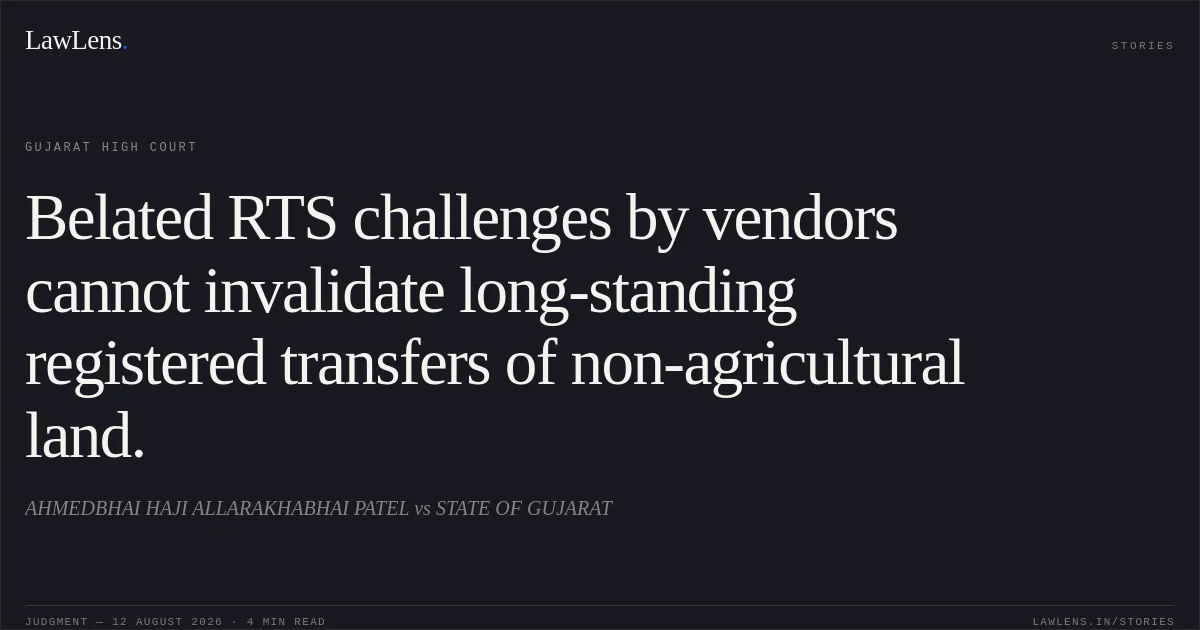
The Court found that the 1969 non-agricultural permission, the subsequent construction permission, the revenue record, and the recitals in the registered sale deed established that the land had been converted from agricultural to non-agricultural use before the relevant transfers.
Source reference: pp. 17–19; paras. 7–9Consequently, the restrictions applicable to agricultural land and transfers to non-agriculturists could not ordinarily be invoked against the transactions.
Source reference: pp. 17–19; paras. 7–9The Court further held that the RTS authorities had exceeded their limited jurisdiction by effectively examining the validity of the transaction under Section 63 of the Tenancy Act, a question reserved for the competent tenancy authority.
Source reference: pp. 20–22; para. 11Independently, the challenge was held to be grossly delayed: Respondent No. 5, who had himself executed the original sale deed and received the consideration, could not challenge the transaction after several years and after subsequent transfers had taken place.
Source reference: pp. 19–20, 26–28; paras. 10, 12–15The Special Secretary’s interference with the concurrent orders was therefore unjustified, particularly when the matter ought not to have been decided on merits in RTS proceedings after the issue of delay.
Source reference: p. 12; para. 3.13Holding
The Court allowed the petition and quashed and set aside the Special Secretary (Appeals), Revenue Department’s order dated 14 August 2017 in Revision Application No. MVV/HKP/AMD/333/2014.
The order dated 24 December 2013 passed by the City Deputy Collector, Ahmedabad, insofar as it concerned the petitioners, was restored and confirmed.
Source reference: para. 14The Court accordingly made the Rule absolute to that extent and directed that there would be no order as to costs.
Source reference: para. 14Acts & Sections Cited
3 provisions across 2 statutes referred to in this judgment. Each provision opens on LawLens.
Bombay Tenancy and Agricultural Lands Act-19482
Gujarat Prevention of Fragmentation and Consolidation of Holdings Act, 19471
Original Court PDF
AHMEDBHAI HAJI ALLARAKHABHAI PATELvsSTATE OF GUJARAT
Click to open original judgment
Original judgment, available to read, download and summarize on LawLens.in