Facts
The appellant was engaged as a Panchayat Shiksha Mitra on 18 February 2003 and joined on 25 February 2003. Her engagement was periodically extended, and she was subsequently recognised as a Panchayat Teacher under the 2006 framework.
Source reference: paras. 2, 18At the time of engagement, her school leaving certificate recorded her date of birth as 10 September 1984. However, her matriculation records maintained by the Bihar School Examination Board recorded her date of birth as 10 September 1986.
Source reference: paras. 3, 20A complaint was made in 2019 alleging irregular appointment. Although an official report noted the discrepancy and stated that correction proceedings were pending before the Board, the appellant’s salary was stopped in December 2021 pending verification.
Source reference: paras. 3–4, 19The Panchayat Employment Unit terminated her services on 26 August 2022, alleging that she had altered her date of birth to obtain employment. Her challenge before the State Appellate Authority was dismissed on 4 November 2022. The learned Single Judge dismissed her writ petition on 9 August 2023, holding that there was no illegality in the termination. The appellant preferred the present Letters Patent Appeal.
Source reference: paras. 5–6, 19Issues
1. Whether the appellant had fraudulently or by forgery obtained appointment as Panchayat Shiksha Mitra by relying on an incorrect date of birth?
Source reference: paras. 20–252. Whether the discrepancy between the date of birth in the school leaving certificate and the matriculation records justified termination of the appellant’s services after approximately nineteen years?
Source reference: paras. 23–263. Whether the termination order dated 26 August 2022 was contrary to the Bihar Panchayat Elementary School Service Rules, 2020?
Source reference: para. 244. If the matriculation date of birth—10 September 1986—were accepted, whether the appellant could continue in service for a maximum of forty-two years from the date of her initial appointment?
Source reference: para. 27Law Applied
The Court applied the Bihar Panchayat Elementary School Service (Appointment, Promotion, Transfer, Disciplinary Proceeding and Service Condition) Rules, 2020, particularly the provisions governing disciplinary action and service conditions, including Rule 13, and the provisions concerning the minimum age and maximum period of service under Rules 9 and 14.
Source reference: paras. 23–27It distinguished R. Vishwanathan Pillai v. State of Kerala, (2004) 2 SCC 105, which denies constitutional protection where appointment is obtained through fraud, forgery, or a forged caste certificate, because the present case did not involve a forged certificate or established fraud.
Source reference: paras. 21, 25The Court relied on Rajiawa Narayan Mishra v. Bihar Rajya Khadi Gramoudyog Board, 2006 (1) PLJR 410, and State of Bihar v. Birendra Kumar, LPA No. 426 of 2010, for the principle that an employee who entered service while below the prescribed age could remain in service for a maximum of forty-two years, rather than claim the benefit of the normal retirement age of sixty years.
Source reference: paras. 15–17, 27The Court also referred to Article 311 of the Constitution in holding that its protection was attracted in the absence of a fraudulent or forged appointment.
Source reference: paras. 21, 25Reasoning
The Court found that the school leaving certificate recording the appellant’s date of birth as 10 September 1984 was not shown to be forged or tampered with, while the Board itself had confirmed that the matriculation certificate recording 10 September 1986 was genuine.
Source reference: paras. 20–22, 26The coexistence of two dates of birth therefore constituted a bona fide dispute and did not establish that the appellant had deliberately altered a certificate or committed fraud to obtain appointment.
Source reference: paras. 21–24At most, acceptance of the 1984 date by the appointing authority could have resulted in an irregular appointment, since the appellant would otherwise have been below eighteen years of age in February 2003. However, the authorities had themselves allowed her to serve for nearly nineteen years and could not, without establishing fraud or forgery, impose the extreme penalty of termination at such a belated stage.
Source reference: para. 23The termination was also held contrary to the procedure and requirements of the 2020 Rules.
Source reference: para. 24Nevertheless, since the appellant relied on the 1986 date in the matriculation record, she could not claim the benefit of the 1984 date for retirement purposes and would be limited to forty-two years of service from her initial appointment.
Source reference: para. 27Holding
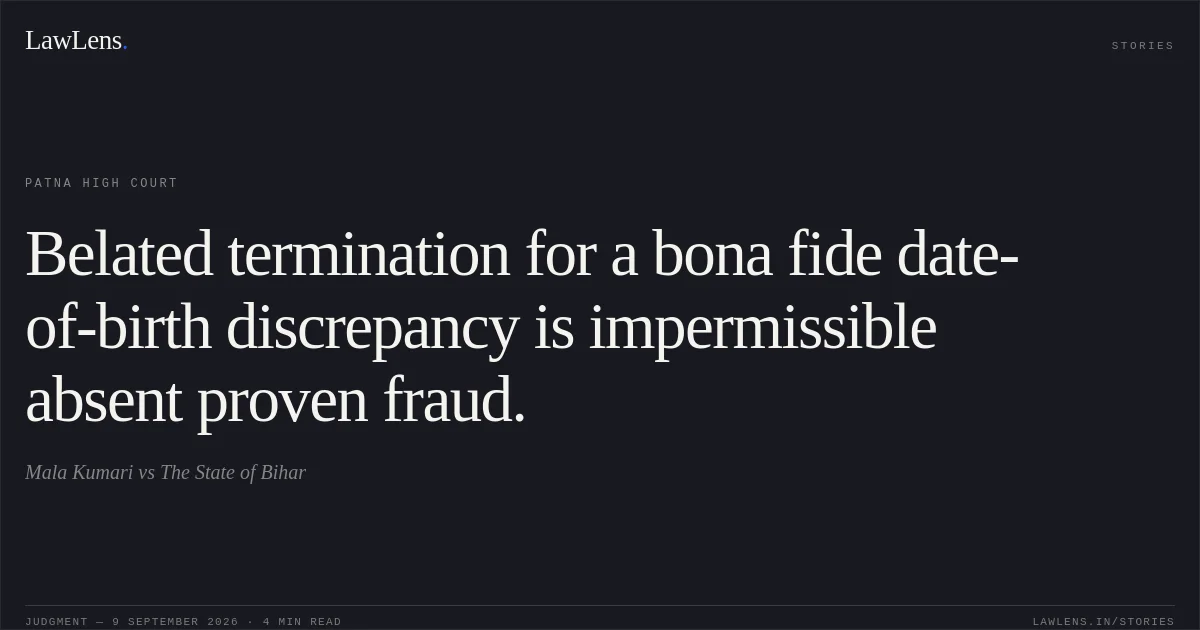
The Division Bench allowed the appeal and set aside the termination order dated 26 August 2022, the State Appellate Authority’s order dated 4 November 2022, and the Single Judge’s order dated 9 August 2023.
The Court held that the appellant had not been proved to have obtained employment through fraud or forgery and that termination after nineteen years was illegal and unsustainable.
Source reference: para. 28She was held entitled to back wages for the period during which she had worked.
Source reference: para. 28The Court further clarified that, treating 10 September 1986 as her operative date of birth for service purposes, she could remain in service for a maximum of forty-two years from 18 February 2003 and could not rely on the 10 September 1984 date recorded in the school leaving certificate.
Source reference: para. 27Original Court PDF
Mala KumarivsThe State of Bihar
Click to open original judgment
Original judgment, available to read, download and summarize on LawLens.in