Facts
M/s Eveready Industries India Ltd. manufactured primary cells and batteries classifiable under Heading 8506 10 00 of the Central Excise Tariff.
Source reference: p. 2It cleared identical batteries to two independent torch manufacturers, M/s PMS Flashmatics Pvt. Ltd., Haridwar and M/s Elin Electronics Ltd., Solan, at contractual prices under Section 4 of the Central Excise Act, 1944.
Source reference: p. 3The batteries were co-packed with torches manufactured according to Eveready’s specifications and the co-packed products were sold back exclusively to Eveready for onward sale.
Source reference: pp. 3–5, 18–22The Department alleged that the parties had mutuality of business interest and that the contractual prices were artificially low.
Source reference: pp. 3–6Two show-cause notices were issued for the periods November 2013–November 2014 and December 2014–March 2016, followed by a statement of demand for April 2016–June 2017.
Source reference: pp. 6–9The adjudicating authority confirmed the demands and imposed penalties. The Commissioner (Appeals) upheld the demands, while reducing part of the penalty in the first proceedings.
Source reference: pp. 8–10Issues
Whether the batteries cleared to PMS Flashmatics and Elin Electronics were assessable at the contractual transaction value under Section 4, or whether their value was required to be determined by reference to the cost of manufacture/CAS-4 value under the Central Excise Valuation Rules
Source reference: paras. 4.3–4.12; pp. 17–41Whether the contractual prices were affected by mutuality of interest or extra-commercial considerations arising from the buyback and co-packing arrangements
Source reference: paras. 2.7–2.9, 4.4, 4.6–4.9; pp. 5–6, 17–22Whether the extended period of limitation under Section 11A(4) of the Central Excise Act was validly invoked
Source reference: paras. 4.13–4.15; pp. 41–42Whether interest and penalties under Section 11AC and Rule 15 of the CENVAT Credit Rules, 2004 were legally sustainable
Source reference: paras. 4.16–4.18; pp. 42–43Law Applied
Section 4 of the Central Excise Act permits assessment on transaction value only where the buyer is not a related person and the price is the sole consideration for the sale; where those conditions are not satisfied, valuation must be made under Section 4(1)(b) and the Central Excise Valuation Rules.
Source reference: pp. 22–34Rule 4 of the Valuation Rules adopts the value of comparable goods sold nearest to the time of removal, while Rule 8 adopts 110% of the cost of production where goods are captively consumed or used on the assessee’s behalf.
Source reference: p. 17Relying principally on Commissioner of Central Excise, Mumbai v. Fiat India Pvt. Ltd., 2012 (283) E.L.T. 161 (S.C.), the Tribunal held that a persistently loss-making or artificially low price influenced by extra-commercial considerations may be rejected even without conclusively establishing that the buyer is a related person.
Source reference: pp. 22–41The Tribunal also applied the principle that extended limitation requires suppression or non-disclosure of material facts, and that penalty under Section 11AC requires the statutory conditions identified in Union of India v. Rajasthan Spinning & Weaving Mills Ltd., 2009 (238) E.L.T. 3 (S.C.).
Source reference: pp. 11–12, 41–43Rule 15 of the CENVAT Credit Rules applies to wrongful taking or utilisation of CENVAT credit and is not the proper penal provision for undervaluation of manufactured goods.
Source reference: p. 43Reasoning
The Tribunal found that the MOUs required PMS and Elin to manufacture torches according to Eveready’s specifications, co-pack them with Eveready’s batteries, affix Eveready’s branding, and sell the finished products only to Eveready.
Source reference: pp. 18–22Although the Tribunal considered it unnecessary to finally determine whether the parties were “related persons,” it held that the buyback arrangement demonstrated that the battery transactions were not ordinary arm’s-length sales.
Source reference: pp. 18–22The batteries were identical to those transferred to Eveready’s Lucknow unit, yet were sold to PMS and Elin at prices substantially below the CAS-4 cost-based values.
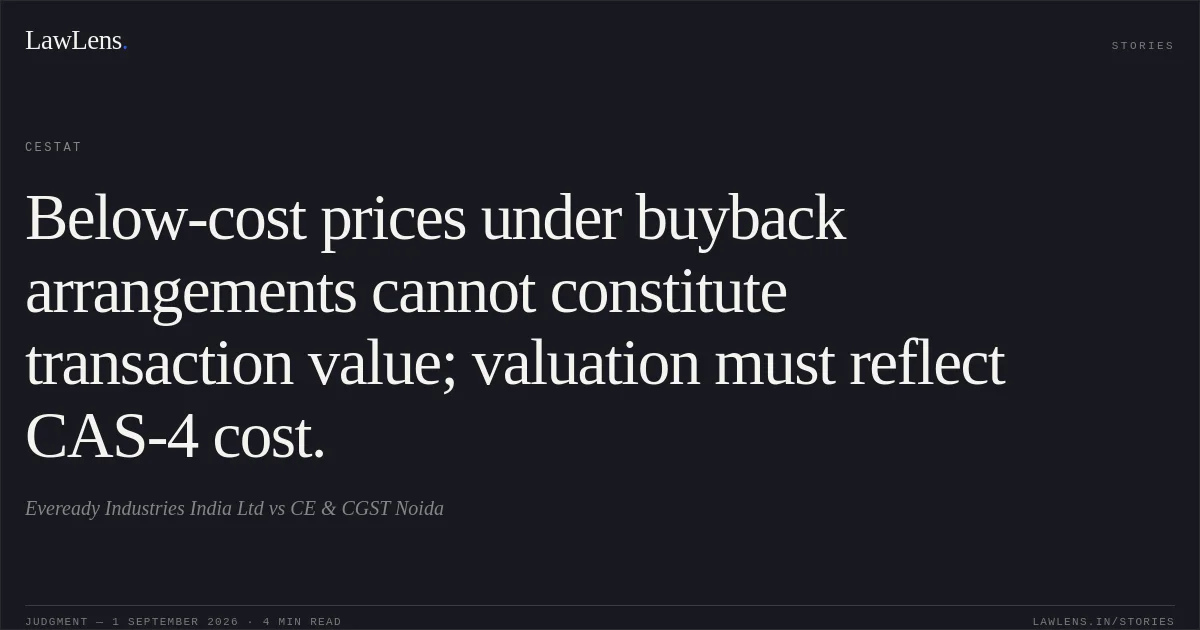
Source reference: paras. 4.8–4.12; pp. 21–41Applying Fiat India, the Tribunal concluded that a price below the cost of manufacture, maintained under a continuing buyback arrangement, could not be accepted as the true assessable value because it was not the result of purely commercial considerations.
Source reference: paras. 4.8–4.12; pp. 21–41The CAS-4-based valuation and corresponding normal-period demands were therefore sustained.
Source reference: paras. 4.8–4.12; pp. 21–41However, Eveready was registered, had filed the prescribed returns, and the relevant agreements and transactions were available to the Department; consequently, the Department could not establish suppression sufficient to invoke the extended period.
Source reference: paras. 4.13–4.15; pp. 41–42The Tribunal further held that interest followed the valid confirmation of duty, but the penalties were unsustainable because Section 11AC was not properly attracted and Rule 15 of the CENVAT Credit Rules had been invoked for conduct unrelated to wrongful CENVAT credit.
Source reference: paras. 4.16–4.17; p. 43Holding
The appeals were partly allowed.
The Tribunal upheld the CAS-4/cost-based valuation and the duty demands falling within the normal limitation period, together with applicable interest.
Source reference: para. 4.18; pp. 42–43The demand for November 2013–November 2014, raised by invoking the extended period, was set aside as time-barred.
Source reference: para. 4.14The demands for December 2014–March 2016 and April 2016–June 2017 were upheld as within the normal limitation period.
Source reference: para. 4.15All penalties imposed under Section 11AC—including those imposed by reference to Rule 15 of the CENVAT Credit Rules—were set aside.
Source reference: paras. 4.16–4.18Acts & Sections Cited
4 provisions across 3 statutes referred to in this judgment. Each provision opens on LawLens.
Central Excise Act, 19442
Customs Act,19621
Indian Contract Act, 18721
Original Court PDF
Eveready Industries India LtdvsCE & CGST Noida
Click to open original judgment
Original judgment, available to read, download and summarize on LawLens.in