Facts
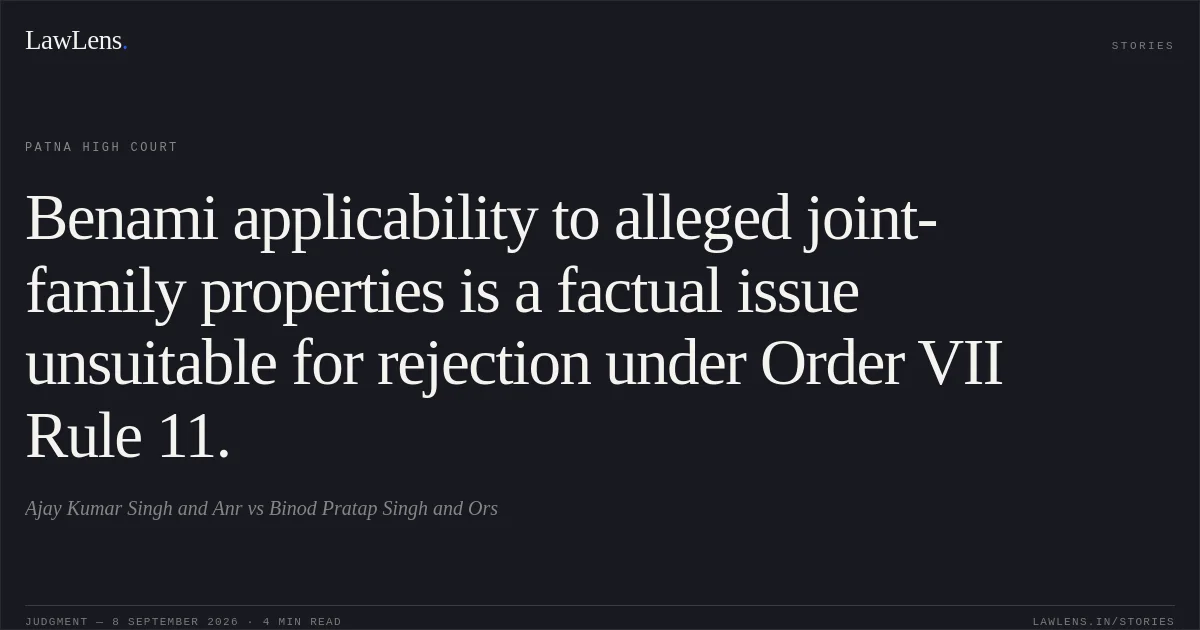
Respondent No. 1, Binod Pratap Singh, instituted Partition Suit No. 68 of 2013, subsequently renumbered as Partition Suit No. 146 of 2017, claiming a 1/5th share in various immovable and movable properties.
Source reference: pp. 2–3, paras. 3–4He pleaded that the properties were joint family properties, comprising ancestral properties and properties purchased in the names of different family members out of joint family funds, and alleged mismanagement of the joint family properties by one of the defendants.
Source reference: pp. 2–3, paras. 3–4The present petitioners, arrayed as defendant Nos. 3 and 6, sought rejection of the plaint under Order VII Rule 11(a) and (d) of the Code of Civil Procedure, 1908 (“CPC”), contending that properties standing in the names of the wives of the family members could not constitute coparcenary property, that the suit was not maintainable without a declaration of title and proper court fee, and that the claim was barred by the Benami Transactions (Prohibition) Act, 1988.
Source reference: pp. 3–4, paras. 4–5The Trial Court rejected the application, holding that the plaint disclosed a cause of action and that the issues concerning the nature of the properties, court fee, concealment of facts and applicability of the Benami Act required adjudication on evidence.
Source reference: pp. 3–5, para. 5Issues
Whether the Trial Court was justified in rejecting the petitioners’ application under Order VII Rule 11(a) and (d) CPC for rejection of the plaint?
Source reference: p. 7, para. 11Whether the plaint, read as a whole and accepting its averments as true, disclosed a cause of action for partition?
Source reference: pp. 7–13, paras. 12–16Whether the suit was ex facie barred by the Benami Transactions (Prohibition) Act, 1988 merely because certain properties stood in the names of female family members?
Source reference: pp. 16–19, paras. 22–23Whether disputes regarding the properties’ joint-family character, the necessity of a declaration of title and court-fee valuation could justify rejection of the plaint at the threshold?
Source reference: pp. 14–16, paras. 17–20Law Applied
Order VII Rule 11(a) and (d) CPC mandates rejection of a plaint that does not disclose a cause of action or is barred by law; however, the court must examine the plaint as a whole, assume its material averments to be correct, and ordinarily cannot consider the defence or conduct a mini-trial.
Source reference: pp. 7–13, paras. 12–16; Dahiben v. Arvindbhai Kalyanji Bhanusali, (2020) 7 SCC 366A plaint cannot ordinarily be rejected in part; if it survives against any defendant or property, the suit as a whole must proceed.
Source reference: p. 13, para. 16; Sejal Glass Ltd. v. Navilan Merchants Pvt. Ltd., (2018) 11 SCC 780; Madhav Prasad Aggarwal v. Axis Bank Ltd., (2019) 7 SCC 158; Kum. Geetha v. Nanjundaswamy, (2024) 14 SCC 390A partition claim concerning properties standing in the names of persons outside the coparcenary may involve a declaration of title and consequential relief, with corresponding court-fee consequences, but such matters do not warrant rejection under Order VII Rule 11 where factual adjudication is necessary.
Source reference: p. 14, para. 17; Kaulasan @ Bhola v. Ramdut, AIR 1951 Pat 633Section 4 of the Benami Transactions (Prohibition) Act bars suits concerning property held benami, but whether a property is benami and whether any statutory exception applies are ordinarily factual questions requiring evidence.
Source reference: pp. 17–19, para. 23; Shaifali Gupta v. Vidya Devi Gupta, 2025 SCC OnLine SC 1181Section 14 of the Hindu Succession Act, 1956, which recognises a female Hindu’s full ownership of property possessed by her, does not itself bar a suit concerning such property.
Source reference: p. 19, para. 23Reasoning
The plaint alleged that the disputed properties were joint family properties acquired from ancestral property or joint family funds and that the plaintiff was entitled to a share therein.
Source reference: pp. 2–3, paras. 3–4These averments, taken as true for the purposes of Order VII Rule 11, disclosed a triable cause of action.
Source reference: pp. 10–13, paras. 14–16, 20The petitioners’ contention that the wives were not coparceners and that properties standing in their names could not be partitioned raised questions concerning the source of acquisition, the existence of a joint-family nucleus and the true character of the properties.
Source reference: pp. 10–13, paras. 14–16, 20Those questions could not be resolved solely from the plaint or on the basis of the defence.
Source reference: pp. 10–13, paras. 14–16, 20Similarly, the assertion that the suit was barred by the Benami Act was not apparent on the face of the plaint.
Source reference: pp. 16–19, paras. 22–23The plaintiff described the properties as joint family properties rather than expressly pleading a prohibited benami arrangement.
Source reference: pp. 16–19, paras. 22–23Whether the properties fell within the statutory definition of a benami transaction, or within an exception, required evidence and could be considered at trial.
Source reference: pp. 16–19, paras. 22–23The objections concerning declaration of title and court fees also did not justify rejection because they were connected with disputed factual and legal questions and could be addressed through appropriate issues or procedural directions during the suit.
Source reference: pp. 14–16, paras. 17–20Since the plaint disclosed a surviving partition claim, it could not be rejected only with respect to particular properties or defendants.
Source reference: p. 13, para. 16Holding
The High Court held that the plaint disclosed a cause of action and was not ex facie barred by the Benami Transactions (Prohibition) Act or any other law.
The questions concerning the joint-family character of the properties, the applicability of the Benami Act, court fees and the necessity of declaratory relief were left open for determination after the parties adduced evidence.
Source reference: pp. 19–20, paras. 23–24The civil revision was dismissed, the Trial Court’s order refusing rejection of the plaint under Order VII Rule 11(a) and (d) CPC was affirmed, and the parties were permitted to contest the suit on merits.
Source reference: p. 20, paras. 24–25The Trial Court was left free to frame and decide appropriate issues after evidence. There was no order as to costs.
Source reference: p. 20, paras. 24–25Acts & Sections Cited
3 provisions across 2 statutes referred to in this judgment. Each provision opens on LawLens.
Hindu Succession Act, 19561
Original Court PDF
Ajay Kumar Singh and AnrvsBinod Pratap Singh and Ors
Click to open original judgment
Original judgment, available to read, download and summarize on LawLens.in