Facts
The appellant is the widow of Late Vijay Kumar Toodu, a Sub-Inspector who died on 08.09.2003 in a naxalite bomb blast while on duty
Source reference: para. 4Following his death, the appellant was granted an ex-gratia payment of Rs. 10 lakhs and extraordinary family pension for seven years (2003–2010) under the then-prevailing Finance Department Letter dated 24.07.1979
Source reference: para. 5After the pension ceased in 2010, the appellant sought an extension until the date of her husband's notional retirement (2027), citing a subsequent Finance Department Resolution dated 12.11.2005
Source reference: para. 6Her representations were rejected by the State, and a learned Single Judge dismissed her writ petition (CWJC No. 22625 of 2019) on 10.01.2020, holding the 2005 Resolution inapplicable to her case
Source reference: para. 6-7Issues
1. Whether the Finance Department Resolution dated 12.11.2005 is prospective in operation or can be applied retrospectively to a death occurring in 2003?
Source reference: para. 122. Whether the appellant, having already received benefits under the 1984 scheme, is entitled to claim extended benefits under the 12.11.2005 Resolution?
Source reference: para. 12Law Applied
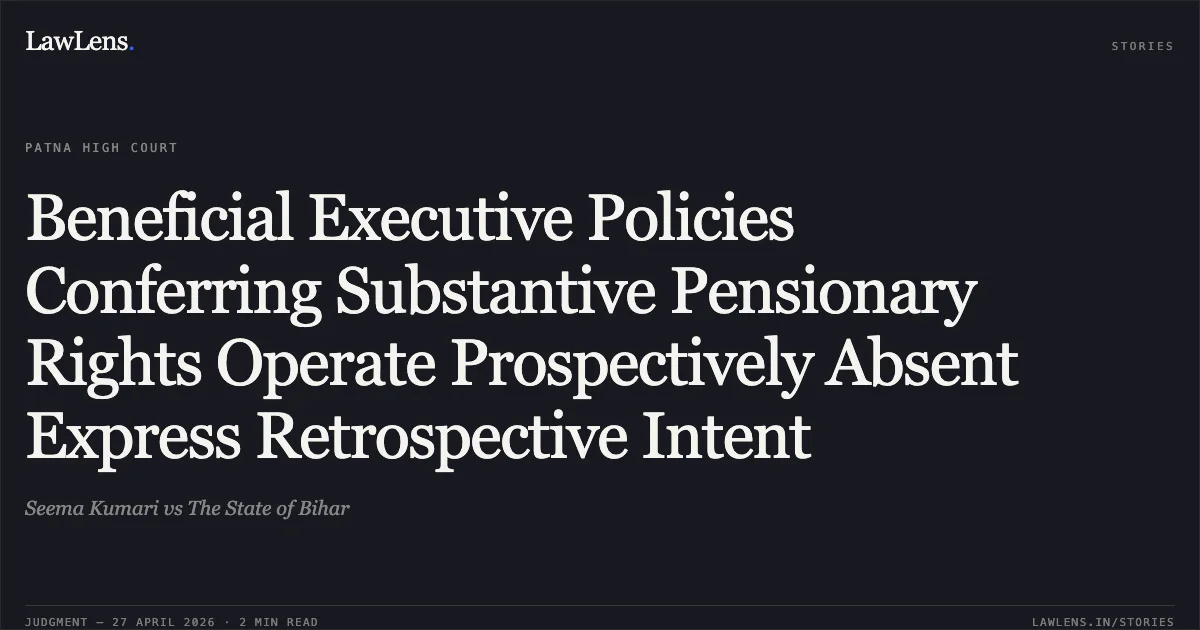
The Court applied the principle of lex prospicit non respicit (law looks forward, not backward), establishing that statutes or executive instructions affecting substantive rights are presumed prospective unless expressed otherwise
Source reference: para. 15It relied on CIT v. Vatika Township (P) Ltd. [(2015) 1 SCC 1], which held that legislation modifying substantive rights is presumed prospective
Source reference: para. 15regarding the prospective nature of substantive law. Regarding the classification of beneficiaries, the Court relied on Union of India v. P.N. Menon [(1994) 4 SCC 68], which validly permits cut-off dates based on financial and administrative constraints
Source reference: para. 16, 24Chandigarh Administration v. Jagjit Singh [(1995) 1 SCC 745], which clarifies that Article 14 does not envisage "negative equality"
Source reference: para. 25Reasoning
The Court reasoned that the 2005 Resolution was a policy decision with specific restrictive stipulations: it was effective from its date of issuance and Clause 7 limited its application to cases approved by a specific Committee on 15.06.2005
Source reference: para. 14The appellant’s rights crystallized in 2003 upon her husband's death and were governed by the policy then in force
Source reference: para. 17The Court rejected the argument for retrospective application based on "beneficial legislation," noting that executive intent was clearly prospective
Source reference: para. 18-20It found no discrimination or violation of Article 14, as the appellant's case had already been settled in 2003–2004 and thus did not fall within the zone of consideration for the 2005 Committee
Source reference: para. 23-26The Court emphasized that it cannot rewrite policy under the guise of interpretation to include beneficiaries the State chose to exclude
Source reference: para. 29Holding
The Court answered both issues in the negative, holding that the Resolution dated 12.11.2005 is prospective and the appellant is not entitled to its benefits as she does not satisfy the prescribed conditions
The Court upheld the Single Judge's order and dismissed the Letters Patent Appeal. However, it granted the appellant liberty to approach the competent authority via representation
Source reference: para. 30, 31Acts & Sections Cited
3 provisions across 3 statutes referred to in this judgment. Linked provisions open on LawLens.
Finance Department Resolution dated 12.11.20051
Finance Department Letter No. 7584 dated 24.07.19791
Finance Department Resolution dated 12.10.19841
Original Court PDF
Seema KumarivsThe State of Bihar
Click to open original judgment
Original judgment, available to read, download and summarize on LawLens.in