Facts
The appellants, whose son died in a road-traffic accident in 2012, sought compensation before the Motor Accident Claims Tribunal. The Tribunal awarded them ₹3,00,000 on 12 September 2014, which they received
Source reference: p. 5–6In 2024, they filed an appeal under Section 173(1) of the Motor Vehicles Act seeking enhancement, accompanied by an application under Section 5 of the Limitation Act to condone a stated delay of 2,615 days.
Source reference: p. 3–4They attributed the delay to bereavement, the second appellant’s depression and health problems, their lack of education and guidance, and their former counsel’s failure to inform them of the right to appeal.
Source reference: p. 4Respondent No. 2 opposed condonation, arguing that the explanation was vague and did not account for the intervening period.
Source reference: p. 4Issues
1. Whether the appellants established sufficient cause to condone the delay in filing the appeal
Source reference: p. 5Law Applied
Section 5 of the Limitation Act empowers a court to condone delay where sufficient cause is shown, but the discretion is not automatic; the explanation must be assessed for bona fides and adequacy.
Source reference: p. 9–11The Court relied on Thirunagalingam v. Lingeshwarn and another (Civil Appeal No. … of 2025, arising out of SLP(C) No. 17575 of 2023; case number incomplete in the judgment), including the principle that limitation cannot be extended on equitable grounds without a proper explanation.
Source reference: p. 6–9It also relied on Pathapati Subba Reddy (D) by L.Rs. & Ors. v. The Special Deputy Collector (LA), 2024 INSC 286, for the principles that limitation serves public policy, a liberal approach cannot defeat the statutory scheme, and even sufficient cause does not invariably require condonation where factors such as inordinate delay, negligence, or want of due diligence weigh against it.
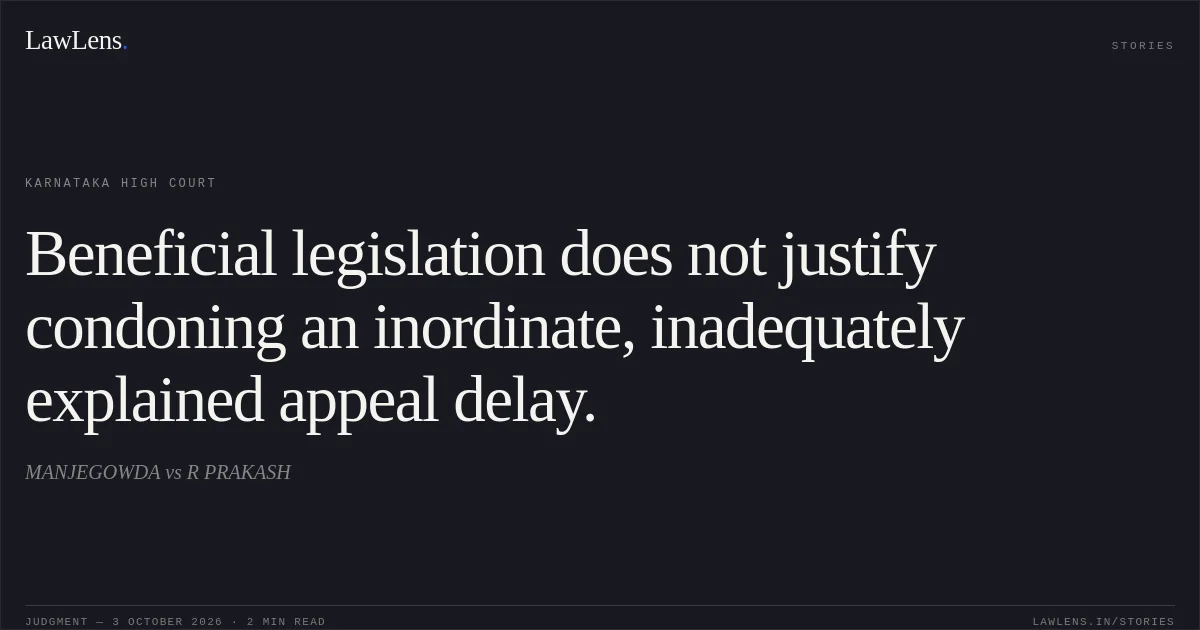
Source reference: p. 9–11The beneficial character of the Motor Vehicles Act does not, by itself, excuse unexplained delay.
Source reference: p. 12Reasoning
The Court found that the appellants had not provided a satisfactory account of the lengthy period between the Tribunal’s award and the 2024 appeal. Their assertions of shock, depression, health problems, and ignorance of the right to appeal were general and unsupported by medical records or other cogent material.
Source reference: p. 11–12The Court also considered that they had pursued the original claim through counsel and had received the compensation awarded, making their plea of ignorance insufficient to explain the prolonged inaction. It therefore held that the beneficial nature of the legislation could not substitute for proof of sufficient cause.
Source reference: p. 11–12Holding
The Court answered the issue in the negative, holding that the appellants had not satisfactorily explained the delay.
It dismissed I.A. No. 1/2024 seeking condonation of delay and, consequently, dismissed the appeal as barred by limitation.
Source reference: p. 13Acts & Sections Cited
3 provisions across 2 statutes referred to in this judgment. Each provision opens on LawLens.
Motor Vehicles Act, 19881
Original Court PDF
MANJEGOWDAvsR PRAKASH
Click to open original judgment
Original judgment, available to read, download and summarize on LawLens.in