Facts
The Appellant, a driver for the Bengaluru Metropolitan Transport Corporation (BMTC), was driving a bus on December 27, 2011, when it struck a pedestrian, Rangamma, who later succumbed to her injuries
Source reference: para. 3The Appellant failed to report the accident to the police
Source reference: para. 3The Trial Court convicted the Appellant under Sections 279 and 304-A of the IPC, and Sections 134(b) read with 187 of the Motor Vehicles Act (MVA)
Source reference: para. 2Upon revision, the High Court of Karnataka set aside the conviction under Section 279 IPC but sustained the conviction under Section 304-A IPC and the MVA provisions, reaffirming the sentence
Source reference: para. 2, 4The Appellant subsequently approached the Supreme Court seeking the benefit of probation
Source reference: para. 6Issues
Whether the Appellant is eligible to be released on probation under Section 3 of the Probation of Offenders Act, 1958, for a conviction under Section 304-A IPC and Sections 134(b) r/w 187 of the MVA
Source reference: para. 7Whether the conviction of the Appellant would result in a disqualification affecting his service career in view of the Probation of Offenders Act
Source reference: para. 8, 9Law Applied
Section 3 of the Probation of Offenders Act, 1958, which empowers the court to release an offender after due admonition if they are found guilty of an offence punishable with imprisonment of not more than two years
Source reference: para. 7Section 12 of the Probation of Offenders Act, 1958, which provides that a person dealt with under Section 3 or Section 4 of the Act shall not suffer disqualification attaching to a conviction
Source reference: para. 8Section 304-A of the IPC (causing death by negligence) and Sections 134 and 187 of the Motor Vehicles Act, 1988 (duties and punishments relating to accidents)
Source reference: para. 2Reasoning
The Court observed that the Appellant met the statutory prerequisites for probation because neither Section 304-A IPC nor Sections 134(b)/187 MVA prescribe a maximum punishment exceeding two years
Source reference: para. 7During the proceedings, the Appellant deposited ₹5,00,000/- as directed to compensate the victim's family, and the State/Respondent expressed no objection to the grant of probation provided this amount was released to the family
Source reference: para. 5, 6Given the Appellant’s employment and the nature of the sentence, it was appropriate to exercise power under Section 3 of the 1958 Act to release him after admonition
Source reference: para. 8the Court determined that the benefit of Section 12 must be extended to ensure that the conviction does not act as a disqualification for his continued service at BMTC
Source reference: para. 9Holding
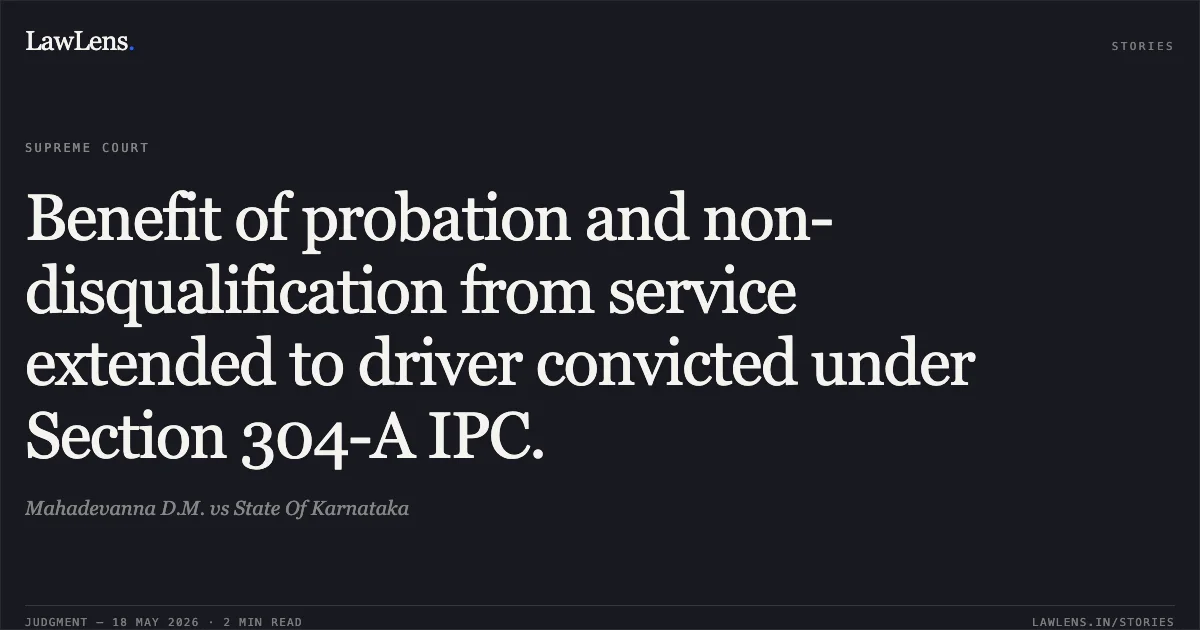
The Supreme Court confirmed the conviction but set aside the substantive sentence of imprisonment
It directed that the Appellant be released after due admonition under Section 3 of the Probation of Offenders Act
Source reference: para. 8The original fines were commuted to a total fine of ₹5,00,000/-, to be treated as compensation for the deceased's family
Source reference: para. 9, 10The Court held that per Section 12 of the 1958 Act, the conviction shall not be treated as a disqualification for the Appellant’s employment or service career
Source reference: para. 8, 9The appeal was disposed of accordingly
Source reference: para. 11Acts & Sections Cited
5 provisions across 3 statutes referred to in this judgment. Each provision opens on LawLens.
Indian Penal Code, 18601
Motor Vehicles Act, 19882
Probation of Offenders Act, 19582
Original Court PDF
Mahadevanna D.M.vsState Of Karnataka
Click to open original judgment
Original judgment, available to read, download and summarize on LawLens.in