Facts
The applicant was convicted by the 5th Senior Civil Judge & JMFC, Rajkot, in Criminal Case No. 11403 of 2005 for an offence under Section 138 of the Negotiable Instruments Act
Source reference: p. 1-2The trial court sentenced the applicant to six months of simple imprisonment and a fine of Rs. 5,000
Source reference: p. 2This judgment was upheld by the Additional Sessions Judge, Rajkot, in Criminal Appeal No. 03 of 2009
Source reference: p. 2During the pendency of the present revision application, the applicant deposited the cheque amount and served ten days of the sentence
Source reference: p. 2The applicant subsequently sought to quash the conviction or modify the sentence based on the payment and the quasi-criminal nature of the offence
Source reference: p. 2Issues
1. Whether the concurrent findings of the lower courts warrant interference under revisional jurisdiction when the cheque amount has been deposited during the pendency of the revision
Source reference: p. 2-32. Whether the applicant is entitled to the benefit of the Probation of Offenders Act, 1958, in light of the payment made to the complainant and the compensatory object of the Negotiable Instruments Act
Source reference: p. 3Law Applied
The court applied Section 138 of the Negotiable Instruments Act, noting its quasi-criminal character and its objective of ensuring payment rather than retribution
Source reference: p. 2The court exercised its revisional powers under Sections 397 and 401 of the Code of Criminal Procedure, 1973, while acknowledging the limited scope to re-analyze evidence where no perversity exists
Source reference: p. 2-3It further relied on Section 4 of the Probation of Offenders Act, 1958, regarding release on probation of good conduct
Source reference: p. 3Finally, the court followed the precedent set by the Hon’ble Supreme Court in Sanjabij Tari v. Kishore S. Borcar (2025 INSC 1158), which supports maintaining conviction while extending probation benefits upon payment of the cheque amount
Source reference: p. 3Reasoning
The court observed that while it found no perversity in the concurrent findings of the trial and appellate courts, the primary object of Section 138 of the NI Act is to promote the credibility of cheques and ensure payment rather than seek retribution
Source reference: p. 2The court noted that because the applicant had already deposited the cheque amount and undergone ten days of custody, the purpose of the Act was largely served
Source reference: p. 2In applying the Sanjabij Tari precedent, the court reasoned that it could maintain the conviction to uphold the legal finding of the lower courts while modifying the punishment to reflect the settlement between the parties
Source reference: p. 3Consequently, the court determined that the applicant was a fit candidate for probation rather than continued incarceration, provided he maintained peace and good conduct
Source reference: p. 3Holding
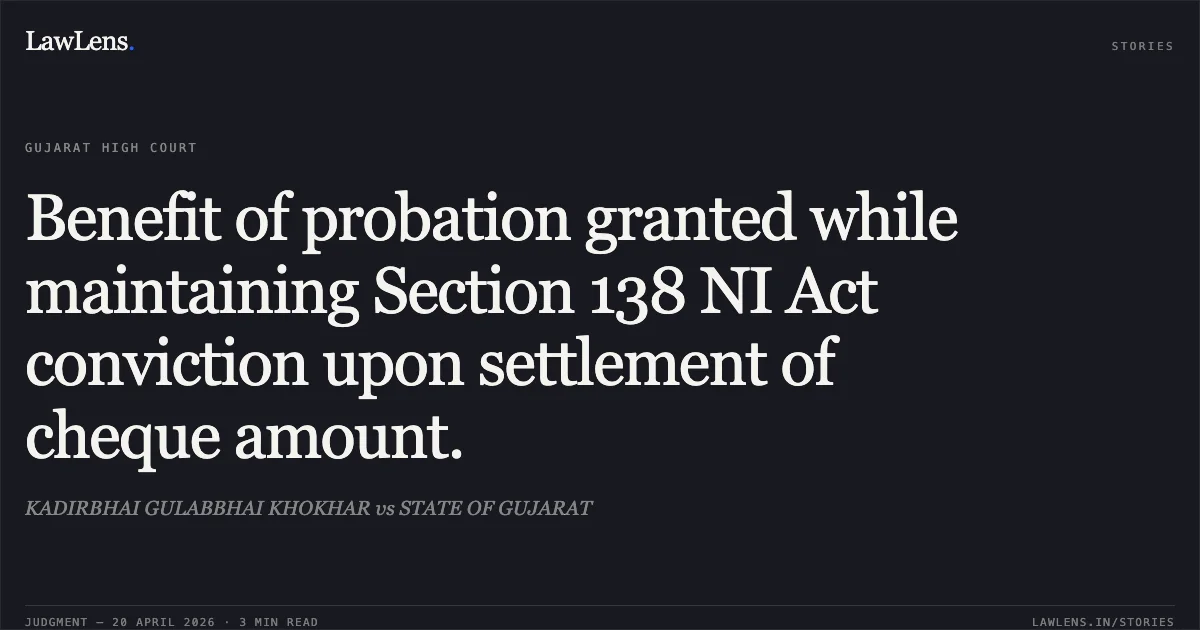
The High Court maintained the conviction but modified the sentence.
The court directed that the applicant be released on probation of good conduct under Section 4 of the Probation of Offenders Act for a period of six months
Source reference: p. 3This release is contingent upon the execution of a probation bond of Rs. 20,000 with one surety of like amount to be submitted to the trial court within 15 days
Source reference: p. 3-4The applicant is required to maintain peace and appear for sentencing if called upon during the probation period
Source reference: p. 3The revision application was disposed of accordingly
Source reference: p. 4Acts & Sections Cited
4 provisions across 3 statutes referred to in this judgment. Each provision opens on LawLens.
Code of Criminal Procedure, 19732
Negotiable Instruments Act, 18811
Probation of Offenders Act, 19581
Original Court PDF
KADIRBHAI GULABBHAI KHOKHARvsSTATE OF GUJARAT
Click to open original judgment
Original judgment, available to read, download and summarize on LawLens.in


