Facts
The petitioner challenged an order dated 11 August 2026 granting the fourth respondent a licence to conduct a fair/exhibition at an open ground in Whitefield from 10 to 25 October 2026 under Section 303(1)(l) of the Greater Bengaluru Governance Act, 2024.
Source reference: p. 3The petitioner relied on its earlier application, dated 16 January 2026, seeking permission to use the ground for the same period; the fourth respondent’s application was dated 10 June 2026
Source reference: p. 3–4The fourth respondent submitted that it had paid ₹1,19,080, commenced use of the ground, and incurred expenditure on infrastructure. The petitioner approached the Court on 5 October 2026
Source reference: p. 4–6Issues
Whether the third respondent’s grant of the licence, without an apparent process inviting and transparently considering applications, warranted judicial intervention
Source reference: p. 5–6Whether the third respondent had jurisdiction under Section 303 of the Act to issue the licence
Source reference: p. 5Whether relief should be granted despite the petitioner’s delay in approaching the Court after the licence had been issued and preparations had commenced
Source reference: p. 6Law Applied
The petition invoked Articles 226 and 227 of the Constitution, and the impugned licence was stated to have been issued under Section 303(1)(l) of the Greater Bengaluru Governance Act, 2024
Source reference: p. 3, 5The Court observed that, where a public facility is licensed, applications should be invited through published notice and considered transparently under guidelines disclosed in that notice; the exercise of power under Section 303 is also subject to the relevant delegation of authority
Source reference: p. 5–7The Court did not cite or apply any judicial precedent.
Source reference: no citationReasoning
The Court noted that the record did not refer to a published notice inviting applications, and observed that this could indicate the licence was not granted through an open and transparent process, with potential implications for public revenue. It also noted that the third respondent’s authority to issue the licence under Section 303 required examination
Source reference: p. 5–6However, the Court declined to grant relief against the existing licence because the petitioner waited until 5 October 2026 to approach the Court, after the fourth respondent had paid the fee and had the opportunity to mobilise resources and build infrastructure. The Court therefore left the merits of the licence and the jurisdictional question unresolved, while directing attention to proper procedure for future licences and examination of the third respondent’s authority
Source reference: p. 6–8Holding
The petition was disposed of without quashing the licence or granting the petitioner permission to use the ground
The petitioner was granted liberty to place the order before the third respondent and to return to the Court if the procedural observations were not followed. The petitioner could also place the order before the second respondent, who was called upon to instruct the Commissioner of the Bengaluru East City Corporation to examine the third respondent’s jurisdiction and ensure compliance with the Court’s observations on publishing notices inviting applications
Source reference: p. 7–8Acts & Sections Cited
2 provisions across 1 statute referred to in this judgment. Linked provisions open on LawLens.
Greater Bengaluru Governance Act, 20242
Original Court PDF
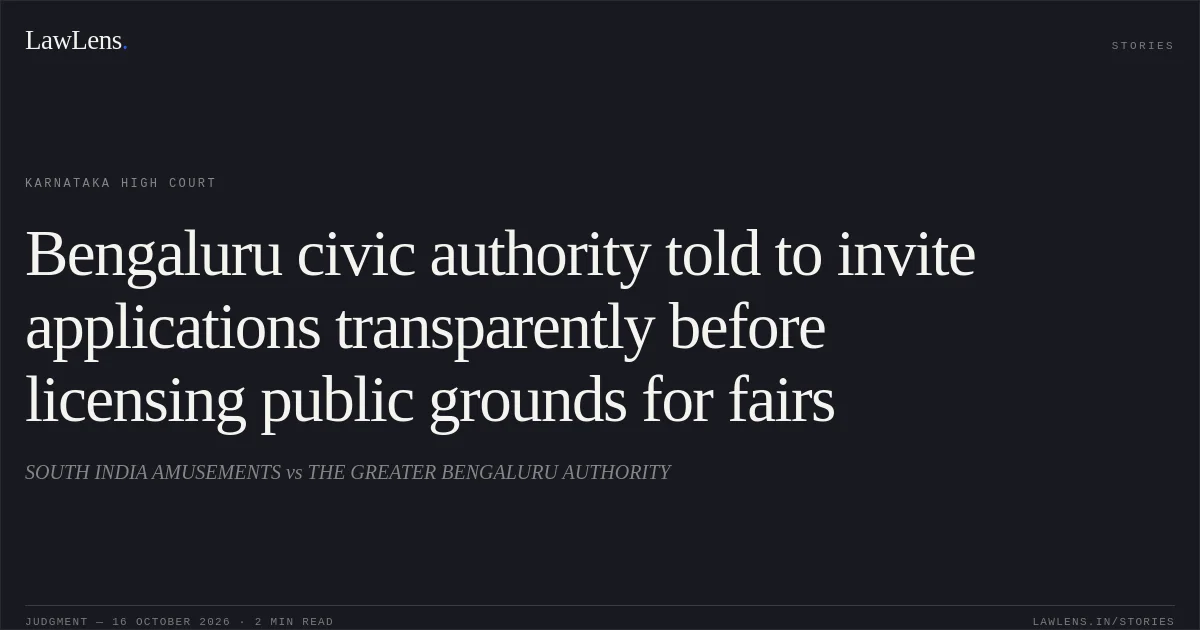
SOUTH INDIA AMUSEMENTSvsTHE GREATER BENGALURU AUTHORITY
Click to open original judgment
Original judgment, available to read, download and summarize on LawLens.in