Facts
On 24 June 2017, police intercepted a car carrying Billu, Mohammad Imtiyaj and another person after its driver fled.
Source reference: para. 3Police recovered 14 packets containing 77.470 kg of ganja from the car and seized the contraband.
Source reference: para. 3The seized material was deposited in the police malkhana, inventoried and sampled before an Executive Magistrate under Section 52A of the NDPS Act, and sample S-1 was confirmed as ganja by the FSL.
Source reference: para. 3, 15–17The Special Court convicted both appellants under Section 20(b)(ii)(C) of the NDPS Act and sentenced each to ten years’ rigorous imprisonment and a fine of ₹1,00,000.
Source reference: para. 2They appealed, challenging the reliability of the recovery and the post-seizure procedure, including discrepancies in the seal description, vehicle description, weight and number of samples; the independent witnesses had turned hostile.
Source reference: para. 5–7Issues
1. Whether recovery of 77.470 kg of ganja from the car in which the appellants were travelling was proved.
Source reference: para. 92. Whether the post-seizure procedure was duly followed and the chain of custody remained intact.
Source reference: para. 93. Whether the appellants’ convictions and sentences warranted interference.
Source reference: para. 9Law Applied
Section 20(b)(ii)(C) of the NDPS Act applies to an offence involving a commercial quantity of cannabis and prescribes a minimum sentence of ten years’ rigorous imprisonment and a fine of ₹1,00,000.
Source reference: para. 2, 23Section 52A provides for inventory and sampling procedures; the Court treated inventory and sampling before a Magistrate, supported by documentation and an intact chain of custody, as sufficient in the circumstances.
Source reference: para. 15–17The Court applied the principle in Rizwan Khan v. State of Chhattisgarh, (2020) 9 SCC 627, that police testimony is not to be rejected merely because the witnesses are police officers, and that hostile independent witnesses do not by themselves defeat the prosecution where official evidence is reliable.
Source reference: para. 14It distinguished Abdul Rajik v. State of M.P., 2026 SCC OnLine SC 1902, on the basis that samples there were not drawn before a Magistrate and lacked identifying marks.
Source reference: para. 19Reasoning
The Court found the recovery supported by the consistent evidence of the investigating officer and a police constable, and held that the hostile witnesses’ evidence did not contradict that account.
Source reference: para. 10–14It accepted that the contraband was deposited in the malkhana, inventoried and sampled before the Executive Magistrate, and that the FSL confirmed the sample as ganja, finding no unexplained break in the chain of custody.
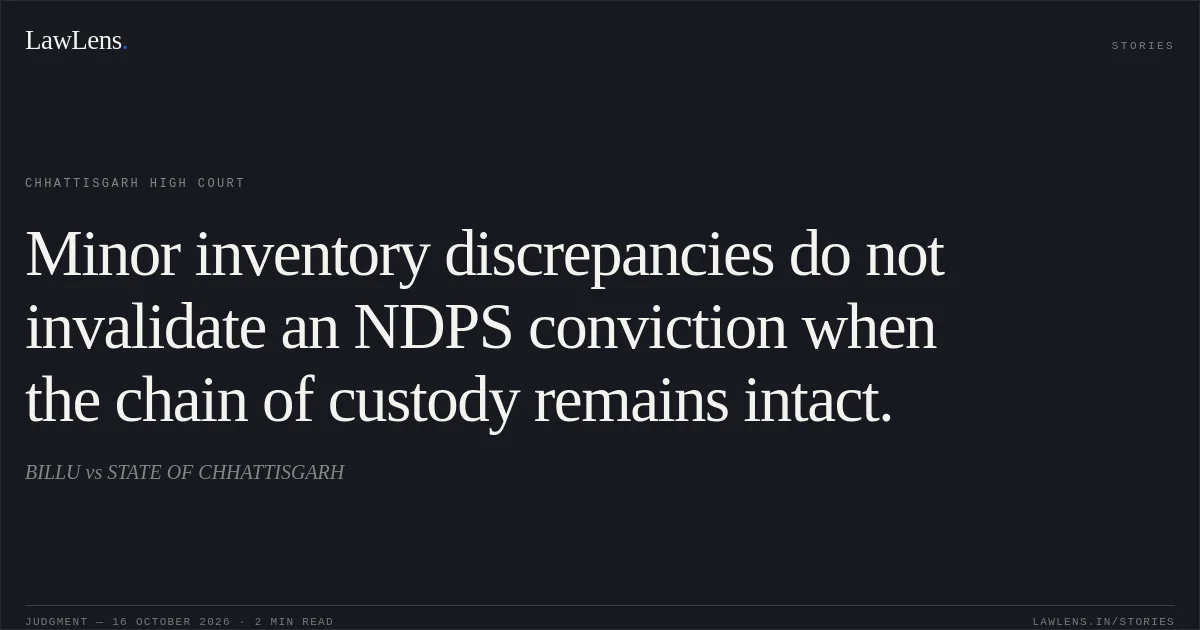
Source reference: para. 15–18It treated the discrepancies in the seal description and vehicle make, the unreduced 100 grams in the recorded weight, and the inconsistent reference to three samples as non-fatal, given the other evidence and the matching seal reported by the FSL.
Source reference: para. 20–21The appellants’ presence in the car containing the concealed packets, together with their failure to offer a plausible explanation, supported the Court’s finding of conscious possession.
Source reference: para. 22Holding
The High Court held that the prosecution proved the recovery and that the procedural discrepancies did not undermine the chain of custody or the convictions.
It dismissed both appeals and affirmed the convictions and sentences imposed on Billu and Mohammad Imtiyaz, noting that the trial court had imposed the statutory minimum sentence.
Source reference: para. 23–24Acts & Sections Cited
4 provisions across 2 statutes referred to in this judgment. Each provision opens on LawLens.
Narcotic Drugs and Psychotropic Substances Act, 19852
Code of Criminal Procedure, 19732
Original Court PDF
BILLUvsSTATE OF CHHATTISGARH
Click to open original judgment
Original judgment, available to read, download and summarize on LawLens.in