Facts
The appellant was convicted under Section 302 IPC for stabbing Bhim Singh in the abdomen with a dagger, causing his death.
Source reference: para. 1The prosecution relied on an eyewitness, PW-1 Sohan Lal, and a dying declaration recorded by an Executive Magistrate after a doctor certified the deceased fit to make a statement.
Source reference: para. 3–5A second named eyewitness, PW-2 Budh Pal, turned hostile.
Source reference: para. 7–8The appellant claimed that the fatal injury was accidental and occurred while he tried to disarm the deceased, who had attacked his father.
Source reference: para. 13, 16The Sessions Court convicted the appellant and sentenced him to life imprisonment; he appealed, challenging, among other matters, the dying declaration, the delayed recording of PW-1’s statement, and the rejection of his defence.
Source reference: para. 18, 20Issues
Whether the trial court committed legal error or perversity in convicting the appellant under Section 302 IPC on the evidence on record.
Source reference: para. 22Whether the dying declaration and eyewitness evidence were reliable despite the differences concerning how the deceased reached hospital, PW-2’s hostility, and the delay in recording PW-1’s statement.
Source reference: para. 20, 23, 28, 32–33Whether the appellant’s account of an accidental injury sustained while exercising private defence raised a basis to interfere with the conviction.
Source reference: para. 16, 20(iii), 31Law Applied
The Court considered Section 302 IPC and the law governing dying declarations under Section 32(1) of the Indian Evidence Act, 1872, referring also to Section 26 of the Bharatiya Sakshya Adhiniyam, 2023.
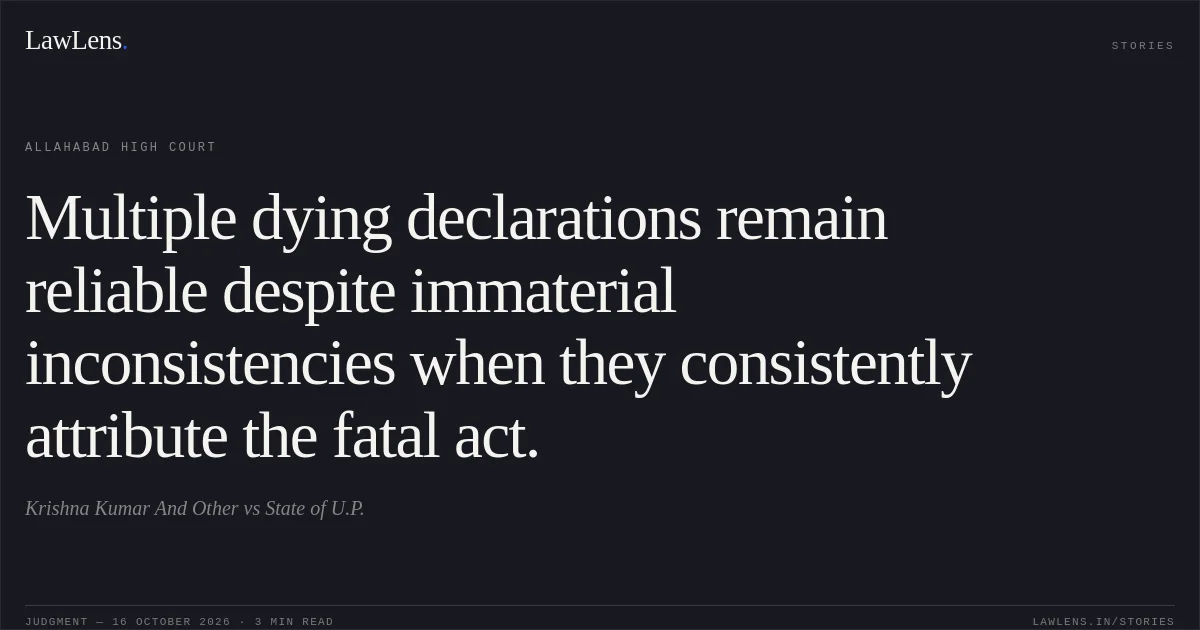
Source reference: para. 24–25It stated that a voluntary, truthful dying declaration made in a fit state of mind may, by itself, sustain a conviction; where there are multiple declarations, they require close scrutiny for material inconsistencies and coherence on the core facts.
Source reference: para. 24–25Relying on Mohan Lal Gangaram Gehani v. State of Maharashtra, the Court noted that an earlier statement is ordinarily preferred unless later statements are equally spontaneous and reliable.
Source reference: para. 26It applied the factors set out in Abhishek Sharma v. State (Govt. of NCT of Delhi), including voluntariness, fitness, materiality of inconsistencies, surrounding circumstances, and the possibility of tutoring.
Source reference: para. 27It further relied on Goutam Joardar v. State of W.B., Sunil Kumar v. State of Rajasthan, and V.K. Mishra v. State of Uttarakhand for the principle that delay in recording a witness statement is not fatal per se where it is explained and the substantive evidence is trustworthy.
Source reference: para. 33Reasoning
The Court found the dying declaration reliable because the Executive Magistrate recorded it after medical certification of the deceased’s fitness, read it back to him, and obtained his confirmation; the doctor also certified the deceased’s fitness after the statement was recorded.
Source reference: para. 29–30PW-1’s account corroborated the declaration on the central fact that the appellant inflicted the fatal abdominal blow, and the post-mortem findings supported the prosecution account.
Source reference: para. 31The Court treated the differing accounts of the deceased’s transport to hospital as peripheral rather than material to the identity of the assailant or the fatal act.
Source reference: para. 32It accepted the explanation that PW-1’s statement was recorded after the investigating officer changed, and held that the delay did not undermine otherwise reliable evidence.
Source reference: para. 33The Court also considered the defence account inconsistent with the medical evidence of multiple incised wounds on the deceased’s hand, which it regarded as defence wounds; it noted the absence of evidence that the appellant or his father had been injured.
Source reference: para. 31Holding
The Court held that the prosecution proved beyond reasonable doubt that the appellant inflicted the fatal dagger blow, and found no legal error or perversity in the trial court’s decision.
It dismissed the appeal and affirmed the conviction and sentence under Section 302 IPC.
Source reference: para. 35–38The appellant was directed to surrender to serve the remaining sentence; the Court also directed that the record be sent to the trial court and that the Amicus Curiae receive legal-aid fees of Rs. 30,000.
Source reference: para. 35–38Acts & Sections Cited
4 provisions across 3 statutes referred to in this judgment. Each provision opens on LawLens.
Indian Penal Code, 18601
Code of Criminal Procedure, 19732
Bharatiya Sakshya Adhiniyam, 20231
Original Court PDF
Krishna Kumar And OthervsState of U.P.
Click to open original judgment
Original judgment, available to read, download and summarize on LawLens.in