Facts
Ceiling proceedings concerning land originally held by four sons of Ch. Rasheed Uddin Ashraf were pursued principally against Ch. Azeem Uddin Ashraf, with the holdings treated together.
Source reference: para. 5After successive proceedings and remands, the Commissioner, by order dated 4 April 2025, directed the Prescribed Authority to determine each heir’s holdings separately, exclude pre-cut-off transfers and land within municipal limits, and issue separate notices where required.
Source reference: paras. 14–20The Prescribed Authority nevertheless declared 48-3-16 as surplus by order dated 13 October 2025.
Source reference: paras. 14–20Saeeda Fatima Ashraf challenged that order under Article 226; the State and respondent No. 4 objected on the grounds of an available statutory appeal and Radhey Shyam v. Chhabi Nath.
Source reference: paras. 19–20, 38Issues
Whether the writ petition under Article 226 was maintainable despite the appeal provided by Section 13 of the U.P. Imposition of Ceiling on Land Holdings Act, 1960, and the objection that the impugned order should be challenged only under Article 227.
Source reference: paras. 19–38Whether the Prescribed Authority’s order was unsustainable for failing to comply with the appellate remand directions and the requirements of the Ceiling Act.
Source reference: paras. 38–47Law Applied
Section 13 of the Ceiling Act provides a statutory appeal, but the alternative-remedy rule is one of discretion, not a bar to Article 226 jurisdiction; interference may be warranted, among other circumstances, where the authority has acted contrary to statute or fundamental procedural requirements (State of U.P. v. Mohammad Nooh; Whirlpool Corporation v. Registrar of Trade Marks; Commissioner of Income Tax v. Chhabil Dass Agarwal).
Source reference: para. 33Sections 3(13), 3(17), 11 and 12 govern the Prescribed Authority, tenure-holders and determination of surplus land; Section 37 confers civil-court powers and privileges for the statutory inquiry but does not make the Prescribed Authority a civil court.
Source reference: paras. 35–37, 41Under Radhey Shyam v. Chhabi Nath, judicial orders of civil courts are not amenable to certiorari under Article 226; the Court distinguished such orders from those of statutory authorities.
Source reference: paras. 27, 37A subordinate authority must act within the limits of a remand and give effect to determinations that have attained finality (K.P. Dwivedi v. State of U.P.).
Source reference: paras. 17, 39, 45Reasoning
The Court held that the Prescribed Authority was a statutory authority, not a civil court, so Radhey Shyam did not bar an Article 226 challenge.
Source reference: paras. 36–38Although a Section 13 appeal was available, the Court exercised its discretion because the impugned order allegedly disregarded specific remand directions and the matter had already undergone prolonged litigation.
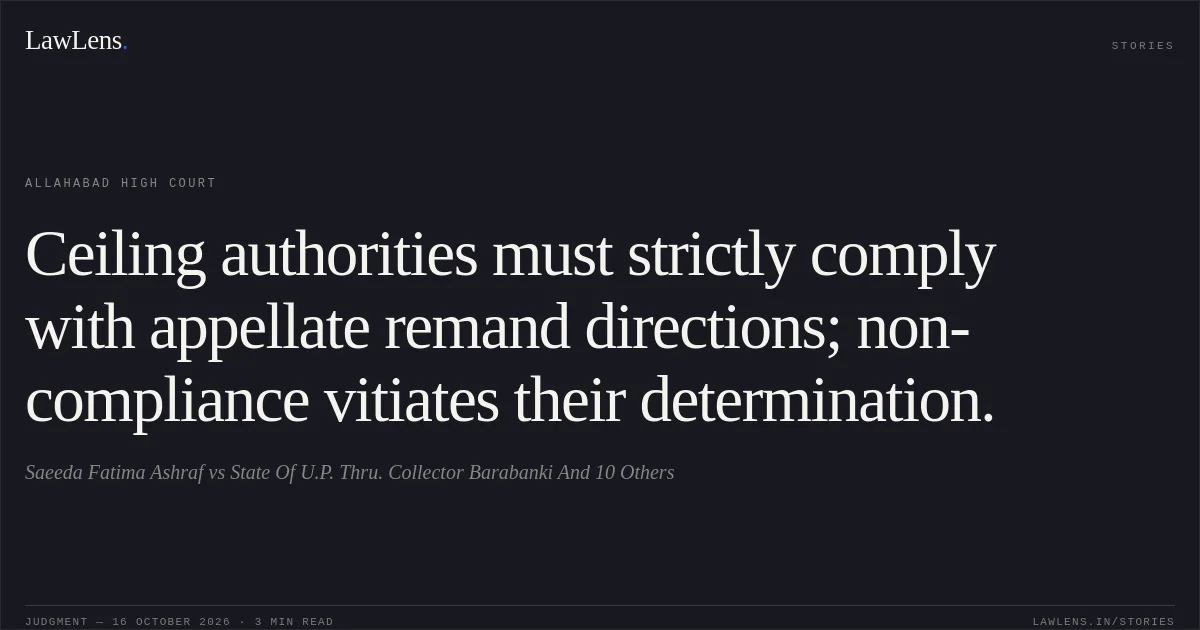
Source reference: paras. 38, 40, 47On the merits, it found that the remand required separate assessment of the four brothers’ holdings, exclusion of land transferred before the relevant cut-off and land within municipal limits, and separate notice where an individual’s holdings attracted the Act.
Source reference: paras. 41–46The Prescribed Authority’s failure to carry out those steps rendered the determination unsustainable and contrary to the binding remand directions.
Source reference: paras. 41–46Holding
The Court held the writ petition maintainable under Article 226 and allowed it.
It quashed the Prescribed Authority’s order dated 13 October 2025 and remanded the matter for fresh determination in accordance with law and the appellate remand directions.
Source reference: paras. 47–49The Prescribed Authority was directed to conclude the proceedings, preferably within six months of production of a certified copy of the judgment.
Source reference: paras. 47–49Acts & Sections Cited
1 provisions across 1 statute referred to in this judgment. Each provision opens on LawLens.
Code of Civil Procedure, 19081
Original Court PDF
Saeeda Fatima AshrafvsState Of U.P. Thru. Collector Barabanki And 10 Others
Click to open original judgment
Original judgment, available to read, download and summarize on LawLens.in