Facts
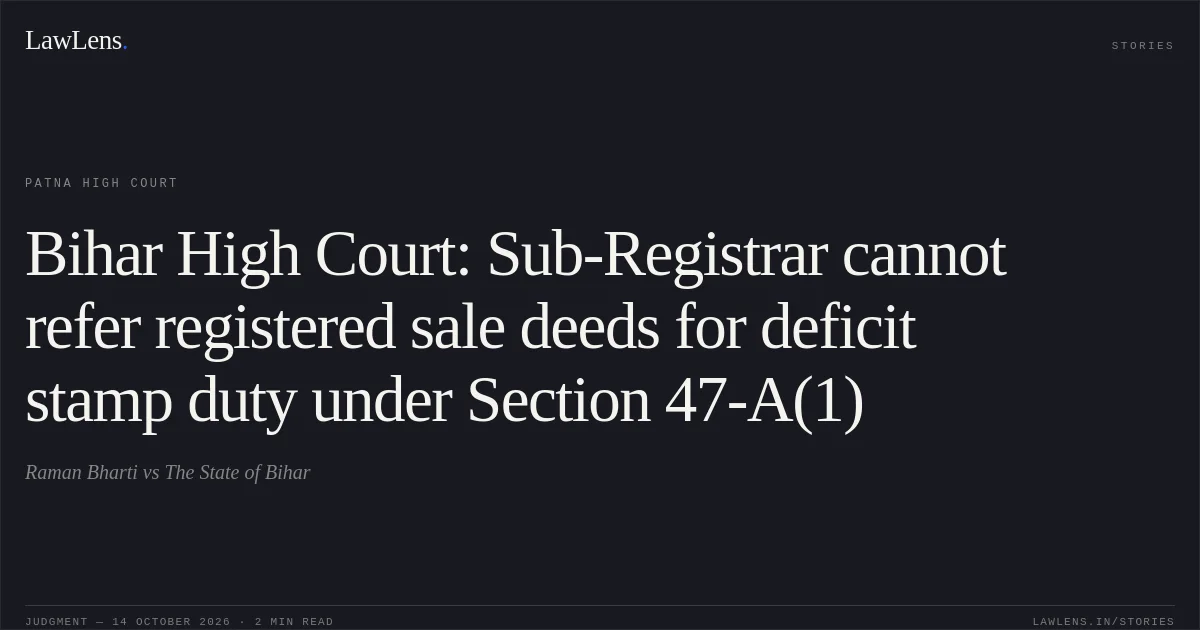
In CWJC No. 6242 of 2024, Raman Bharti’s sale deed was registered on 30 March 2014. The District Sub-Registrar referred it for determination of alleged deficit stamp duty only on 14 October 2014; the Assistant Inspector General of Registration later ordered him to pay ₹5,14,800. Bharti’s appeal was dismissed for want of prosecution, and he sought, among other relief, quashing of both orders and refund of his ₹2,57,400 pre-deposit.
Source reference: p. 2–6, 9–10In CWJC No. 7665 of 2024, Ramashray Pandey’s sale deed was registered on 27 July 2016. Following a post-registration inspection, the District Sub-Registrar referred the deed for valuation; the Assistant Inspector General directed payment of ₹3,24,324 in deficit duty and ₹32,432 as fine. The Divisional Commissioner affirmed that order, and Pandey sought its quashing and refund of his ₹1,62,162 pre-deposit.
Source reference: p. 11–14, 16–17Issues
1. Whether a registering authority may refer a registered instrument to the Collector or Assistant Inspector General of Registration under Section 47-A(1) of the Indian Stamp Act, 1899, for determination of market value and deficit stamp duty
Source reference: p. 8–10, 14–162. Whether the resulting assessment and appellate orders could stand, and whether the petitioners were entitled to refund of their appeal pre-deposits
Source reference: p. 9–10, 16–17Law Applied
Section 47-A(1) of the Indian Stamp Act, 1899, as reproduced and applied by the Court, permits the registering officer, when dissatisfied with the stated property classification, measurements or market value, to refer the instrument to the Collector for determination of proper market value and duty before registering it.
Source reference: p. 8–9, 14–15The Court held that, once the instrument has been registered, the Sub-Registrar lacks jurisdiction under that provision to make such a reference for determination or recovery of deficit duty.
Source reference: p. 9–10, 15–16It relied on the decisions in Rakesh Kumar Singh v. The State of Bihar & Ors., CWJC No. 17335 of 2022, and Santoshi Devi v. The State of Bihar & Ors., CWJC No. 10106 of 2024, which it described as reaching the same conclusion.
Source reference: p. 9, 15Reasoning
In both petitions, the relevant references were made after the sale deeds had already been registered: Bharti’s deed was registered in March 2014 and referred in October 2014; Pandey’s deed was registered in July 2016 and referred following a later inspection.
Source reference: p. 9–10, 15–16Applying its interpretation of Section 47-A(1), the Court held that the post-registration references were beyond the registering authorities’ jurisdiction.
Source reference: p. 9–10, 15–16The valuation allegations and the petitioners’ conduct in the appellate proceedings did not cure that jurisdictional defect; the Court therefore quashed the underlying assessment orders and, consequentially, the appellate orders.
Source reference: p. 9–10, 15–16Holding
The Court allowed both writ petitions.
It quashed the Assistant Inspector General’s orders dated 29 December 2015 and 25 May 2018, respectively, and set aside the corresponding Divisional Commissioner’s orders dated 26 August 2022 and 2 March 2023.
Source reference: p. 10, 16–17The respondents were debarred from proceeding further in the matters, and each petitioner’s appeal pre-deposit was directed to be refunded within eight weeks.
Source reference: p. 10, 16–17Acts & Sections Cited
1 provisions across 1 statute referred to in this judgment. Linked provisions open on LawLens.
Indian Stamp Act, 18991
Original Court PDF
Raman BhartivsThe State of Bihar
Click to open original judgment
Original judgment, available to read, download and summarize on LawLens.in