Facts
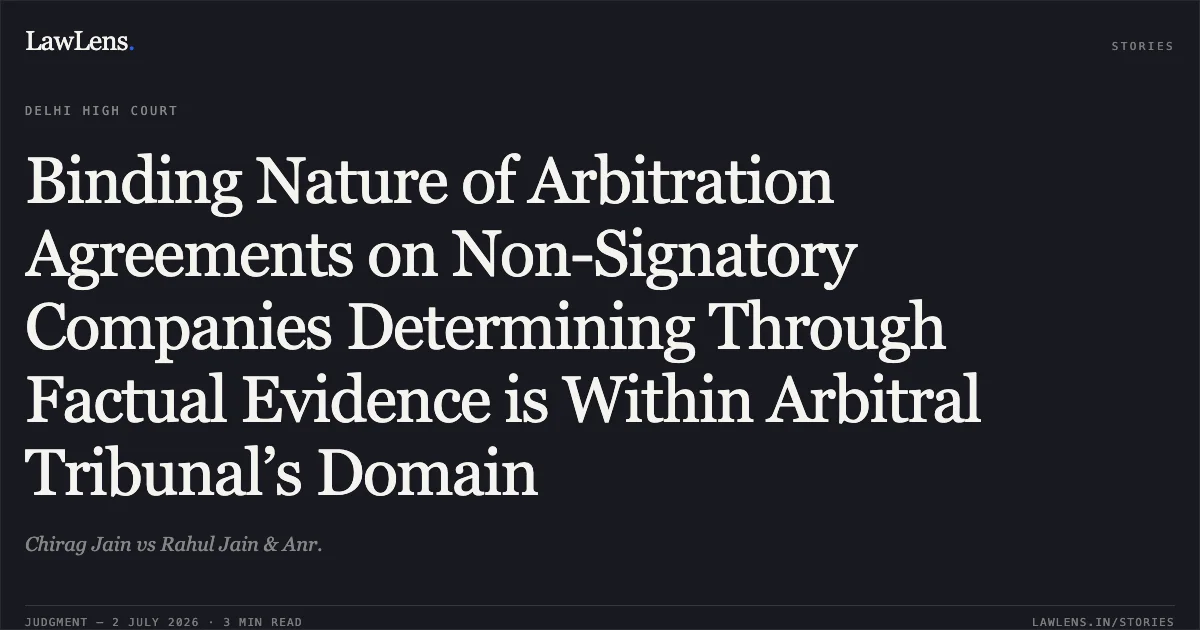
The Petitioner, an investor, entered into two Share Purchase Agreements (SPAs) dated 27th April 2024 (amended 6th May 2024) with Respondent No. 1 in both matters (the "Sellers") for equity shares in Respondent No. 2, Beanly Beverages Private Limited
Source reference: paras 1, 5.3Despite paying the full consideration, the Petitioner alleged the Sellers failed to transfer the shares and instead allotted fresh equity to third parties
Source reference: paras 5.5, 5.7The Sellers attempted to reverse the transaction, claiming it was linked to an unfulfilled "primary transfer"
Source reference: paras 5.8, 5.9While the Sellers (R-1) consented to arbitration, Respondent No. 2 (the Company) opposed its impleadment, arguing it was a non-signatory to the SPAs and that such disputes fell under the exclusive jurisdiction of the NCLT
Source reference: paras 6, 8.2, 8.15Issues
1. Whether a non-signatory (Respondent No. 2) can be referred to arbitration under Section 11 of the Arbitration Act when its "veritable party" status is disputed.
Source reference: para 16 / 462. Whether the non-service of a Section 21 notice specifically to the non-signatory is fatal to the petition.
Source reference: para 493. Whether disputes involving share transfers and corporate actions are inherently non-arbitrable as matters in rem.
Source reference: para 55Law Applied
The Court applied Section 11(6) and 11(6A) of the Arbitration and Conciliation Act, 1996, which limits judicial intervention to the "examination" of the existence of an arbitration agreement
Source reference: para 19It relied on Cox and Kings Ltd. v. SAP India Pvt. Ltd., establishing that the "Group of Companies" doctrine and the "veritable party" test allow non-signatories to be bound based on conduct and relationship
Source reference: para 21, 22It further applied the "hands-off" approach from SBI General Insurance v. Krish Spinning and Bhagheeratha Engineering Ltd. v. State of Kerala, which holds that Section 21 notices are for reckoning limitation rather than being a jurisdictional prerequisite
Source reference: para 19, 51Finally, it followed Vidya Drolia v. Durga Trading Corp. to distinguish between arbitrable actions in personam and non-arbitrable actions in rem
Source reference: para 60Reasoning
The Court observed that Clause 5.1.1(a) of the SPAs recorded that the Company (R-2) had subscribed its common seal to the agreement and held the business "in trust" for the Petitioner
Source reference: para 37Although R-2 disputed the affixation of the seal, the Court held that such contested factual questions constitute a "mini-trial" which is impermissible under Section 11
Source reference: paras 45, 47Applying the Cox and Kings precedent, the Court reasoned that since the Sellers (R-1) are majority shareholders and directors of R-2, the Company’s involvement was "structurally embedded" in the performance of the SPAs
Source reference: paras 7.6, 34On the issue of Section 21, the Court determined that failure to serve the notice to R-2 did not denude the Tribunal of jurisdiction to implead them
Source reference: para 53Regarding arbitrability, the Court found that the claims for specific performance and registration of shares are rights in personam arising from contract, not in rem matters reserved for the NCLT
Source reference: paras 57, 58Holding
The Court held that at the Section 11 stage, the Referral Court need only be satisfied with the prima facie existence of the arbitration agreement
The Court allowed the petitions and referred the parties to arbitration, appointing Ms. Veena Ralli, Advocate, as the Sole Arbitrator. The specific question of whether Respondent No. 2 is a "veritable party" bound by the agreement, and objections regarding non-arbitrability, were left open for final determination by the Arbitral Tribunal under Section 16 of the Act
Source reference: para 64, 66, 67Acts & Sections Cited
9 provisions across 1 statute referred to in this judgment. Each provision opens on LawLens.
Arbitration and Conciliation Act, 1996
Original Court PDF
Chirag JainvsRahul Jain & Anr.
Click to open original judgment
Original judgment, available to read, download and summarize on LawLens.in