Facts
Late Sukhidas Kurre had married Shobha Sahu, with whom he had a son, Avinash.
Source reference: paras. 4–15, 18; pp. 5–14The plaintiffs claimed that Shobha’s marriage to Sukhidas had been dissolved by a customary consent deed (Ex. P-4), after which Sukhidas married Ashok Lata; they had two daughters.
Source reference: paras. 4–15, 18; pp. 5–14Shobha disputed the dissolution and claimed rights as Sukhidas’s widow.
Source reference: paras. 4–15, 18; pp. 5–14After Sukhidas’s death, the parties disputed rights in his house and approximately ₹17 lakh in service-related dues.
Source reference: paras. 4–15, 18; pp. 5–14The trial court found neither that Ashok Lata was Sukhidas’s legally wedded wife nor that Shobha’s marriage had been dissolved, but recognized the daughters’ rights and granted Shobha relief concerning the house and service benefits.
Source reference: paras. 4–15, 18; pp. 5–14The plaintiffs appealed
Source reference: paras. 4–15, 18; pp. 5–14Issues
1. Whether the trial court was justified in recognizing the daughters’ entitlement to service benefits on the basis of their parentage
Source reference: para. 18(i); p. 142. Whether Shobha remained Sukhidas’s legally wedded wife, and was entitled to a share in his service benefits and possession of the house
Source reference: para. 18(ii); pp. 14–153. Whether Ashok Lata’s marriage to Sukhidas was valid despite the question of her prior marriage
Source reference: para. 18(iii); p. 154. Whether declaratory relief concerning the immovable property and service-related dues could be granted without the appropriate consequential relief
Source reference: paras. 45–56; pp. 24–27Law Applied
The proviso to Section 34 of the Specific Relief Act, 1963 bars a bare declaration where the claimant is able to seek further relief but omits to do so
Source reference: paras. 45–46, 51–52Under Sections 107(1)(a) and 107(2) of the Code of Civil Procedure, 1908, an appellate court may determine the case and exercise powers available to a court of original jurisdiction, including examining a statutory requirement not addressed by the trial court
Source reference: paras. 47–48The Court applied the principle against approbation and reprobation: a party cannot rely on a transaction for one purpose and reject it when claiming a contrary advantage
Source reference: paras. 38–40It also held that claims to qualifying debts and securities may be pursued under Part X of the Indian Succession Act, 1925, through a succession certificate
Source reference: paras. 53, 56It treated a subsequent marriage during the subsistence of an earlier marriage as invalid when considering Ashok Lata’s marital status
Source reference: para. 41Reasoning
Shobha’s service records and admissions showed that she had a husband, Arun, and that she treated her marriage to Sukhidas as dissolved when entering that relationship.
Source reference: paras. 35–40The Court held that she could not rely on the alleged dissolution to support her subsequent marriage while denying its effect to claim Sukhidas’s estate; she was therefore not his legally wedded wife at his death
Source reference: paras. 35–40Ashok Lata admitted that her earlier marriage to Dhanesh Kosle had not been dissolved, so her marriage to Sukhidas could not establish her status as his legally wedded wife
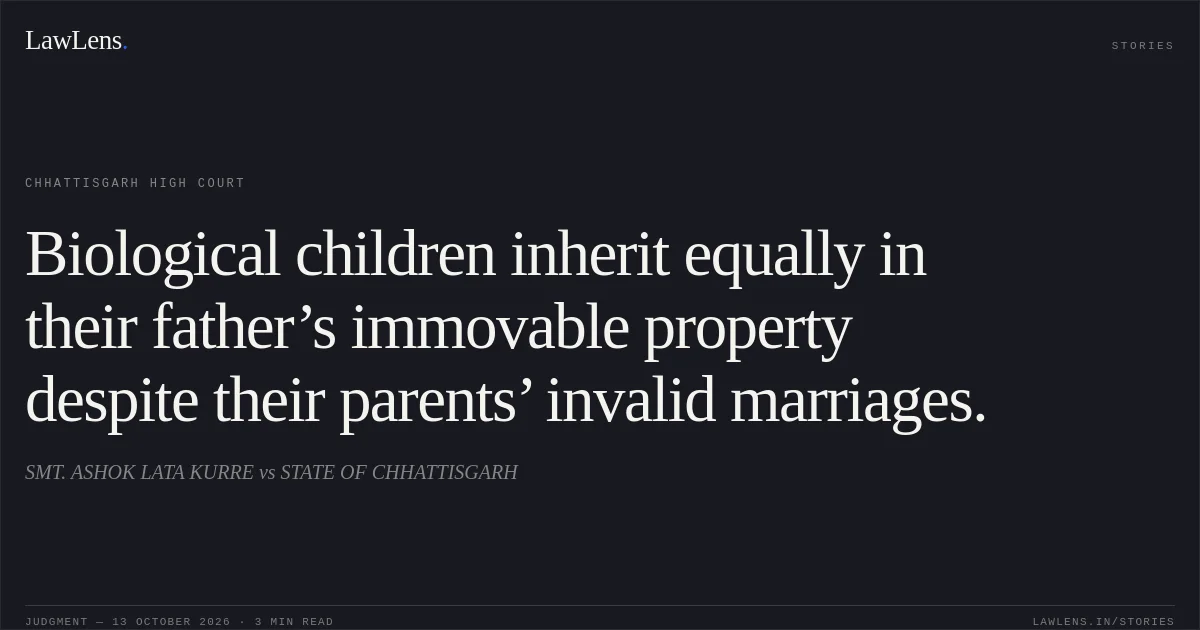
Source reference: para. 41The parties did not dispute that all three children were Sukhidas’s biological children, and the evidence established his ownership of the immovable property; each child was therefore entitled to an equal share
Source reference: para. 43For service-related dues, however, the parties had sought declarations without seeking recovery or paying the requisite ad valorem court fee.
Source reference: paras. 50–56A bare declaration could not support payment, and the competing claims were more appropriately addressed through succession-certificate proceedings
Source reference: paras. 50–56Holding
The Court held that neither Shobha nor Ashok Lata was Sukhidas’s legally wedded wife at the time of his death.
It modified the decree to grant Sukhidas’s three children equal shares in his immovable property and set aside the declaratory relief concerning service-related dues, leaving the parties at liberty to seek an appropriate succession certificate under Part X of the Indian Succession Act, 1925.
Source reference: paras. 57–62Both appeals were disposed of, with parties bearing their own costs
Source reference: paras. 57–62Acts & Sections Cited
4 provisions across 3 statutes referred to in this judgment. Each provision opens on LawLens.
Code of Civil Procedure, 19082
Hindu Marriage Act, 19551
Specific Relief Act, 19631
Original Court PDF
SMT. ASHOK LATA KURREvsSTATE OF CHHATTISGARH
Click to open original judgment
Original judgment, available to read, download and summarize on LawLens.in