Facts
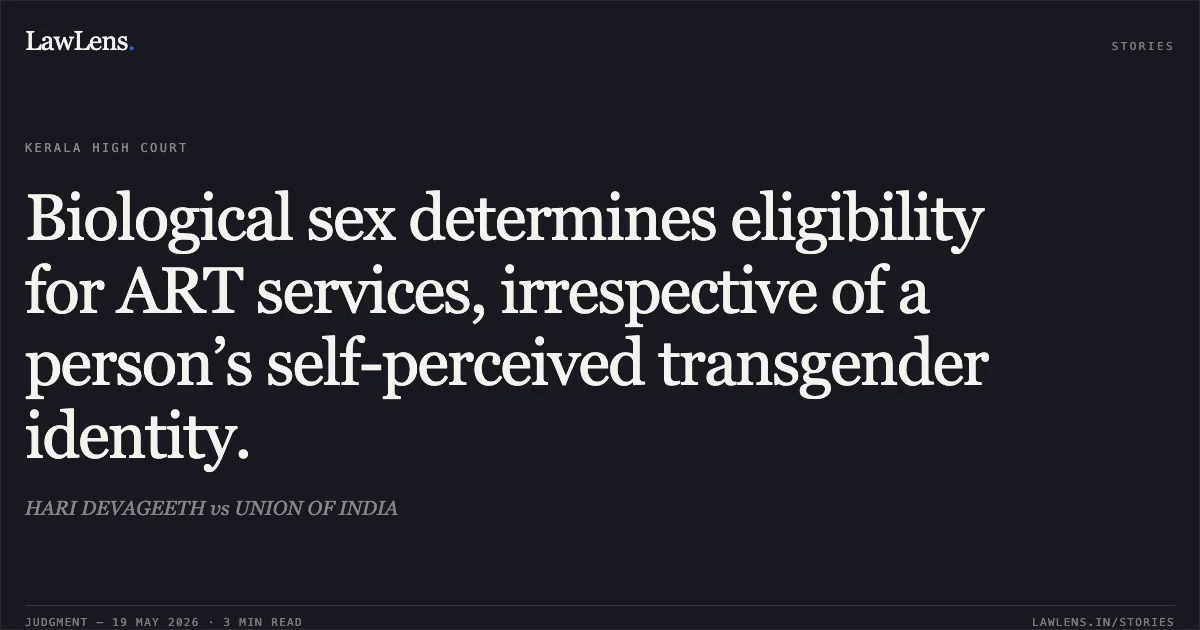
The petitioner, assigned female at birth, identifies as a transman and holds a gender identity certificate as 'male' issued under Section 7 of the Transgender Persons (Protection of Rights) Act, 2019.
Source reference: para. 3, 11Having undergone hormone therapy and mastectomy but not a full hysterectomy, the petitioner sought to cryopreserve oocytes (eggs) before completing gender reassignment surgery.
Source reference: para. 3A medical report confirmed the petitioner’s reproductive organs (uterus and ovaries) remained intact.
Source reference: para. 3The 5th Respondent (an ART Clinic) refused the service, citing that the Assisted Reproductive Technology (Regulation) Act, 2021 (ART Act) limits services to "commissioning couples" and "women," and contains no express provision for transgender persons.
Source reference: para. 3, 6The petitioner challenged the constitutionality of Section 21(g) of the ART Act as discriminatory.
Source reference: para. 2Issues
1. Whether a person assigned female at birth, whose self-perceived gender identity is male, can be permitted to undergo cryopreservation of oocytes under the ART Act before completing gender reassignment surgery.
Source reference: para. 12. Whether the exclusion of transgender persons from ART services under Section 21 of the ART Act is violative of Articles 14, 15, and 21 of the Constitution of India.
Source reference: para. 2, 24Law Applied
Section 21(g) and Section 2(1)(u) of the ART Act, which restrict services to a "woman" or "commissioning couple".
Source reference: para. 16Sections 6, 7, and 15 of the Transgender Persons (Protection of Rights) Act, 2019, which protect the right to self-perceived identity and healthcare.
Source reference: para. 18, 19, 33The precedent of Suchita Srivastava v. Chandigarh Administration [(2009) 9 SCC 1], established that reproductive choice is a fundamental dimension of personal liberty under Article 21.
Source reference: para. 32The 'Third Gender' recognition established in National Legal Services Authority (NALSA) v. Union of India [(2014) 5 SCC 438].
Source reference: para. 20Reasoning
The court found that sex and gender are conceptually distinct; sex refers to biological attributes, while gender refers to internal identity.
Source reference: para. 28It interpreted the term "woman" in Section 2(1)(u) of the ART Act as a "biological woman"—an adult human female with the capacity to produce eggs.
Source reference: para. 25-28Since the petitioner remains biologically female with intact reproductive organs, the court reasoned that the petitioner possesses a fundamental "naturally inbuilt" right to reproduction under Article 21.
Source reference: para. 32The court noted that the State had failed to issue a Health Manual under Section 15(d) of the Transgender Act, leaving trans persons without necessary guidance on fertility preservation before surgery.
Source reference: para. 33It concluded that because the petitioner is biologically female, the refusal of oocyte retrieval based solely on a legal gender change to 'male' would violate the right to dignity and reproductive autonomy.
Source reference: para. 32The court distinguished between ART "clinics" (which perform procedures) and "banks" (which handle storage), noting that under Section 2(1)(b), only ART banks are authorized for independent cryopreservation.
Source reference: para. 35Holding
The court held that as a biological woman with intact reproductive organs, the petitioner has a fundamental right under Article 21 to seek oocyte retrieval.
The court declined to strike down Section 21(g) of the ART Act, leaving the constitutional challenge open for a future proceeding.
Source reference: para. 24, 37The Court directed the petitioner to approach an ART Bank of his choice, which is ordered to take steps to retrieve and cryopreserve the petitioner’s gametes for future use, and the petition was partly allowed.
Source reference: para. 36, 37Acts & Sections Cited
14 provisions across 2 statutes referred to in this judgment. Each provision opens on LawLens.
Assisted Reproductive Technology (Regulation) Act, 20217
Transgender Persons (Protection of Rights) Act, 2019.7
Original Court PDF
HARI DEVAGEETHvsUNION OF INDIA
Click to open original judgment
Original judgment, available to read, download and summarize on LawLens.in