Facts
The plaintiff, Ses Ram, filed a suit seeking a declaration that Mutation Nos. 900 and 903, which recorded the defendant (Reshmu) as an heir to the estates of Jogi and Fagnu, were void
Source reference: para. 2The plaintiff contended that Reshmu was not the daughter of his grandfather, Rirku, and thus not entitled to inherit from Rirku’s sons
Source reference: para. 2The defendant relied on a birth certificate (Ext. D5) showing a female child born to Rirku in 1924 to establish her relationship
Source reference: para. 7The Trial Court dismissed the suit, accepting the defendant's status as Rirku’s daughter
Source reference: para. 7However, the First Appellate Court reversed this, noting that Rirku died in 1923, while the child in the certificate was born in 1924, and that the defendant failed to prove her identity or conduct-based relationship under the Evidence Act
Source reference: para. 8The legal representatives of the defendant appealed to the High Court
Source reference: para. 9Issues
1. Whether a birth certificate issued by the Registrar of Births & Deaths is prima facie admissible under Section 35 of the Indian Evidence Act without examining witnesses to prove it
Source reference: para. 92. Whether the genuineness of such a certificate must be presumed under Section 79 of the Indian Evidence Act
Source reference: para. 93. Whether the Civil Court's jurisdiction to quash mutations is barred under Section 171(2)(vi) of the H.P. Land Revenue Act
Source reference: para. 94. Whether the application for additional evidence under Order 41 Rule 27 CPC to produce photocopies of public records is maintainable
Source reference: para. 14Law Applied
The court applied Section 35 of the Indian Evidence Act regarding the admissibility of public records
Source reference: para. 26Section 50 regarding the relevance of opinions on relationships expressed through conduct
Source reference: para. 35It relied on Madan Mohan Singh v. Rajni Kant, distinguishing between the admissibility of a document and its probative value
Source reference: para. 33Regarding additional evidence, the court applied Order 41 Rule 27 CPC, requiring due diligence
Source reference: para. 17Section 65(e), which mandates that public documents be proved only by certified copies, not photocopies
Source reference: para. 21For jurisdiction, it followed the Full Bench decision in Chuhniya Devi v. Jindu Ram, holding that Section 46 of the H.P. Land Revenue Act preserves the right to sue for a declaration of rights despite the bar in Section 171
Source reference: para. 37Reasoning
The court rejected the application for additional evidence, noting that the documents were available during the trial and the applicants failed to show due diligence; furthermore, photocopies of public records are inadmissible under Section 65 of the Evidence Act
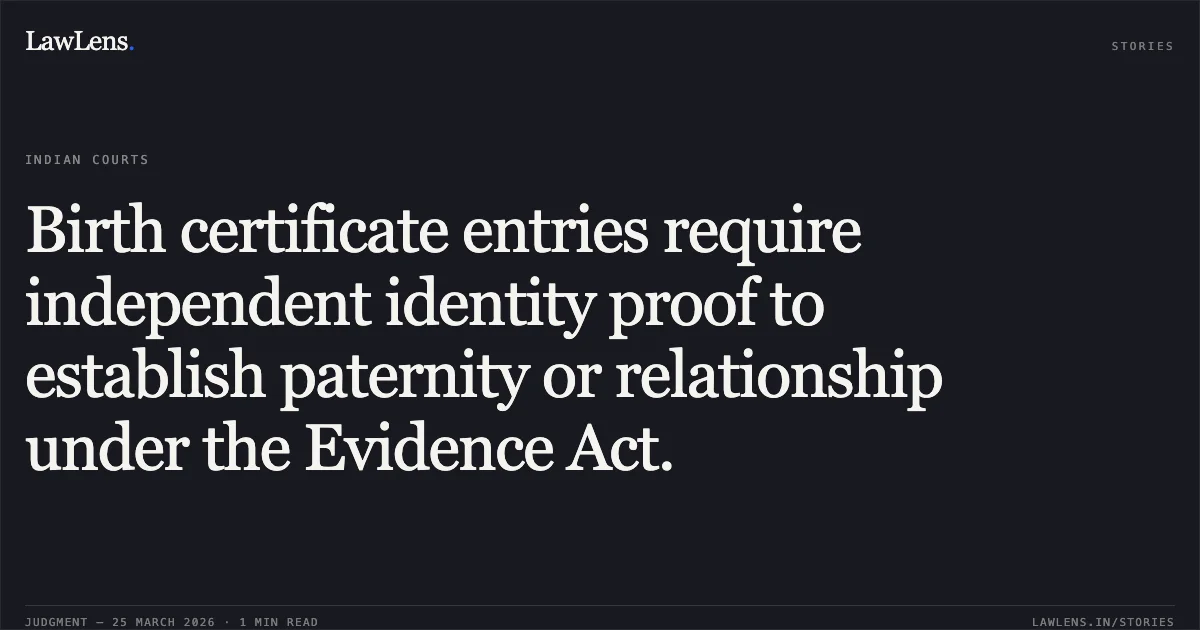
Source reference: paras. 20, 23On the merits, the court held that while a birth certificate is admissible under Section 35, it does not automatically prove the identity or paternity of the person named therein without corroborating evidence
Source reference: paras. 26, 30The court found a fatal discrepancy: Rirku died in September 1923, whereas the birth certificate cited by the defendant recorded a birth in January 1924
Source reference: para. 32Additionally, the defendant failed to produce witnesses or evidence of family "conduct" required under Section 50 of the Evidence Act to prove the alleged relationship
Source reference: para. 36Regarding jurisdiction, the court clarified that while Section 171 of the H.P. Land Revenue Act limits interference in revenue processes, Section 46 explicitly allows an aggrieved party to seek a Civil Court declaration regarding their rights in land
Source reference: paras. 37, 40Holding
The High Court dismissed the appeal and upheld the First Appellate Court’s judgment
(1) A birth certificate, though admissible, lacks probative value regarding identity if contradicted by other evidence such as the purported father's date of death
Source reference: para. 34(2) Relationship must be proved by the opinion of persons with special knowledge via conduct under Section 50
Source reference: para. 36(3) A civil suit for declaration of title and challenge to revenue entries is maintainable under Section 46 of the H.P. Land Revenue Act
Source reference: para. 40The application for additional evidence was dismissed
Source reference: para. 24Acts & Sections Cited
6 provisions across 3 statutes referred to in this judgment. Each provision opens on LawLens.
Manipur Municipalities Act, 19941
Tripura Land Revenue and Land Reforms Act, 19603
Code of Civil Procedure, 19082
Original Court PDF
SHRAWN LALvsKAMLA
Click to open original judgment
Original judgment, available to read, download and summarize on LawLens.in