Facts
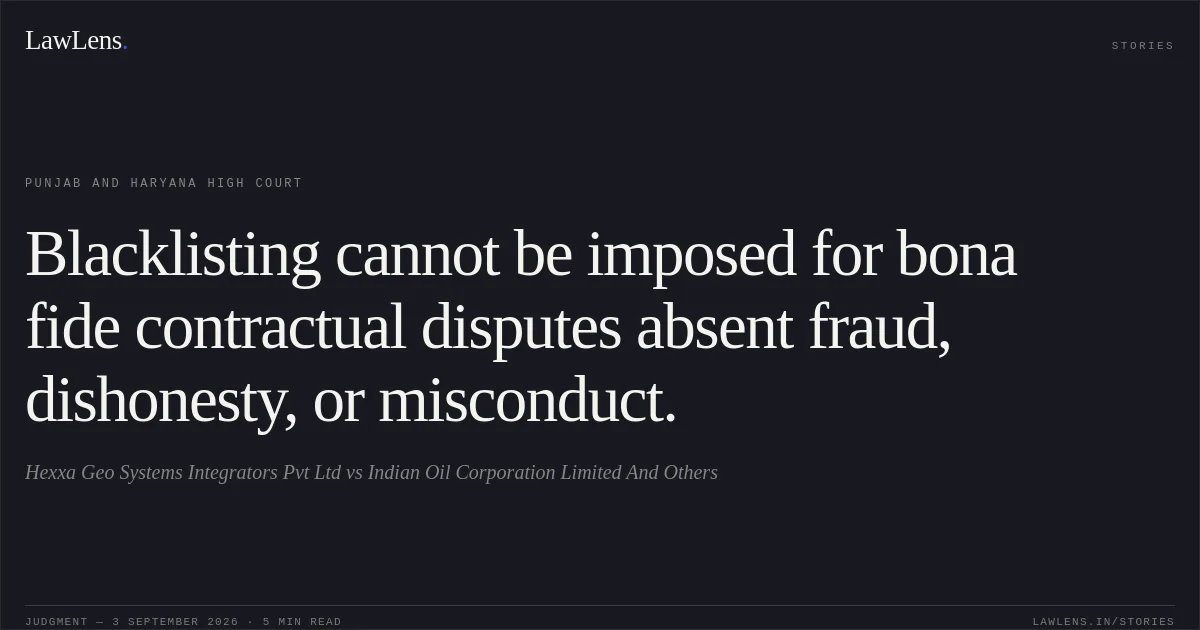
Indian Oil Corporation Ltd. (“IOCL”) floated a tender for the design, supply, installation, testing and commissioning of an IP-based CCTV surveillance system and associated works at various LPG and AFS locations in Punjab. The petitioner was declared successful and received a letter of acceptance dated 18 January 2023, followed by a work order dated 23 February 2023.
Source reference: pp. 1–3; para. 2During execution, disputes arose concerning delay and completion of the contractual work. IOCL terminated the contract on 8 January 2025 and issued a show-cause notice dated 27 January 2025 proposing to place the petitioner on its holiday list for failure to complete the work within the stipulated period. The petitioner replied that the delay was attributable to site-related impediments and other defaults on IOCL’s part and was afforded a personal hearing.
Source reference: pp. 1–3; para. 2By order dated 17 December 2025, IOCL placed the petitioner on its holiday list for one year and debarred it from entering into future contracts with IOCL. The order also referred to allegations regarding defects and deficiencies in material and equipment supplied by the petitioner.
Source reference: pp. 1–3; para. 2On the same date, IOCL issued a separate demand for ₹1,11,64,906.64 towards the cost of executing the balance work and related contractual liabilities. The petitioner challenged both orders under Articles 226 and 227 of the Constitution, contending that the holiday-listing order was based on a bona fide contractual dispute and that its defence had not been properly considered.
Source reference: pp. 2–3; para. 3Issues
1. Whether IOCL’s order placing the petitioner on its holiday list and debarring it from future contracts was sustainable when the alleged default arose from a disputed question of contractual delay, without allegations of fraud, corruption, dishonesty, forgery, misrepresentation or similar misconduct?
Source reference: pp. 4–5; para. 72. Whether the Court should examine, in proceedings under Article 226, IOCL’s monetary demand of ₹1,11,64,906.64, involving questions of delay, responsibility for unfinished work, quality of material, expenses and contractual liability?
Source reference: pp. 5–6; para. 93. Whether the petitioner’s writ petition was liable to be rejected on the ground of an alternative appellate remedy under IOCL’s holiday-listing guidelines or the contractual dispute-resolution mechanism?
Source reference: pp. 5–6, 7; paras. 8–9Law Applied
The Court applied the distinction between ordinary contractual remedies—such as termination, recovery of damages and risk-and-cost recovery—and blacklisting or holiday listing, which has a punitive and stigmatic effect extending beyond the contract by impairing a contractor’s commercial reputation and ability to participate in future public contracts.
Source reference: p. 4; para. 6Relying on Isolators and Isolators through its Proprietor v. Madhya Pradesh Madhya Kshetra Vidyut Vitran Company Ltd., (2023) 8 SCC 607, the Court held that relevant material and the contractor’s defence must receive due consideration and that blacklisting cannot be imposed without adequate notice and a proper decision-making process.
Source reference: p. 4; para. 6Relying on Blue Dreamz Advertising Pvt. Ltd. v. Kolkata Municipal Corporation, (2024) 15 SCC 264, the Court distinguished a bona fide contractual dispute from conduct warranting the stigmatic consequence of blacklisting; blacklisting may be justified to protect the public from irresponsible or dishonest contractors, but not merely because of a genuine dispute concerning contractual performance.
Source reference: p. 4; para. 6The Court also relied on Techno Prints v. Chhattisgarh Textbook Corporation, 2025 SCC OnLine SC 343, for the principle that a contractor should not be subjected to the consequences of blacklisting merely on the basis of an alleged contractual breach, absent conduct of sufficient deviance or aberration to justify such grave action.
Source reference: pp. 4–5; paras. 6–7Disputed claims involving contractual performance and monetary liability ordinarily require detailed adjudication and are not suitable for determination in writ proceedings under Article 226; where the contract provides for conciliation and arbitration, the parties should pursue that agreed mechanism.
Source reference: p. 6; para. 9Reasoning
The Court found that the show-cause notice alleged failure to complete the work within time, while the petitioner’s reply attributed the delay to site-related impediments and IOCL’s conduct. This demonstrated a genuine dispute regarding which contracting party was responsible for the delay.
Source reference: p. 5; para. 7There were no allegations of fraud, corruption, forgery, dishonesty or comparable misconduct against the petitioner.
Source reference: p. 5; para. 7Although the petitioner had submitted a detailed response, the impugned holiday-listing order merely referred to the show-cause notice and reiterated the allegations, without undertaking a meaningful adjudicatory consideration of the petitioner’s defence.
Source reference: p. 5; para. 7Given the serious and stigmatic impact of debarment on the petitioner’s commercial standing, the order did not satisfy the required standard of procedural fairness and proportionality.
Source reference: p. 5; para. 7The Court rejected IOCL’s reliance on its holiday-listing guidelines as an alternative remedy because the guidelines produced during the hearing did not mention their date and the petitioner was not shown to be bound by them.
Source reference: p. 6; para. 8However, the monetary demand stood on a different footing. Determining its validity would require examination of responsibility for delay, the scope and quality of the work, unfinished work executed at the petitioner’s risk and cost, alleged deficiencies in supplied material and equipment, expenses incurred and reconciliation of accounts.
Source reference: p. 6; para. 9These were disputed contractual matters unsuitable for adjudication in a writ petition. Since the contract contained a dispute-resolution mechanism providing for conciliation and arbitration, the Court declined to examine the merits of the monetary demand.
Source reference: p. 6; para. 9Holding
The Court quashed the order dated 17 December 2025 placing the petitioner on IOCL’s holiday list and debarring it from future contracts.
It directed that the petitioner would not suffer any disqualification in future tender processes on account of that debarment order.
Source reference: p. 7; para. 10(i)The Court expressed no opinion on the legality or merits of IOCL’s separate monetary demand of ₹1,11,64,906.64 and granted the petitioner liberty to challenge it through the conciliation/arbitration mechanism provided in the contract.
Source reference: p. 7; para. 10(ii)If such proceedings were initiated, both parties could raise all their contentions, and the matter was to be decided independently on its merits, uninfluenced by the quashing of the holiday-listing order or any observations in the judgment.
Source reference: p. 7; para. 10(ii)The writ petition and pending miscellaneous application(s) were disposed of.
Source reference: p. 7; para. 11Acts & Sections Cited
1 provisions across 1 statute referred to in this judgment. Linked provisions open on LawLens.
the Act (alias, unresolved)1
Original Court PDF
Hexxa Geo Systems Integrators Pvt LtdvsIndian Oil Corporation Limited And Others
Click to open original judgment
Original judgment, available to read, download and summarize on LawLens.in