Facts
Petitioner No. 1 was a Registered Vehicle Scrapping Facility (“RVSF”) under the Motor Vehicle (Registration and Functions of Vehicle Scrapping Facility) Rules, 2021 (“RVSF Rules”), and Petitioner No. 2 was its Managing Director.
Source reference: p.2A Delhi-registered vehicle was impounded by the Transport Department on 27 June 2023 and handed over to the petitioners. Although the competent authority subsequently approved its release subject to an undertaking for transfer outside Delhi, the petitioners had already scrapped the vehicle when the registered owner sought its release.
Source reference: p.2The respondents issued a show-cause notice dated 24 July 2023 alleging that the vehicle had been scrapped without the registered owner’s consent, contrary to Rules 10(1)(i) and 10(1)(v) of the RVSF Rules, and before the expiry of a purported 90-day period from impounding.
Source reference: p.2By order dated 25 August 2023, the Transport Department blacklisted Petitioner No. 1 from its panel of RVSFs and prohibited it from scrapping Delhi-registered end-of-life vehicles, with immediate effect.
Source reference: p.3The High Court stayed the impugned order during the pendency of the writ petition.
Source reference: p.3Issues
Whether Rules 10(1)(i) and 10(1)(v) of the RVSF Rules applied where a vehicle was handed over to an RVSF after being impounded by an enforcement agency, rather than voluntarily submitted by its registered owner for scrapping?
Source reference: pp.4–5Whether the respondents could rely on a 90-day waiting requirement arising from meeting minutes, when the requirement was not contained in the RVSF Rules and was communicated after the vehicle had been scrapped?
Source reference: pp.4–5Whether the blacklisting order was invalid because the show-cause notice did not disclose that blacklisting was proposed?
Source reference: pp.5–7Whether blacklisting for an unspecified or indefinite period was legally permissible?
Source reference: pp.7–8Law Applied
The Court applied Rules 10(1)(i) and 10(1)(v) of the Motor Vehicle (Registration and Functions of Vehicle Scrapping Facility) Rules, 2021, which require the registered owner or authorised representative to hand over the vehicle and furnish specified original documents when voluntarily seeking scrapping.
Source reference: p.4It relied on Gorkha Security Services v. Government of NCT of Delhi, (2014) 9 SCC 105, as followed in UMC Technologies Pvt. Ltd. v. Food Corporation of India, (2021) 2 SCC 551, for the rule that a show-cause notice preceding blacklisting must disclose both the alleged misconduct and the specific penalty proposed, including blacklisting.
Source reference: pp.5–7The Court further relied on Kulja Industries Ltd. v. Chief General Manager, (2014) 14 SCC 731, which establishes that debarment or blacklisting cannot be permanent and must bear a reasonable relation to the nature of the misconduct.
Source reference: p.7Reasoning
The Court held that Rules 10(1)(i) and 10(1)(v) were inapplicable because the vehicle had been handed over to the petitioners after impounding by an enforcement agency; those provisions governed voluntary scrapping initiated by the registered owner.
Source reference: p.5The alleged 90-day restriction had no basis in the RVSF Rules and arose only from meeting minutes circulated on 12 July 2023. Since the petitioners asserted that they received the communication on 18 July 2023, after scrapping the vehicle on 14 July 2023, the respondents could not validly found adverse action on that requirement.
Source reference: pp.4–5Independently, the blacklisting order violated natural justice. The show-cause notice alleged breaches relating to the scrapping procedure but did not state that blacklisting was contemplated.
Source reference: pp.5–7Applying Gorkha Security Services, the Court held that the petitioners were denied a meaningful opportunity to address whether blacklisting was warranted, even assuming the alleged breach had been established.
Source reference: pp.5–7The order was also impermissible because it imposed blacklisting for an unspecified period, effectively amounting to indefinite debarment, contrary to Kulja Industries.
Source reference: p.7Holding
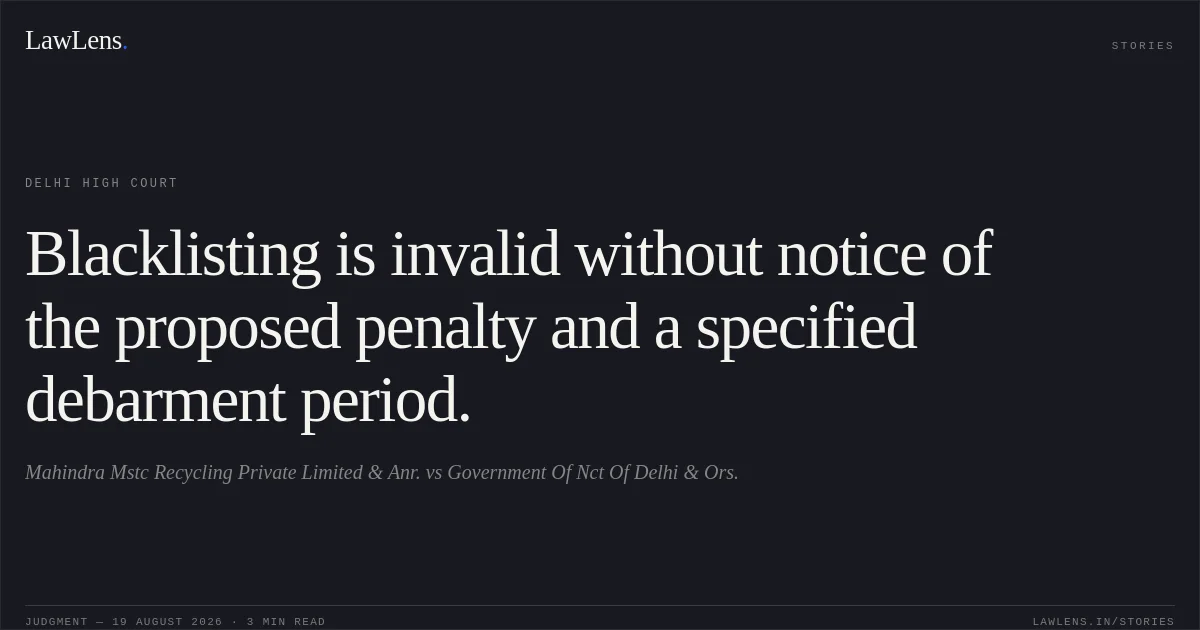
The Court answered the issues in favour of the petitioners. It held that the cited RVSF provisions did not apply to the impounded vehicle, that the 90-day waiting requirement lacked statutory basis and could not retrospectively bind the petitioners, and that the blacklisting action was procedurally defective because the show-cause notice did not disclose the proposed penalty.
The indefinite nature of the blacklisting was an additional illegality.
Source reference: p.7Accordingly, the impugned order dated 25 August 2023 was quashed as unjust, arbitrary, and contrary to settled legal principles. The writ petition and pending application were disposed of.
Source reference: p.8Original Court PDF
Mahindra Mstc Recycling Private Limited & Anr.vsGovernment Of Nct Of Delhi & Ors.
Click to open original judgment
Original judgment, available to read, download and summarize on LawLens.in