Facts
Nitin Enterprises, a proprietorship firm and registered PWD contractor, was awarded a cement-concrete roadwork contract by the Indore Municipal Corporation on 23 March 2020.
Source reference: no citationThe contract required completion within 240 days. The Superintending Engineer subsequently terminated the contract and blacklisted the petitioner for three years by a composite order dated 30 October 2020.
Source reference: no citationThe petitioner later challenged the forfeiture of securities, termination and blacklisting, alleging, inter alia, denial of natural justice and factual error in attributing delay to violation of the election model code.
Source reference: no citationSince the petitioner’s representation was not decided and a fresh tender was issued for the same work, it filed the writ petition under Article 226.
Source reference: no citationThe Division Bench referred the questions concerning the arbitrability of blacklisting and the maintainability of a writ petition against a composite termination-and-blacklisting order to a Larger Bench.
Source reference: paras. 4–9Issues
Whether losses arising from an order of blacklisting or debarment are ascertained or ascertainable monetary claims within Section 2(1)(d) of the Madhya Pradesh Madhyastham Adhikaran Adhiniyam, 1983, so that a challenge to blacklisting is referable to the statutory Arbitration Tribunal?
Source reference: paras. 3, 14–16Whether blacklisting is a consequential relief arising from termination of a works contract and can therefore be claimed before the Tribunal under Section 7-A of the Adhiniyam?
Source reference: paras. 321–365Whether a writ petition challenging a composite order of termination and blacklisting is maintainable despite the availability of a statutory remedy before the Tribunal concerning the termination component?
Source reference: paras. 15–16, 373–380Whether the 2025 amendments to Sections 17-A and 17-AB of the Adhiniyam alter the maintainability of proceedings challenging blacklisting?
Source reference: paras. 276–290, 380(x)–(xi)Which authority is competent to pass an order of blacklisting or debarment under the PWD circular dated 24 March 2015?
Source reference: paras. 292–308, 380(i)–(ii)Law Applied
The Court held that the State’s power to blacklist or debar a contractor flows from its inherent executive power to carry on trade and enter into contracts under Article 298 of the Constitution, although that power remains subject to Articles 14, 19 and 21, natural justice, fairness, non-arbitrariness and proportionality.
Source reference: paras. 297–308Blacklisting is an administrative and public-law action, not merely a contractual consequence, even where the contract contains a blacklisting clause.
Source reference: paras. 304–308Under Section 2(1)(d) of the Madhya Pradesh Madhyastham Adhikaran Adhiniyam, 1983, the Tribunal’s jurisdiction is confined to disputes involving ascertained or ascertainable money valued at ₹50,000 or more arising from execution or non-execution of a works contract.
Source reference: paras. 336, 343, 361–365The Court relied on Erusian Equipment & Chemicals Ltd. v. State of West Bengal, Raghunath Thakur v. State of Bihar, Gorkha Security Services v. Government (NCT of Delhi), Kulja Industries Ltd. v. Bharat Sanchar Nigam Ltd., Patel Engineering Ltd. v. Union of India, UMC Technologies Pvt. Ltd. v. Food Corporation of India and Blue Dreamz Advertising (P) Ltd. v. Kolkata Municipal Corporation for the principles that blacklisting carries severe civil consequences, is stigmatic, requires a specific and meaningful show-cause notice, and must be proportionate to the misconduct.
Source reference: paras. 299–318, 357–358, 374–377Applying Section 73 of the Indian Contract Act, 1872, the Court held that losses based on uncertain future tenders, goodwill, reputation and business opportunities are remote, speculative and incapable of ascertainment through a legally recognised formula.
Source reference: paras. 322–335Sections 7-A and 20 of the Adhiniyam cannot enlarge the Tribunal’s substantive jurisdiction or convert an administrative blacklisting challenge into a consequential monetary dispute.
Source reference: paras. 346–365Article 226 remains available where fundamental rights are infringed, natural justice is violated, the authority acts without jurisdiction, or the impugned action is arbitrary or disproportionate, subject to the High Court’s discretion regarding disputed facts and alternative remedies.
Source reference: paras. 373–379Reasoning
The majority distinguished termination-related monetary claims from blacklisting. Losses arising from termination—such as unpaid amounts, forfeiture, recovery or the value of unexecuted work—may ordinarily be quantified and referred to the Tribunal.
Source reference: paras. 309–335Blacklisting, however, prospectively excludes a contractor from future government tenders and produces stigma, reputational injury and commercial disability.
Source reference: paras. 309–335Whether tenders will be issued, whether the contractor would be eligible or participate, whether it would succeed, and what profit it might earn are contingent matters; consequently, the resulting loss cannot be treated as an ascertainable monetary claim under Section 2(1)(d).
Source reference: paras. 309–335The Court further held that the procedural requirement under Section 7-A to include the whole claim cannot confer jurisdiction over a subject matter—the legality of blacklisting—that is outside the Tribunal’s statutory competence.
Source reference: paras. 353, 361–365Nor can the amended interim-relief provisions under Sections 17-A and 17-AB create substantive jurisdiction where none exists.
Source reference: paras. 353, 361–365Since blacklisting is an administrative order affecting constitutional and public-law interests, its validity may be examined under Article 226, particularly where the order was passed without a proper show-cause notice, by an incompetent authority, in breach of natural justice, or with disproportionate consequences.
Source reference: paras. 373–379The Court also found that, under the PWD circular of 24 March 2015, the Chief Engineer or an officer of equivalent rank alone could pass the blacklisting order; the contractual or appellate authority could only recommend such action.
Source reference: paras. 302–308Holding
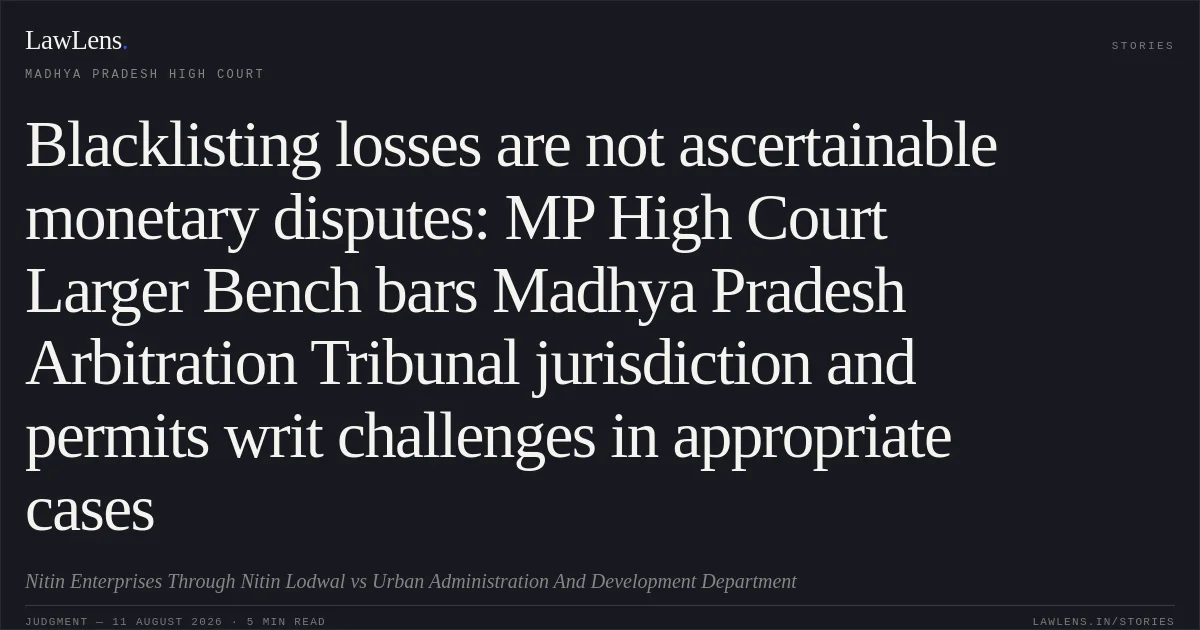
By majority, the Larger Bench held that blacklisting or debarment is an inherent administrative power of the State under Article 298, subject to constitutional limitations.
A blacklisting order must be passed by the Chief Engineer or an equivalent authority under the PWD circular dated 24 March 2015; a contractual competent or appellate authority may only recommend blacklisting.
Source reference: para. 380(i)–(ii)Loss arising from blacklisting is speculative, reputational and not an ascertainable monetary loss; therefore, a challenge to blacklisting is not a “dispute” under Section 2(1)(d) and is not referable to the Madhya Pradesh Arbitration Tribunal.
Source reference: para. 380(iii)–(iv)Gouri Ganesh Shri Balaji Constructions and Awasthi Brothers Construction Company were overruled to the extent that they treated blacklisting as consequential relief referable to the Tribunal, while Viva Highways was approved on the non-ascertainability of blacklisting losses.
Source reference: para. 380(v)–(vii)Since Section 20 does not bar matters outside the Tribunal’s jurisdiction, a civil suit for declaration against blacklisting is maintainable.
Source reference: para. 380(viii)A writ petition under Articles 226/227 may also be entertained, including against a composite termination-and-blacklisting order, where fundamental rights are infringed or natural justice is violated, subject to the facts and circumstances and the need for evidence.
Source reference: para. 380(ix)The 2025 amendments did not alter the maintainability of proceedings concerning blacklisting, although the Tribunal now possesses certain interim-relief powers in matters within its jurisdiction.
Source reference: para. 380(x)–(xi)The parties were directed to bear their own costs.
Source reference: para. 384Original Court PDF
Nitin Enterprises Through Nitin LodwalvsUrban Administration And Development Department
Click to open original judgment
Original judgment, available to read, download and summarize on LawLens.in