Facts
The petitioner challenged an order dated July 8, 2015, which blacklisted and debarred them for three years from maintenance operations at an EHV Sub Station due to alleged non-compliance with a 2014 work order.
Source reference: para. 1-2Although the three-year period had technically lapsed by the time of the hearing, the petitioner argued the order remained a legal stigma affecting their ability to participate in future public tenders.
Source reference: para. 2The respondents claimed the action was justified under the terms of their agreement and several prior notices.
Source reference: para. 3Issues
1. Whether an order of blacklisting is legally valid if the preceding show-cause notices failed to explicitly state the intent to debar or blacklist the party.
Source reference: para. 2 / para. 52. Whether the impugned order violated the principles of natural justice by failing to provide the petitioner with a specific opportunity to defend against the proposed penalty of blacklisting.
Source reference: para. 5 / para. 6Law Applied
The court primarily relied on the principles of natural justice and the precedent established by the Supreme Court of India in Gorkha Security Services v. Government (NCT of Delhi) and others (2014) 9 SCC 105.
Source reference: para. 2 / para. 5This precedent mandates that a show-cause notice for blacklisting must be "explicitly clear" and must specify that such an action is contemplated, as blacklisting carries serious civil consequences and creates a "stigma".
Source reference: para. 5Reasoning
The court examined the internal record and the notices (Annexures R-14 to R-20) issued by the respondents to determine if the procedural requirements for blacklisting were met.
Source reference: para. 5Upon review, the court found that while several notices were issued regarding performance issues, none of them contained an expressed intention to blacklist the petitioner under the relevant contractual clauses.
Source reference: para. 5Applying the Gorkha Security Services standard, the court reasoned that the failure to state the proposed penalty in the notice meant the petitioner had no opportunity to specifically refute the debarment.
Source reference: para. 6Consequently, even if there were performance failures, the omission of a specific "blacklisting" warning in the show-cause notice rendered the final order a nullity under the law.
Source reference: para. 6Holding
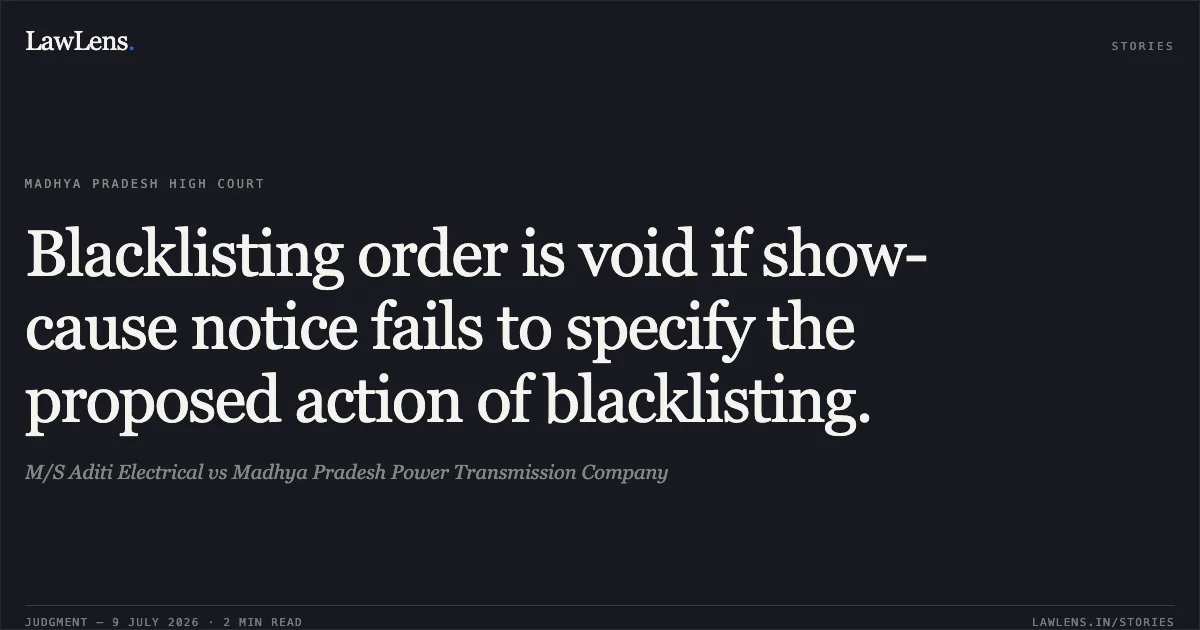
The court held that the respondents could not blacklist a party without an explicit notice to that effect, as it violates the principles of natural justice.
The court allowed the petition and set aside the order dated July 8, 2015, specifically regarding the blacklisting of the petitioner.
Source reference: para. 7-8The court clarified that the respondents remain at liberty to take further action provided they comply with the necessary procedural formalities and legal standards.
Source reference: para. 5 (citing precedent)Acts & Sections Cited
1 provisions across 1 statute referred to in this judgment. Linked provisions open on LawLens.
the Agreement1
Original Court PDF
M/S Aditi ElectricalvsMadhya Pradesh Power Transmission Company
Click to open original judgment
Original judgment, available to read, download and summarize on LawLens.in